
Greenhouse Tomato Flowers but No Fruit: What to Check
Greenhouse tomato troubleshooting
Tomato flowers can look healthy and still fail to produce fruit, but petals falling is not proof that pollination has failed. First check for a swelling green ovary; then compare flower loss with the greenhouse’s day and night temperatures, pollen conditions and the plant’s overall care. This order narrows the possibilities without encouraging several changes at once.

Check whether fruit has started to form
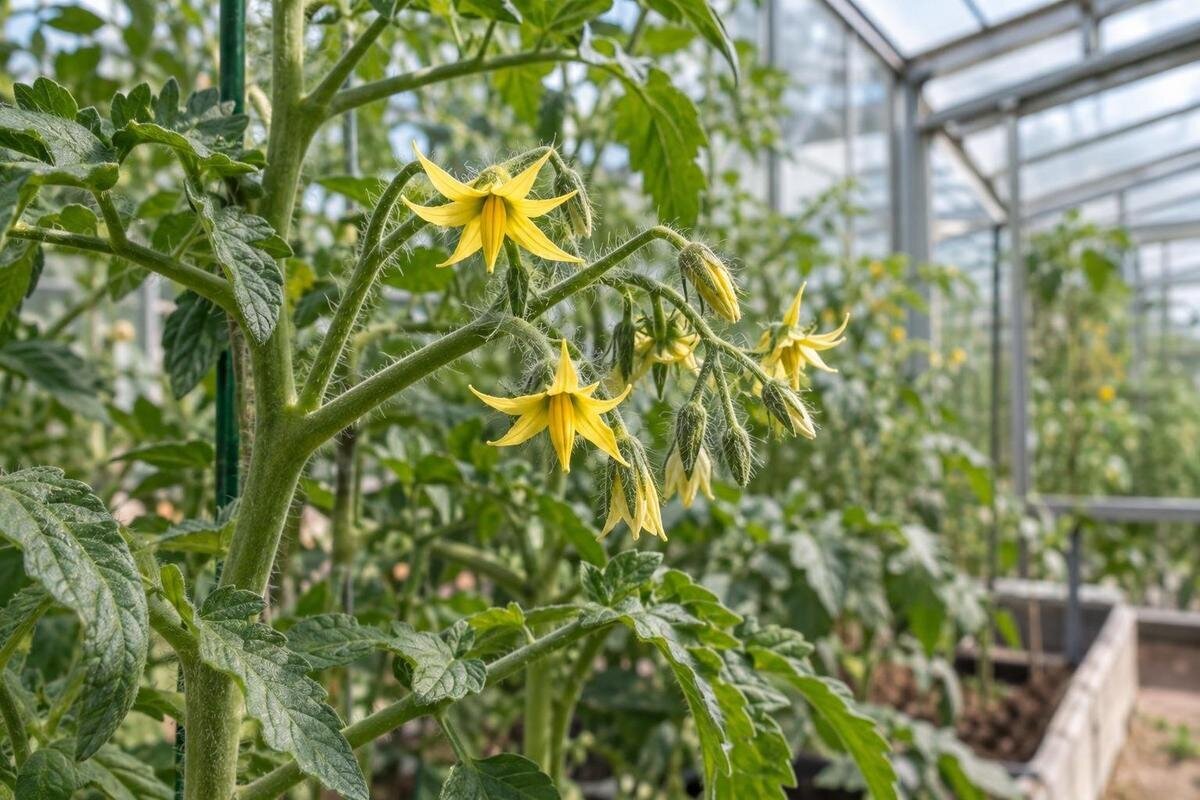
First establish whether the flower has actually failed. After a successful set, the petals usually fade and curl while the small green ovary at the flower’s base begins to swell. A spent flower can therefore look untidy even as a tomato is forming. In contrast, a flower that dries or falls away with no enlarging green base has produced no visible fruit. Check several flowers at different ages and positions: fruit set can vary from one truss to another, and a few losses do not establish a crop-wide problem. Look at the flower base rather than judging by petals alone.
Mark one truss and revisit it over the next few days. A close photograph of an open flower and its base can make a small change easier to spot than memory does. Note whether the petals browned while attached, the flower fell with no swelling, or the ovary stayed green and grew. Blossom drop describes flowers lost before fruit develops; it is a symptom, not a cause. Choose flowers that are already open for this comparison, and keep unopened buds separate in your notes. Record how many of the flowers you are following develop a visible swelling, rather than counting every flower on the plant as a failure. Photograph from a similar angle each time so that petals do not hide the base in one image but reveal it in another. If most flowers are still open, allow time for the next stage before altering care. This helps distinguish normal petal loss from a repeated failure to set fruit.
Record temperatures at flower height
Use a minimum–maximum thermometer in the crop zone, at the height of flowering trusses, for at least five to seven days. Keep it out of direct sun and away from glazing, an open door or a vent, where it may not represent the air around the flowers. Record the daytime maximum and overnight minimum, and note when each flower opened. A reading taken while you happen to be in the greenhouse can miss a rapid afternoon peak or a cold spell before dawn. Read and reset the thermometer at a consistent time, following its instructions, so that each pair of readings covers a comparable period. Alongside the numbers, note whether the day was sunny or cloudy and when doors or vents were open. These details help you interpret a temperature change without assuming that a different reading means your latest adjustment worked. If plants are spread across a large space, compare more than one position and identify each location in your notes.
Repeated daytime temperatures in the low 30s °C or nights around or below 13°C are useful warning signs: either extreme may reduce pollen function and fruit set. These are not exact cut-offs; cultivar, exposure and how long conditions last all matter. Prolonged warm nights can also interfere with setting. If persistent hot or cold pockets lead you to consider a different structure, the Pyramid-type greenhouse is listed in sizes from 60 to 203 sq ft. Floor area alone does not predict temperature or ventilation at a particular site.
Look for signs of greenhouse overheating
A greenhouse can overheat on a bright day even when the outdoor air feels mild, particularly if it has been closed for several hours. Record when the temperature rises and whether flowers are open at the same time. Temporary leaf drooping or curling during a hot spell, followed by recovery as the air cools, is a clue to heat stress, but it does not prove that heat caused every flower to fall. Note which plants show these changes and whether they are concentrated in one part of the greenhouse. If a nearby plant appears unaffected, compare its position and growing conditions rather than assuming the whole crop has experienced the same stress. Keep observations of leaf recovery separate from observations of fruit set: they describe different aspects of the plant’s response. High temperatures can affect pollen and flower development, so a problem may appear after the hottest day rather than at the time of the reading.
Use existing vents and doors to manage excess heat in line with the greenhouse’s operating guidance, rather than waiting for the plants to wilt. Temporary shade may help during exceptional heat, but it also reduces light, so consider the crop’s needs and the duration. If you are comparing structural options, the T-Shaped Orangery Greenhouse is one catalogue format to review; check the ventilation details of the particular configuration instead of assuming its shape will prevent overheating.
Check cold nights and recent temperature swings
A warm afternoon does not rule out a cold night. Check the minimum reading, especially after clear days when the greenhouse cools rapidly, and record several nights rather than relying on one. Cool conditions can interfere with pollen development and fruit set. The relevant period may begin before a flower opens, while it is still developing in the bud, so the temperature on the day you notice a fallen blossom may not explain what happened. Compare conditions across the days leading up to flowering as well as afterwards.
Notice whether poor set follows a run of cold nights, or whether the plant has also faced a sudden change in growing conditions. A greenhouse does not automatically maintain a suitable temperature for tomatoes overnight. The Bloomcabin Prestige Greenhouse listing covers sizes from 40.6 to 302 sq ft; that range is a footprint detail, not evidence of night-time warmth. If considering a structural change, assess the specific construction and the conditions you need to manage rather than treating size as a temperature guarantee.

Check pollen release from tomato flowers
Tomato flowers are self-fertile: each flower has pollen-producing and pollen-receiving parts, so a second plant is not normally needed. The pollen still has to move from the anther cone to the central stigma. Vibration dislodges it; insects such as bumblebees can provide that movement, and air movement may help. In a still greenhouse, flowers can look open and healthy even when little pollen has been released. There is no separate male and female tomato flower to identify or pair.
When flowers are dry, gently tap a truss or its supporting stem and watch for a light dusting of pollen. Do this gently, without pulling petals or shaking the whole plant hard. Lack of visible pollen is a clue, not proof that the flower is sterile; temperature and humidity can affect release. Note which open flowers you tried and the conditions at the time, then follow their development rather than repeatedly tapping them to obtain a visible result. If you compare tapped and untapped flowers, choose flowers of a similar age on plants with similar care. Such a comparison is an observation, not a controlled test, but it is more informative than judging by a single tap. If it is difficult to reach and inspect trusses, a future layout should account for access: classic aluminium greenhouse listings range from 40.6 to 302.3 sq ft, but a footprint does not show where paths or plants will sit.
Check humidity and airflow around the flowers
Persistently damp air can make tomato pollen sticky or clump, which makes release less reliable. Look for condensation, flowers that remain wet, or dense foliage that traps humid air around a truss. Condensation is a useful clue to damp conditions, not a precise reading of humidity at each flower. Misting blossoms is not a remedy; it can leave them wetter. Very hot, dry conditions can also stress flowers, so do not treat humidity as the only possible cause when temperatures are unsuitable.
Aim for sensible air exchange without exposing the crop to a sudden cold draught. Use the vents and doors already available, and observe whether dampness clears from the crop after conditions change. A lean-to greenhouse needs to be considered with its adjoining wall and site; the category name alone does not show where openings are positioned or whether humid air will clear from a particular growing area. If only one corner stays damp, compare that area with a better-ventilated part of the greenhouse before changing care across the whole crop.
Check moisture at the roots
Tomatoes under water stress may abort flowers even when pollen has moved. Check the soil or growing medium below the surface, rather than relying only on how dry the top looks or following a rigid calendar. A container can dry quickly in bright weather; a saturated bed or pot can also cause wilting because poorly aerated roots cannot function well. Both extremes can disrupt the plant’s water balance. Record what you find before watering, together with the container or bed concerned. If several plants share a watering routine, do not assume their growing medium is equally moist: compare the actual condition around each affected plant. Distinguish the amount of water applied from the moisture you find afterwards. A watering entry in a notebook records what you did, but does not by itself show the condition of the roots. Note whether flowers drop after a missed watering, a very hot day or a period when the growing medium stayed wet.
Aim for reasonably even moisture and allow excess water to drain; do not keep the root zone continuously saturated. Compare plants in different beds or containers, if you have them, and check that drainage is not blocked. When planning a new crop layout, the aluminium greenhouse with built-in storage is one configuration to review; check how the chosen plan leaves access to growing areas, rather than assuming all floor space is available for beds and watering. This is a layout consideration, not a treatment for blossom drop.
Review light, spacing and feeding
Insufficient light can limit flowering, while crowded plants may shade their own trusses and restrict air movement. Look at the canopy at the time of day when the greenhouse is bright: are leaves or neighbouring plants covering the flowering clusters? Tomato varieties differ in growth habit, so follow the training guidance for the variety you are growing. Avoid stripping healthy leaves in an attempt to expose every flower; excessive pruning can stress a plant and remove useful foliage. Consider the spacing and mature size of the plants, not just the gaps between young stems.
Lush, dark growth with few flowers can be consistent with excessive nitrogen, but leaf colour alone cannot confirm a nutrient problem. Review what has already been applied and follow the feed label rather than adding more fertiliser, trace elements or a high-potash product without a clear reason. If you are planning a different crop layout, the limited-edition aluminium greenhouse range is listed from 40.6 to 302 sq ft; the area range does not show whether a particular bed plan gives mature plants enough room.

Inspect flowers, leaves and recent changes
Look closely for signs that suggest a wider plant-health issue: distorted buds, unusual spots, damaged flowers, tiny insects, scarring or grey growth. Check the undersides of leaves and the growing tips as well as the open blossoms. These signs can point towards different problems, but none identifies a cause on its own. Take a clear photograph of the affected part and compare it with healthy growth on the same plant. Include a wider view showing where the damage occurs, as well as a close-up; an isolated detail can be difficult to interpret without its position on the plant. Record whether the marks first appeared on buds, open flowers or older leaves, and whether neighbouring plants show similar changes. Keep the description factual: note colour, shape and location rather than assigning a pest or disease name before it has been identified. If symptoms spread or become more severe, a knowledgeable horticultural adviser may be able to assess the plant from photographs or a sample.
Think back to recent changes such as transplanting, root disturbance, hard pruning, a sharp change in watering or a new feeding routine. Any of these may add stress, particularly to a young plant or a newly formed truss. Crowded rows also make it harder to inspect flowers and notice a problem early. The Spacious Greenhouse is listed from 506 to 753 sq ft, but floor area alone does not tell you whether each crop row will receive enough light or remain easy to inspect.
Test one likely cause at a time
Use the record to rank possible causes rather than trying to fix everything at once. A pattern of high daytime peaks points towards heat management; poor pollen release on damp, still days suggests checking humidity and movement; flowers lost after dry or waterlogged conditions make the root zone worth examining. These are clues, not proof. Choose the best-supported change, keep other care as steady as you can, and observe the next flowers to open. Write down the adjustment and its date so that you can distinguish flowers already open beforehand from those that open afterwards. Define what improvement would look like: more of the followed flowers developing an enlarging green base, rather than simply fewer petals on the floor. Also note any unavoidable changes in weather during the comparison. If conditions have changed substantially, acknowledge that uncertainty instead of attributing every improvement to your intervention. This makes the record more useful than changing shade, watering and feeding together.
If several trusses continue to fail despite more suitable recorded temperatures, dry flowers and steady root conditions, reassess the variety, plant health and greenhouse layout. Share dated photographs and notes on temperature, watering and feeding with a horticultural adviser or the seed supplier if the cause remains unclear. A few flowers may fail naturally, and one lost truss does not establish a lasting problem. Repeated failure across successive trusses is more useful evidence that something in the growing conditions needs attention.
Frequently asked questions
Why are my greenhouse tomato flowers falling off without fruit?
Flower drop can follow heat, cold, poor pollen release or stress from uneven watering, among other causes. It is a symptom rather than a diagnosis. Check whether the ovary at the flower’s base has started to swell, then compare the timing of flower loss with temperature and care records.
Do greenhouse tomatoes need bees to set fruit?
No. Tomato flowers contain both pollen-producing and pollen-receiving parts, so a plant can set fruit without a second plant or a bee. Pollen still needs to move within the flower, usually through vibration; insects can help, but they are not essential.
Should I shake my tomato plants to pollinate them?
If flowers are dry and the greenhouse is still, gently tap a flower truss or its supporting stem to create a little vibration. Avoid shaking hard or pulling at petals. This may help release pollen, but it cannot correct problems caused by unsuitable temperatures or plant stress.
How can I tell whether a tomato flower has set fruit?
Look for a small green swelling behind the petals. If it enlarges over the following days as the petals fade or fall, fruit has set. Petals dropping on their own is normal; a flower that dries or falls with no swelling has not produced a visible tomato.
Will more water or fertiliser stop blossom drop?
Not necessarily. A dry root zone can stress a plant, but persistently wet growing medium can also damage roots. Extra fertiliser is not a reliable fix and excess nitrogen may encourage leafy growth. Check moisture, drainage and your existing feeding routine before changing anything.
A single fallen bloom tells you less than a repeated pattern across successive trusses. Use flower development, temperature records and observations of the plant to identify the most likely difficulty. Make one measured adjustment where the evidence points, then judge the response by fruit forming on later flowers rather than by the appearance of spent petals.
