
Tomato Leaf Curl in a Greenhouse: Stress or Disease?
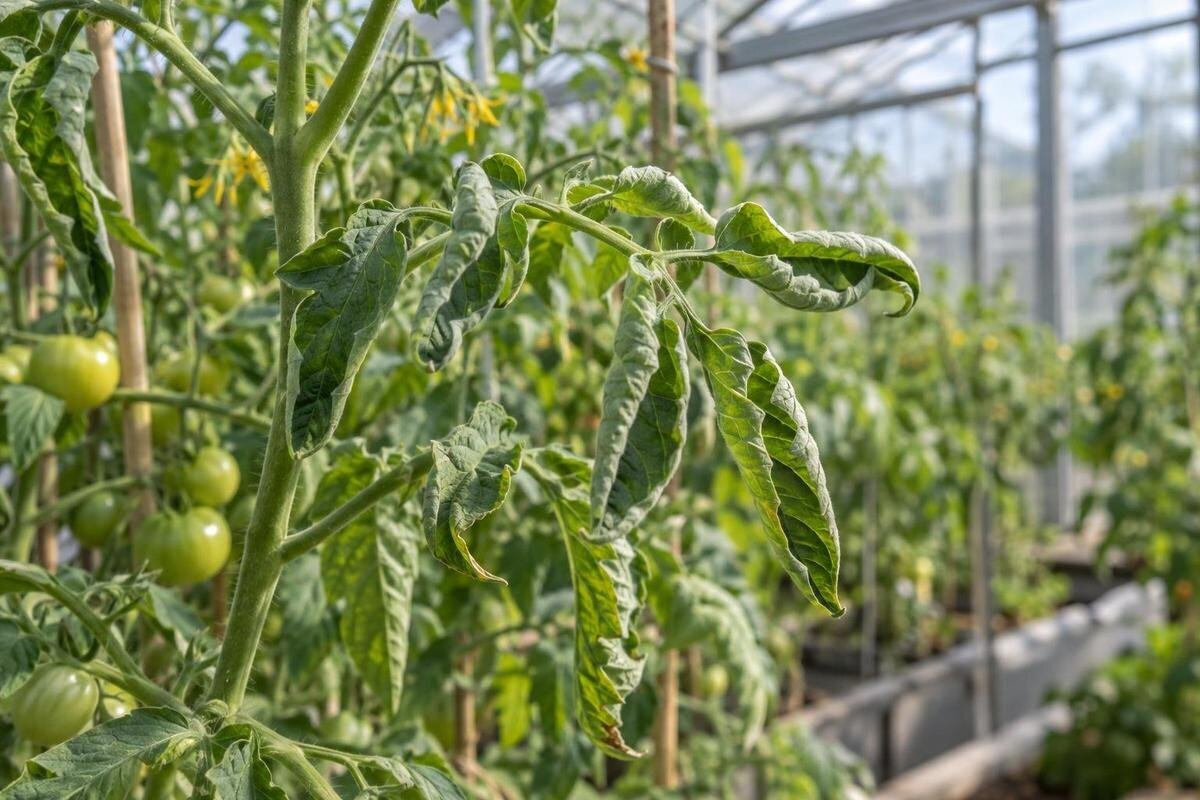
Tomato health in the greenhouse
Tomato leaf curl in a greenhouse is a symptom, not a diagnosis. Upward-rolled older leaves on otherwise vigorous plants often fit a physiological response to heat, strong light or uneven root moisture. Curl with yellow mottling, distorted young growth, stunting or visible pests deserves closer attention. The pattern and its progression matter more than the curl alone.

How to describe curled tomato leaves
Tomato leaves can curl in more than one way. In physiological leaf roll, leaflets commonly roll upwards along their length, bringing their edges inwards and exposing more of the underside. It is often first noticed on older, lower leaves, which may stay green and firm. A leaflet that is twisted, narrowed, blotched or unusually small has additional clues worth noting. None is conclusive: heat, root stress, pest feeding, spray injury and infection can overlap in appearance. Describe the direction of the roll, the leaf’s age, colour and texture before naming a cause; the word curl is not a diagnosis.
Then step back and assess the whole plant. Is the growing tip making normal leaves? Are stems extending, and do flowers or fruit look usual? Compare more than one tomato, including an apparently healthy neighbour, and check the oldest affected leaf as well as the newest. Plants can also differ naturally in leaf shape between varieties. A vigorous plant with plain green lower leaves fits physiological roll better than one with several kinds of abnormal growth, but vigour alone cannot rule out disease. If access is also on your greenhouse-planning list, the Prestige greenhouse range is listed in several floor areas; compare a chosen footprint with the space needed to inspect leaf undersides and mark affected plants.
Where the curl appears can narrow the possibilities
Distribution often tells you more than one curled leaflet. Record whether symptoms begin on one plant, a whole row, the sunniest end, near a door or along one bed. A shared pattern may point to a common exposure or irrigation difference; it can also occur as infection moves between plants, so it cannot settle the diagnosis. Compare tomatoes of similar age and variety where possible, because leaf size and vigour vary naturally. An isolated plant is not automatically diseased: root damage or uneven watering can affect one plant too. Mark affected plants on a rough sketch so changes are easier to see than from memory.
Track progression as well as location. Curl that remains on older leaves while later leaves grow normally differs from distortion newly appearing at the top. Note which plants were moved, pruned, tied in or planted at different times, and whether they were watered or fed together. The Spacious Greenhouse listing states available areas from 506 to 753 ft²; as with any footprint, that figure cannot show where local hot spots or uneven watering occur. Map your own crop and conditions rather than treating greenhouse size as evidence of a uniform climate.
Temperature and light changes can affect leaves
Temperature changes deserve attention, not just afternoon heat. RHS guidance identifies fluctuating temperatures, including warm days followed by cold nights, as a cause of tomato leaf curling. Variable light and temperature can also cause mild distortion. Record daytime peaks and overnight lows before attributing curled leaves to strong sunshine alone. Compare exposed plants with those elsewhere in the greenhouse, and note whether symptoms followed a change in weather. An affected leaf may remain curled, so also examine later growth. A sunny position is a clue about exposure, not proof of the cause: plants there may have different watering or root conditions too. There is no single temperature reading that diagnoses leaf curl.
Measure at canopy height, not near the roof, doorway or outside wall, and note the time, vent and shade position, plus which plants are affected. A maximum–minimum thermometer can reveal peaks missed during a quick visit; readings in two areas can test whether symptoms follow a hotter zone. Ventilation or shade may change conditions, but neither cures infection, and too much shade can reduce useful light. The aluminium Classic range is listed in footprint options from 40.6 to 302.3 ft²; floor area alone cannot tell you the temperature among leaves, so assess where the crop actually grows.
Water and root stress can look similar
Drying and re-wetting can stress tomatoes, while roots kept too wet may also function poorly. Check moisture in the main rooting area rather than judging from a dry surface, and consider whether a pot, grow bag or border receives water evenly. Containers and beds can dry at different rates, so compare the actual root zone rather than applying one timetable to every plant. Think back to changes in watering, drainage, root disturbance and plant handling. A curled leaf alone does not tell you to add water: if the growing medium is already saturated, more may deepen the underlying stress.
Root damage after planting, abrupt disturbance or a concentrated feed can also affect growth; none can be identified reliably from curl alone. Review what changed and when, and avoid adding fertiliser as a reflex. Check whether the same watering routine reaches every bed. Where tomatoes sit beside an attached wall, compare that row’s moisture and sunlight with the outer edge; the Lean-To Greenhouse listing names a lean-to format, but actual wall-side conditions depend on the site. Note whether curl follows dry spots, wet patches or neither.

Mottling or distorted new growth needs closer attention
Unusual young growth raises the priority of diagnosis. RHS guidance describes several signs associated with tomato viruses: lighter-green mosaic patterns, reduced leaf area, distorted or bubbly leaf surfaces and stunted growth. Different viruses produce different combinations; some can also affect fruit colour or fruit set. These signs do not form a checklist that proves infection. Hormone weedkiller exposure can also cause stunting and strongly distorted leaves, while variable light and temperature may cause milder changes. Pale or mottled older leaves can have a nutritional explanation, particularly when the plant remains vigorous. Record which leaves show each change rather than grouping every colour variation under disease. The combination of symptoms and their progression is more informative than one curled leaflet.
Concern rises when the newest leaves are misshapen or unusually small, growth is stunted, or yellowing and mottling develop alongside curl. Compare with healthy plants and record whether symptoms are progressing, but do not assume spread proves a virus: neighbouring tomatoes also share temperature, watering and handling. A virus cannot be confirmed by leaf shape alone, and an unaffected older leaf does not clear the plant. If several signs occur together or growth is deteriorating, ask a plant-health adviser to assess the whole plant and decide whether examination or testing is appropriate. It is better to seek advice early than to wait for every sign to appear.
Check leaf undersides for pests
Inspect the undersides of curled leaves and the growing tip for insects or other signs of pest activity. RHS guidance identifies aphid attack as a possible cause of tomato leaf curling and lists whitefly and glasshouse red spider mite among pests associated with tomato leaf problems. Finding a pest gives you something specific to investigate, but it does not show that every symptom has the same cause. Pest activity and environmental stress may occur together. Some tomato viruses are transmitted by aphids or thrips; others can spread through contaminated hands or tools. An insect on a leaf therefore cannot confirm a virus, and a plant without visible insects is not necessarily free of infection.
Use a hand lens if available, and compare affected and unaffected plants rather than inspecting just one leaf. Photograph the underside in focus and note speckling, sticky residue or webbing; a close image may help an adviser distinguish insects from leaf hairs or dust. Check several leaves at different heights, since one clean surface is not a representative sample. Do not choose an insecticide solely because leaves curl: the cause might not be an insect, and controlling a vector is not the same as diagnosing a virus already present. If you cannot identify what you see, get expert identification before treatment.
Review spray and feeding history
Chemical injury deserves a place in the history. Weedkiller drift, accidental contact during spraying or contaminated growing material can distort new leaves; symptoms may be strongest on plants at an exposed edge or may follow a particular batch of compost. Twisting, narrow or strap-like growth can be a clue, but it overlaps with disease and other damage. Ask what was sprayed nearby and when, whether a new product or compost was introduced, and whether affected plants share a batch or position. Keep product names and dates for an adviser rather than trying another chemical to counteract the first.
Feed changes can also mislead. Excess fertiliser or an imbalance in the root zone may disturb foliage, but leaf curl alone cannot identify a nutrient shortage or excess. Review the feeding record and growing medium before changing the dose; repeated additions can make a root-zone problem harder to interpret. If symptoms cluster along a boundary, note the side exposed to outdoor spraying and the greenhouse’s doors or vents. When comparing the limited-edition aluminium greenhouse with other structures, consider where its openings would sit relative to neighbouring garden work. The supplied listing does not establish protection from spray drift; that question depends on the site and exposure.
Keep a comparable record of greenhouse conditions
A useful record connects observations to individual plants. Give each affected tomato a simple identifier and record its variety, position and growing medium. Use the same terms on each visit: older or younger leaves, rolled or twisted, plain green or mottled, stable or worsening. Add the watering and feeding history alongside temperature readings, rather than keeping separate notes that are difficult to match later. Distinguish what you observed from what you suspect. For example, ‘three plants beside the door have distorted young leaves’ is an observation; ‘a spray caused the damage’ is a hypothesis. Keeping those separate helps an adviser assess alternatives without inheriting an untested diagnosis.
In a divided or irregular growing space, identify each observation point on your plan. The T-shaped orangery model is a named layout; if your own greenhouse has arms, corners or a long wall-side bed, use consistent location labels in the record. Note where a thermometer was placed, when moisture was checked and whether doors or vents were open, so later observations can be compared fairly. Record changes in weather and crop care as well as symptoms. Missing information should remain marked as unknown rather than reconstructed from memory. A short, consistent record is more useful than pages of readings without plant identities, dates or locations.

Photographs should show both detail and context
Good photographs make comparisons useful only if they show both detail and context. Take a whole-plant view, a close-up of the newest growth, and a clear image of an affected leaf from above and below. Include an unaffected neighbour and note the plant’s position, date and variety. Keep distance and lighting as similar as possible on later visits; glare or automatic colour correction can make yellowing and mottling difficult to compare. Include enough of the stem and growing tip to show size and shape, and use a simple label so images are not confused across plants.
For comparison, photograph an older, plain-green leaflet rolled upwards alongside the plant’s normal top growth. If another plant has small, twisted, yellow-mottled new leaves and shortened growth, record those features together rather than cropping the image to one curled leaf. These views document whether curling occurs alone or with other abnormalities; neither confirms a cause. The second pattern warrants prompt assessment. The greenhouse photographs accompanying this article show structures, not these symptoms, and should not be used for diagnosis. The Pyramid-type greenhouse listing gives footprint options from 60 to 203 sq ft. When planning crop positions within any footprint, allow access for repeat photographs of whole plants and leaf undersides, not just a view from the doorway.
When to seek a plant-health diagnosis
Seek a plant-health diagnosis promptly if distortion is appearing in new growth, growth is stunted, several symptoms occur together, or the pattern is spreading despite a stable routine. Ask for advice as well when pests are present but hard to identify, or herbicide exposure is possible. Share whole-plant and leaf-underside images, a greenhouse sketch, temperature and watering notes, feed and planting dates, and recent treatments or compost changes. An adviser may need to see a sample; ask how to collect and handle it before transporting it, particularly if infection is suspected. This history helps distinguish an isolated leaf response from a continuing crop problem.
Until the cause is clearer, avoid changing several variables at once, applying extra feed or spraying solely in response to curl. Keep affected plants identifiable, avoid taking cuttings from suspect plants and ask an adviser how to handle potentially infected material. Some tomato viruses can spread through hands or tools, so cleaning these after handling suspect plants is a useful precaution. Review stored garden products too: RHS guidance warns against keeping hormone weedkillers or lawn weed-and-feed products in a greenhouse, because their vapours can damage tomatoes. The greenhouse model with built-in storage has storage in its product name, but that does not establish suitability for chemicals. Keep a record of products used nearby, their dates of use and any possible contact with the crop.
Frequently asked questions
Do upward-curled tomato leaves always mean heat stress?
No. Upward rolling on older leaves while the rest of the plant grows normally can fit physiological leaf roll, but root stress, pests, chemical injury and infection can look similar. Check which leaves are affected, whether new growth is changing, and whether there is mottling, yellowing, stunting or pest activity. The direction of the curl alone is not diagnostic.
Can I identify a tomato virus from a photograph?
Not reliably. Tomato viruses can cause mosaic patterns, distorted leaves and stunted growth, but weedkiller injury and other problems may produce overlapping signs. Take whole-plant and close-up photographs, note how symptoms develop, and ask a plant-health adviser whether an in-person assessment or testing is appropriate.
Should I remove curled leaves?
Not just because they are curled. Removing foliage may add stress and can discard useful evidence. Photograph the plant first. If tissue is badly damaged or an adviser recommends removal, ask how to handle it, particularly if infection is suspected.
Should I give the plant more water or fertiliser?
Not automatically. A curled leaf cannot show whether the root zone is dry, saturated, damaged or affected by excess feed. Check the compost or soil, drainage, and recent watering and feeding history before changing anything. Adding water or fertiliser in response to leaf shape alone may make the cause harder to assess.
Can ventilation prevent tomato leaf curl?
Ventilation can help manage excess greenhouse heat when used appropriately, but it will not treat a virus, correct root damage or reverse chemical injury. Check conditions at plant height and look at later growth. If distortion, mottling, stunting or pest evidence is present, seek a diagnosis rather than relying on ventilation as the explanation or cure.
Leaf curl deserves a measured response: a plain upward roll on older leaves with healthy ongoing growth often fits environmental stress, while distorted growth, mottling, yellowing, stunting and signs of pests warrant closer investigation. No single photograph or greenhouse reading settles the question. Comparing affected and unaffected plants, recording where and when symptoms appear, and checking root-zone and canopy conditions gives a plant-health adviser better evidence than an immediate dose of water, feed or spray.
