
Growing Kohlrabi Under Glass
Greenhouse growing guide
Kohlrabi can make good use of greenhouse space at the cooler edges of the growing season, but it is not a crop that needs a hot, closed structure. Its edible swollen stem develops quickly when growth is steady; crowding, uneven moisture and delayed picking are more likely to disappoint than a lack of elaborate equipment. In the UK, use glass to bring a sowing forward or protect an autumn batch, then plan short successions around the temperatures and space you actually have.

Why grow kohlrabi under glass?
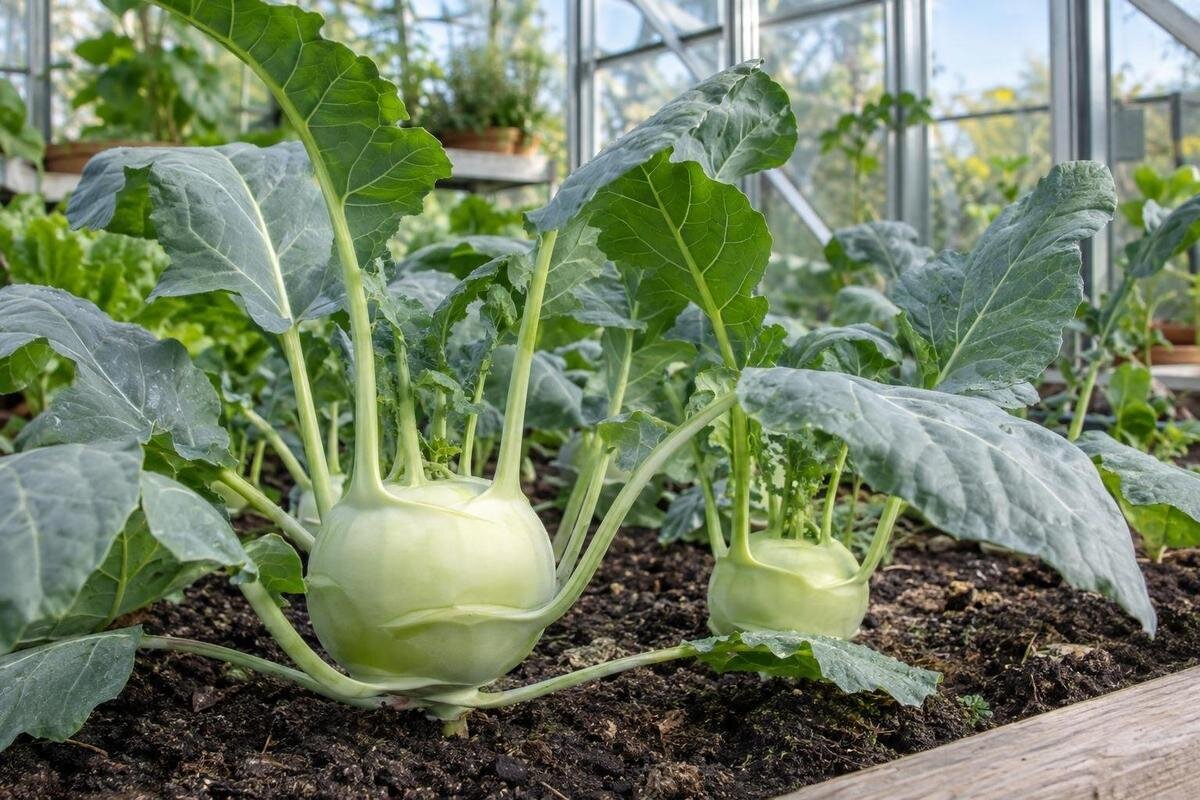
Kohlrabi is a brassica grown for the swollen stem that forms above ground, not for a root. Under glass, the main advantage is control over timing and exposure: seedlings can be started before an open bed is ready, and plants may be sheltered from wind and heavy rain. Because the crop matures relatively quickly, it can fill a gap between longer-season crops. It does not need a permanent place indoors, though; in mild weather, an outdoor bed may offer the cooler conditions it prefers and free the greenhouse for less hardy plants. Treat each batch as a short crop with a planned harvest, then clear the bed for its next use.
Glass changes exposure, not the crop’s basic requirements. An unheated greenhouse still cools at night and can heat up sharply in sunshine, so cover does not guarantee frost-free growth or a longer harvest. The catalogue includes a lean-to greenhouse; whichever format you consider, assess the actual site for light, ventilation, overnight temperatures and access rather than treating the model name as a growing specification. A small min–max thermometer near the crop is more useful than judging conditions from the doorway. If the space is regularly hot, outdoor sowing may be the better choice for a summer batch.
Choose sowing dates for a cool-season crop
For an early crop, sow indoors in spring, using a bright position where temperatures remain suitable rather than relying on an unheated greenhouse during cold spells. The RHS warns that cold conditions can cause kohlrabi to bolt instead of developing its swollen stem. A sunny afternoon does not tell you how cold the space becomes overnight, so check a min–max thermometer before moving seedlings into it. For planting out, the RHS advises temperatures consistently above 10°C; greenhouse cover alone does not ensure this. If those conditions are not yet available, delay the batch rather than forcing an early sowing date.
Spring batches can continue while daytime temperatures remain moderate. For an autumn crop, a late-summer sowing may be more useful than sowing in the hottest part of the year; leave enough time for the selected variety to mature as daylight shortens. When looking at the classic aluminium greenhouse, compare the proposed bed position with surrounding shade and the space occupied by summer crops. A late batch needs light after those crops have grown, not just an empty patch on the spring plan. If the bed will remain shaded or crowded until autumn, raise fewer plants or reserve a separate growing area.
Stagger sowings for a steady harvest
Kohlrabi is better suited to a sequence of small sowings than to one large batch that all reaches size at once. Sow a few modules or a short row at regular intervals, then adjust the next sowing after seeing how quickly the current batch develops and how many stems you use. The RHS notes that baby crops can be ready in as little as six weeks, while full-size crops may take about twelve weeks. Variety, light and temperature affect that timing. Check whether the packet’s maturity figure is counted from sowing or transplanting, and treat it as a guide rather than a guaranteed picking date.
Keep a note of sowing date, variety, transplant date and first harvest; the record soon shows whether your greenhouse is running ahead or behind. Start the next batch only if you have a bed or container coming free, rather than creating a queue of crowded seedlings. The catalogue lists the Spacious Greenhouse in sizes from 506 to 753 sq ft, a reminder to judge greenhouse scale across the whole crop plan. Kohlrabi needs only a small, temporary patch; the other crops you intend to grow, along with paths and access, should determine the structure’s size.
Sow in modules and raise sturdy plants
Use clean seed modules or small pots filled with seed compost so roots can be moved with little disturbance. Sow at the depth stated on the packet, cover lightly and keep the compost evenly moist rather than saturated. One seed per cell avoids thinning; if you sow two, remove the weaker seedling once the pair is easy to distinguish, leaving the stronger one undisturbed. Germination benefits from moderate warmth, but do not leave young plants in a hot, dim greenhouse. Once they appear, give them bright light and cooler conditions to limit soft, stretched growth. Label each tray with the variety and sowing date so batches do not get mixed up.
Transplant while seedlings are small, before they become pot-bound; the RHS recommends planting out when they are no more than 5 cm tall. Water the modules first, then gently release each rootball from its cell, supporting it rather than pulling on the stem. Plant at the same depth as before, without burying the stem. Acclimatise plants gradually if they are moving from a warmer indoor position to an unheated greenhouse, and avoid exposing them suddenly to cold. If you are comparing a greenhouse with built-in storage, include seed trays, compost and tools in the space plan. Check how much of the listed arrangement is storage and how much remains available for plants and access. Stored supplies do not replace a bright place for raising seedlings.

Leave room for each swollen stem
Use the RHS spacing of 15 cm between plants and 30 cm between rows as a starting point, allowing more room where the seed packet specifies it for a larger cultivar. Close spacing may give more plants on paper, but leaves can crowd and swollen stems have less room to develop. Even for a small harvest, follow the variety’s spacing guidance rather than squeezing extra plants into a gap. In containers, apply the same principle: the RHS recommends a pot at least 30 cm wide and deep, with seedlings thinned to 15 cm apart. Leave enough access to inspect and pick each plant without pushing through a dense canopy.
Plan spacing for the full batch, including plants that will remain after the first harvest. Picking alternate plants is not a reliable substitute for adequate initial spacing: neighbouring stems may already be crowded before the earliest ones are ready. Before buying, draw a bed to scale using the real planting area rather than the structure’s outside measurements. Include the row spacing and a route from which you can reach the crop. For a T-shaped orangery greenhouse, check the exact layout to see where uninterrupted rows will fit and where an entrance or path breaks up the growing area.
Prepare the bed and plan access
Choose a bright bed with fertile, moisture-retentive soil that drains freely. Before planting, remove weeds and loosen compacted ground; where organic matter is needed, use mature compost rather than adding a heavy layer of fresh material at the last minute. Kohlrabi does not need an elaborate feeding schedule to justify greenhouse space, and a flush of leaves is not the goal: steady, balanced growth matters more than trying to push the crop with strong fertiliser. For containers, use a free-draining growing medium and a pot with drainage holes that can hold a plant through its full growth.
Think about access before setting out rows: leave room to water, inspect the undersides of leaves and lift a mature plant without trampling the next sowing. In a narrow bed, one row may be easier to manage than two crowded rows. Product listings such as the pyramid-type greenhouse should be checked against a scaled site plan, not chosen from the exterior outline alone. Confirm usable bed widths, door clearance and the route from the entrance. A clear path makes it easier to keep batches separate, remove plants promptly at harvest and prepare the growing area for what comes next.
Keep moisture even and ventilate in sunshine
Keep the root zone evenly moist, especially while the stem is swelling. Check beds and containers rather than watering to a fixed calendar: rain does not reach beds under glass, and pots can dry faster than the ground. Check beneath the surface as well, since a dry-looking top layer can conceal damp compost around the roots. Water thoroughly when needed, then let excess drain; avoid leaving roots in waterlogged compost. The RHS identifies lack of water as a cause of slow growth and woody stems. A mulch of mature garden compost around established plants can help retain moisture, but it does not replace regular checks.
Ventilate on bright, warm days before the greenhouse becomes stifling, using its openings and door as intended. Kohlrabi is a cool-season crop, so a hot, closed house is a reason to consider growing a later batch outdoors or postponing it until conditions ease. When comparing a Bloomcabin Prestige Greenhouse, check the ventilation arrangements for the configuration you intend to buy and whether you can reach the openings once beds are planted. Allow for days when you are away from home as well as those when you can monitor the crop. Record hot spells alongside harvest quality to improve future scheduling.
Fit kohlrabi around longer-season crops
Use kohlrabi as a short-term occupant of a greenhouse bed before taller summer crops fill it. An early batch can go in while tomatoes or cucumbers are still small, then be harvested before their foliage throws dense shade or makes the bed hard to reach. Do not plan on keeping kohlrabi under a mature canopy just because both crops fit within the same footprint: it needs good light and room around its swelling stems. If planting dates overlap, give it a separate container or an open end of the bed rather than putting it beneath a dense crop.
Separate sowings can also use different corners or containers, so a new batch is not planted among stems ready to harvest. Mark which plants are due first and keep the seedling tray out of the route between entrance and bed. Greenhouse crops do not all share the same watering and temperature preferences; keep kohlrabi in the coolest suitable, brightest area rather than changing its conditions to suit a heat-loving neighbour. This arrangement lets you clear a batch in one pass, inspect the bed and prepare it for the next planting without damaging nearby plants.

Harvest promptly and watch for common problems
Watch the swollen stem itself, not just leaf height or the number of weeks on the packet. Many varieties are best picked at roughly 5–8 cm across, although recommended sizes differ; check every few days so a fast-growing batch does not become oversized. Small, well-grown stems are usually more tender than plants left in place until they reach their maximum size. If some plants are ready before others, harvest selectively rather than waiting for the whole row to match. Cut or lift the whole plant at the base, taking care not to disturb its neighbours.
Coarse or woody stems can mean the crop stayed too long, while insufficient water can also slow growth and spoil texture. If stems remain small, check spacing, light and moisture before assuming the plant needs more fertiliser. The RHS identifies conditions that are too dry, too cold or too hot as possible triggers for bolting; greenhouse cover cannot prevent all of these. Inspect leaves and growing points for insect damage, and check young plants for slugs and snails. Insect-proof mesh can help exclude cabbage butterflies, provided it fully covers the crop without trapping pests underneath. Keep a record of problems alongside sowing dates so the next batch can be placed or timed more effectively.
Choose greenhouse space for the whole crop plan
Because kohlrabi occupies a bed for a relatively short period and can also grow outdoors, this crop alone rarely determines the right greenhouse size. List everything else you expect to raise or harvest, then add the bed space, access, seedling area and storage you actually need. Consider nearby shading, the position of doors and how the growing area can be ventilated; these affect where a cool-season batch can thrive. A structure that works for the wider plan is more useful than a large floor with little growing space or beds that become inaccessible once other crops are planted.
The catalogue lists the limited-edition aluminium greenhouse in sizes from 40.6 to 302 sq ft. Compare the exact configuration drawings with your proposed beds, paths and storage area, rather than treating the entire footprint as planting space. Work through the busiest point in the season, when seedlings, mature crops and supplies may all need room at once. For kohlrabi, a small accessible bed that can be cleared between batches is more useful than scattered gaps among established plants. If the wider crop plan leaves no bright, well-ventilated space for it, outdoor sowing may be the more straightforward choice.
Frequently asked questions
Can kohlrabi grow in an unheated greenhouse?
Yes, when temperatures and daylight support growth. Kohlrabi is a cool-season crop, but an unheated greenhouse does not guarantee suitable conditions throughout winter. Cover can shelter spring and autumn batches, while cold nights may slow growth and sunny days can overheat the space. Check temperatures near the plants before deciding when to sow.
When should I sow kohlrabi under glass in the UK?
Sow indoors in spring for an early crop, then move young plants into the greenhouse only when conditions are suitable. The RHS advises temperatures consistently above 10°C for planting out, because cold can encourage bolting. Make further small sowings while conditions remain favourable, and consider a late-summer batch for autumn, allowing enough time for the selected variety to mature.
How far apart should kohlrabi plants be?
Use 15 cm between plants and 30 cm between rows as a starting point, following the RHS guidance. Larger varieties may need more space, so check the seed packet. Plant at the seedlings’ original depth and leave a route to reach the plants for watering and picking.
Why has my kohlrabi turned woody?
Plants left too long before harvesting are more likely to become coarse, and stop-start growth or uneven watering can also affect texture. Pick the stems while they are still a manageable size, around 5–8 cm across for many varieties, and use the packet’s guidance for the cultivar you are growing.
Can I grow kohlrabi beside greenhouse tomatoes?
Yes, if it has a bright, open space. An early kohlrabi batch can use a bed before tomato plants become large, but harvest it before dense foliage shades or blocks access to the stems. A separate container is useful if the bed is likely to become crowded.
Treat kohlrabi as a quick, cool-season crop rather than a reason to keep a greenhouse warm. Small, labelled sowings, generous spacing and regular checks make it easier to harvest stems at a tender size and clear the bed before heat or taller crops take over. Where the greenhouse cannot provide a bright, well-ventilated patch, an outdoor sowing can be the better fit.
