
Growing Turmeric in a Greenhouse
Greenhouse growing guide
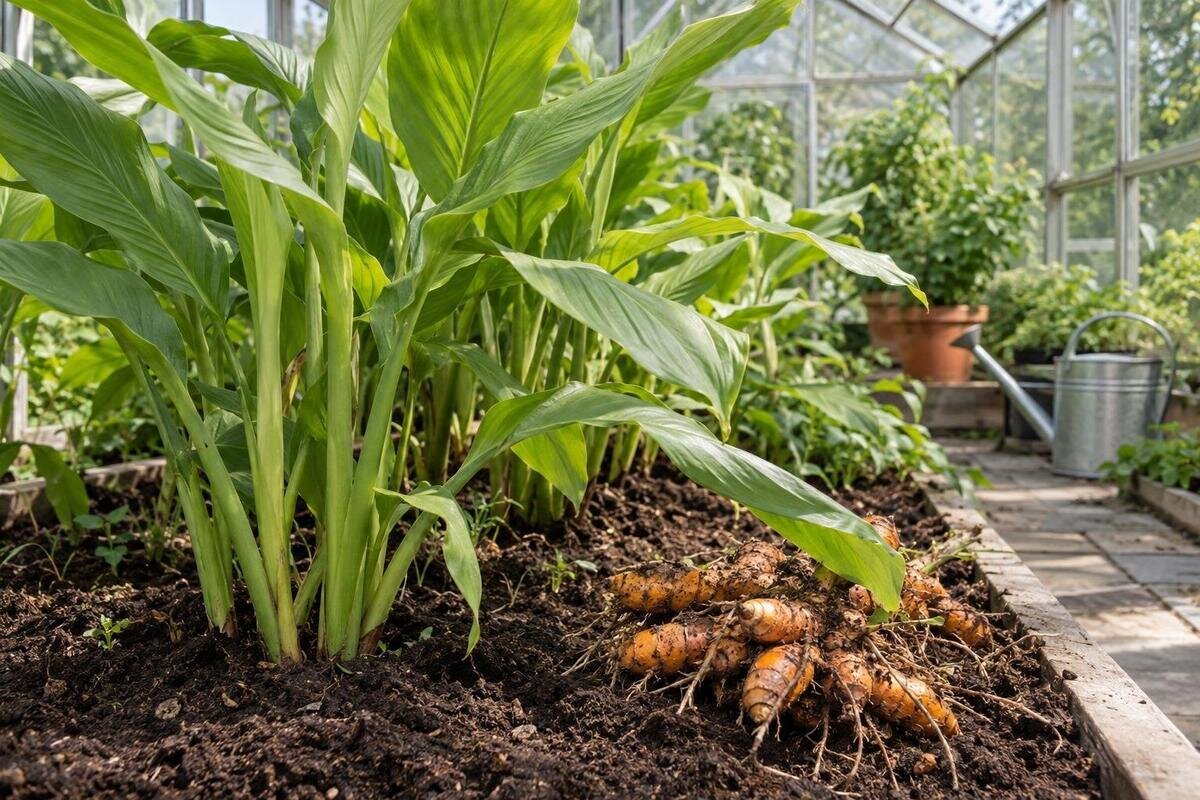
Turmeric can be grown for its rhizomes in a UK greenhouse, but it is a long-season, warmth-loving crop, not a reliable choice for every unheated structure. Greenhouse shelter does not guarantee warm nights, and starting in an unheated greenhouse in spring may leave too few warm months for rhizomes to mature. The practical route is to start a fresh culinary rhizome early in warmth, give it a generous container, and keep the growing compost moist without leaving it saturated. This guide explains what temperatures and timing are realistic, how much pot and greenhouse space to allow, and when a heated setup may be worth considering.

01
Can turmeric mature in an unheated UK greenhouse?
Turmeric (Curcuma longa) is a tropical plant grown for its fleshy underground stems, called rhizomes. It is not a quick summer root crop. The RHS recommends a warm conservatory, greenhouse or indoor window position, with temperatures no lower than 18°C, bright indirect light and moisture-retentive but well-drained soil. That cultivation guidance is a more useful starting point than assuming any greenhouse will be suitable. Shelter from wind and heavy rain does not ensure warmth: an unheated UK structure can still be cold at night and through spring and autumn. The potting compost may also remain cool after the air has warmed. One bright afternoon is not evidence that the growing position consistently meets the plant’s needs.
An unheated greenhouse may support leaves in summer, particularly after an early indoor start, but it cannot be relied on to mature a good crop before cold weather returns. If the aim is useful rhizomes, keep the plant warm for much of the growing period, which may mean supplementary heat; consider the running cost before buying planting material. Growing turmeric as an experiment in a cool house is reasonable if you accept a smaller or immature harvest. Check the minimum temperature where the pot will stand, not just in the warmest part of the house. The Lean-To Greenhouse range is listed from 40 to 154 sq ft; that is a footprint range, not evidence of overnight warmth.
Which turmeric rhizomes are suitable for planting?
Choose a culinary rhizome identified as Curcuma longa; ornamental Curcuma sold for flowers is not automatically the crop grown for kitchen turmeric. The planting piece should feel firm and plump and show at least one visible bud or eye, the raised point from which a shoot can emerge. A fresh supermarket root sometimes sprouts, but its age, storage and condition vary, so it is less predictable than planting stock sold for growing. Inspect loose pieces carefully. Avoid anything with wet or soft patches, mould, deep shrivelling or a musty smell, since damaged tissue is more likely to decay in damp compost. A bud can be small; the rhizome itself should still feel firm.
Large rhizomes with several fingers can be divided, but each section needs a healthy bud and enough firm tissue to support initial growth. Very small slices dry out or fail more readily. Use a clean, sharp knife if you divide one, then leave cut faces to dry briefly before planting rather than placing a fresh, wet cut into saturated compost. Keep any planting pieces you are saving separate from material that is soft or suspect, and inspect them again before potting. If buying turmeric for a first trial, ask for culinary planting stock and confirm that the label names Curcuma longa; appearance alone cannot establish that an ornamental type is suitable.
02
Planning a warm growing season
Plan turmeric around the period for which you can provide suitable conditions, rather than a promised harvest date. The RHS plant profile gives cultivation requirements, but not a timetable for harvesting kitchen-sized rhizomes. Its time-to-maturity entry describes the plant’s development, not a crop calendar. For a UK greenhouse trial, an indoor start can extend the time available for growth before the house becomes reliably warm. However, there is little benefit in planting early if the rhizome will sit in cold compost or the emerging shoots will lack light. Keep a record of planting and emergence, and judge progress from the plant itself rather than treating a particular number of months as a guarantee.
Work backwards from the point when you expect greenhouse conditions to become unsuitable. Decide whether you can then move the container indoors or maintain warmth where it stands; neither option should be an afterthought once the plant has broad leaves. If you cannot heat the whole structure, establish which growing area you can manage and whether it has room for the pot, watering access and neighbouring crops. The limited-edition aluminium greenhouse range is listed from 40.6 to 302 sq ft; use each model’s actual dimensions to plan that area, not as a guide to heating performance. Recording both the available warm period and the plant’s progress will make a second trial easier to plan without relying on a fixed national sowing date.
Starting turmeric indoors
Set a firm rhizome in a pot or shallow tray of free-draining compost that is barely moist, with the bud facing upwards and a light covering of compost. Keep it in a consistently warm place; the RHS cultivation recommendation of no lower than 18°C provides a useful baseline, although it is not a specified propagation temperature or a promise of rapid sprouting. A heated propagator or suitable indoor area can help you maintain warmth. Follow the equipment instructions and check the compost rather than allowing it to become wet. A cold greenhouse or windowsill is a poor starting position. Before leaves appear, little moisture is being used, so extra watering is not a shortcut to growth. Look for a swelling bud and check moisture by touch instead of watering to a rigid daily schedule.
When a shoot appears, give it bright light and keep the root zone warm. If it stays warm but sits in dim conditions for too long, new growth can stretch and weaken; a bright but cold spot can also slow it. Let the young plant develop several leaves before judging its vigour, since the first shoot is not the final canopy. Move the pot to the greenhouse only when its position is warm enough and temperatures are not expected to plunge, or continue growing it in a warm indoor place. Avoid a sudden change from steady indoor conditions to cold greenhouse nights. An indoor start buys time only when light and warmth are balanced.

03
Container size and compost for turmeric
Turmeric forms a clump of rhizomes, so choose a container with room around the planting piece rather than squeezing it into a narrow pot. A broad, sturdy container is a practical choice, but there is no single pot dimension that guarantees a harvest. Match it to the amount of planting material and the space you can keep warm, allowing room for compost beneath and around the rhizome. Drainage holes are essential, and a saucer should not hold standing water. Choose the final position before filling: a large pot of wet compost is awkward to shift, and moving an established plant can damage shoots or leaves. Keep it accessible for checking moisture and, later, examining or lifting the rhizomes.
Use a well-drained, moisture-retentive potting compost rich in organic matter, in line with the RHS cultivation guidance. Dense garden soil can be difficult to manage in a container, particularly when it stays wet. Set the rhizome with its buds facing upwards and cover it lightly; follow any planting instructions supplied with the growing stock rather than treating a fixed depth as universal. Water to settle the mix and let surplus drain. Avoid crowding several sections together, since the underground clump needs room as well as the leaves. If comparing greenhouse layouts, the T-Shaped Orangery Greenhouse is one form to consider, but check a dimensioned plan, door position and clear floor area against the pot and the route around it. The model name does not establish usable growing space.
Light, airflow and canopy space
The RHS recommends bright, indirect light for turmeric and lists partial shade as a suitable position. In a greenhouse, choose somewhere bright without assuming that the strongest direct sun is best. Light shading may help provide that position, but a dark corner is not an equivalent substitute. Check how sun and shade move across the house and whether another crop will eventually overtop the turmeric or block its light. The plant develops broad, upright leaves, and the RHS describes stems reaching about a metre high. Allow headroom and room for the canopy rather than planning only around the pot’s footprint. Leaves should not be pressed against the glazing or trapped beneath shelving as the plant grows.
Leave a workable gap around the foliage so air can move and you can inspect the leaves and compost. Good spacing also makes watering easier and reduces the chance of foliage staying wet after handling or splashing. Keep the pot away from a position where it blocks a doorway, vent or the only route to other crops. A Pyramid-type greenhouse is listed in sizes from 60 to 203 sq ft; compare the measured internal layout, not just its footprint, when allowing room for the plant, path and neighbouring crops. Those size figures do not show how much light a particular garden site will receive.
04
Watering and feeding during active growth
While leaves are growing, keep the compost evenly moist rather than saturated. Water thoroughly until surplus drains, then check again as the surface begins to dry. The right interval depends on the pot, weather and ventilation: a large container may hold moisture longer, while a small one can dry quickly on a sunny day. Check below the surface as well as looking at the top, which may dry before the root area. Turmeric does not want standing water around its rhizomes, particularly in cool conditions; blocked drainage or a full saucer can leave the compost waterlogged and encourage decay. At the other extreme, letting it become bone dry for long periods can interrupt growth.
Once leaves are established, a balanced liquid feed used at the rate on its label can supplement the compost during active growth. Feeding cannot compensate for cold or a shortened season, and increasing the dose is not a way to force larger rhizomes. Reduce watering as the foliage naturally dies back, since the resting plant uses less moisture. If comparing the aluminium greenhouse with built-in storage, its listed options run from 59.4 to 302 sq ft. Work out whether the storage area reduces the floor space available for pots and access, and keep watering equipment and feeds organised so they do not obstruct the crop or path.
Temperature monitoring and greenhouse heating
Use a minimum–maximum thermometer close to the turmeric rather than relying on a sunny midday reading near the roof. Record the overnight low as well as the daytime high, especially during spring and autumn. Air at pot height can differ from a reading higher in the greenhouse, and compost warms and cools more slowly than the air around it. A short temperature log shows whether the plant has a suitable growing window and whether heating is making a difference. Keep the thermometer out of direct sun and away from a heater outlet, so it gives a more representative reading of the conditions around the plant.
If readings show that the growing area is too cold, greenhouse heating may extend the season, but the appropriate equipment depends on the space and the conditions you need to maintain. Consider overnight warmth and the cost of maintaining it for months, not just how quickly a heater raises the daytime temperature. On bright days, ventilate to prevent excessive heat rather than sealing the greenhouse; balancing ventilation and heating takes attention. The Bloomcabin Prestige Greenhouse range is listed from 40.6 to 302 sq ft. Those footprints do not specify insulation, heat retention or energy use. For any fixed heating installation, have the equipment and connection assessed by a suitably qualified professional.

05
When and how to lift turmeric rhizomes
There is no harvest date established by the RHS cultivation profile, so treat the first crop as a trial rather than promising mature rhizomes after a set interval. Leaf colour alone is not a reliable measure of the amount of usable turmeric underground: yellowing can also reflect unsuitable growing conditions. If the plant is still growing and you can maintain warmth, there is no need to lift it simply because summer has ended. If the greenhouse is becoming too cold, decide whether to move the pot to a suitable warm position or end the trial and examine the rhizomes. Do not leave it exposed to frost while waiting for an assumed harvest signal. Lifting will reveal what the available growing period has actually produced.
To lift the crop, tip the root ball out carefully and separate the rhizomes by hand, removing loose compost. Work gently rather than pulling on the stems, and assess the firmness and condition of the rhizomes as you uncover them. Keep sound pieces if you intend to try another cycle, but discard anything soft or rotting. For material you want to save, ask the planting-stock supplier about storage and restarting; do not assume that keeping it frost-free alone provides suitable conditions. Check saved pieces for shrivelling or decay. Plan a clear route for moving the pot: the aluminium Classic Greenhouse range is listed from 40.6 to 302.3 sq ft, but a floor-area figure alone does not show whether a bulky pot can pass through the doorway.
Is turmeric a worthwhile greenhouse crop?
Do not equate tall leaves with a large rhizome harvest. Suitable warmth, compost and room for growth all matter, but the visible canopy cannot tell you exactly what has developed underground. For a first attempt, one or two pots make a manageable trial. Record the planting date, first shoot, coldest readings, watering changes and the condition of the foliage when you lift. Compare the size and firmness of the rhizomes with the original planting material, without expecting an identical result next year. If leaves yellow unexpectedly, check temperature, compost moisture and drainage before adding more feed. That record is more useful than judging the project solely by how impressive the summer foliage looks.
Think of turmeric as a crop for a warm growing environment, not as a reason by itself to heat a whole greenhouse. If warmth is already being provided for other suitable plants, turmeric may share that space; heating a structure solely for one pot can be hard to justify when the result is uncertain and the crop occupies the space for months. The Spacious Greenhouse range is listed from 506 to 753 sq ft. Turmeric does not need that scale on its own, so a greenhouse of that size belongs in a wider growing plan. For this crop, warm and accessible space matters more than sheer floor area.
Frequently asked questions
Can turmeric grow in an unheated greenhouse?
It may grow leaves during a warm summer, but an unheated UK greenhouse cannot be relied on to provide the long, warm season needed for mature rhizomes. An early start indoors can help; if you cannot maintain warmth as the weather cools, treat the crop as an experiment and expect a variable harvest.
When should I start turmeric in the UK?
Start indoors when you can provide sustained warmth and bright light for the emerging shoots. There is no fixed UK planting month or rhizome-harvest timetable established by the RHS plant profile. An early start is useful only if those conditions are available; do not move the pot into a cold greenhouse simply because spring has arrived.
What size pot does turmeric need?
Choose a broad, sturdy container with space around the planting piece for the rhizome clump to develop. Use a larger pot if planting several pieces, but only one that you can accommodate and manage in a warm position. Drainage holes are essential. A particular width or depth cannot guarantee a harvest.
How can I tell when turmeric is ready to lift?
Do not use yellow leaves alone as proof of maturity, because unsuitable conditions can also cause yellowing. The RHS cultivation profile does not specify a rhizome-harvest interval. For a first trial, lift when you decide to end the growing period and assess the rhizomes directly, or keep the plant growing if you can continue to provide suitable warmth. Do not leave the pot exposed to frost.
Can I plant turmeric from a supermarket?
Sometimes: a fresh, firm rhizome with a visible bud may sprout, but its storage history and condition are uncertain. Planting stock sold for growing is generally a more predictable choice. Check that it is culinary Curcuma longa, not an ornamental Curcuma grown for its flowers.
Turmeric is most realistic where you can provide a warm start, a roomy container and suitable conditions beyond a brief spell of summer sunshine. In a cool, unheated UK greenhouse, leaves may flourish without the rhizomes reaching the size you hoped for. Take overnight readings before committing, then treat the first pot as a measured trial. Its planting record, temperature log and lifted rhizomes will help you judge whether the growing space deserves another season.
