
Why Greenhouse Tomatoes Develop Hard Green Shoulders
Greenhouse tomato guide
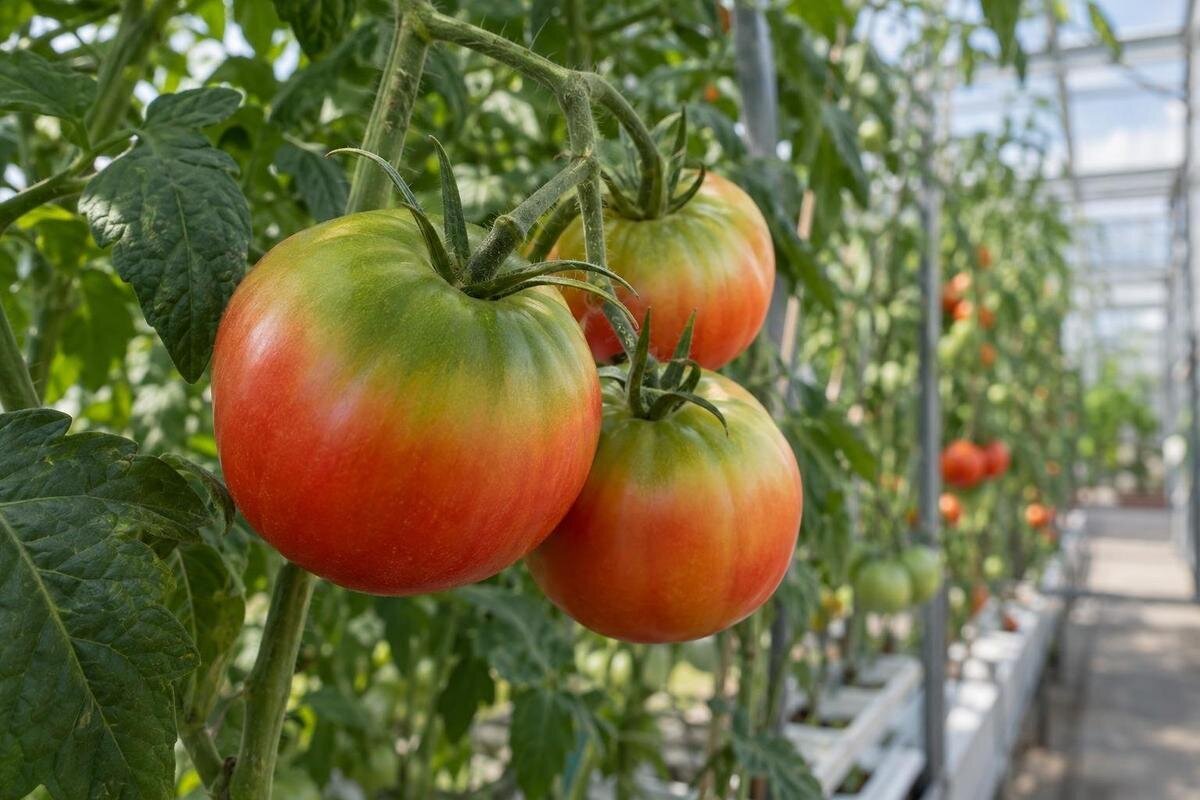
Hard green shoulders on a greenhouse tomato are not automatically a disease or a sign that the plant needs more fertiliser. Some varieties naturally retain green colour near the stem, but colour alone is different from flesh that stays unusually hard as the rest ripens. Cultivar susceptibility, hot conditions during ripening and nutrient availability may contribute to this uneven ripening. Compare tomatoes at the same stage, check the variety’s expected ripe appearance and look for a pattern across the crop before changing feeding or greenhouse routines. The position, texture and any pale tissue inside the fruit are useful clues, but none confirms the cause on its own.

01
What a hard green shoulder looks like
The shoulder is the area around the stem attachment and calyx. A patch or band there may stay green while the sides and blossom end take on the cultivar’s ripe colour. The Royal Horticultural Society (RHS) describes hard green shoulder areas that persist as the rest ripens as greenback, a physiological ripening disorder rather than an infectious disease. This involves firm, unpalatable tissue, not just a difference in skin colour. Distinguish that persistent toughness from the slight firmness of a fruit still ripening. A tomato that is uniformly green and firm may simply be immature, so reserve the word shoulder for the stem-end area.
Look at the outside and a cut surface before deciding what you are seeing. Note whether the patch forms an even ring, is confined to the stem end or appears as irregular islands elsewhere. Cut one representative fruit across the shoulder and through the middle: pale, dense tissue under the green skin supports uneven internal ripening, but does not identify its cause. Take a photograph in even daylight showing the whole fruit, stem end and cut face, and record the variety. A close-up without the whole fruit can hide where the symptom sits.
Check the cultivar and its normal ripe colour
Tomatoes do not all change colour in the same way. Some cultivars retain green colour around the stem end as the rest develops red, pink or orange pigment. Green-when-ripe types may be mature without turning red at all. These colour differences do not, by themselves, indicate a nutrient shortage. However, a shoulder that stays markedly hard while the surrounding flesh ripens needs a separate assessment; a variety’s usual colour is not enough to explain its texture. Identify the variety and its expected ripe appearance before judging the fruit against a generic picture of a red tomato.
Compare several fruits of the same variety at a similar stage, checking texture as well as colour. A repeated green ring with otherwise normal ripening may reflect the cultivar’s appearance. Repeated tough shoulders may instead show susceptibility to greenback under your growing conditions. Check the seed packet or supplier’s description for both the expected ripe colour and any stated greenback resistance; these are different characteristics. The RHS recommends choosing resistant cultivars to help prevent the disorder. A problem confined to one variety is useful evidence, but does not prove that growing conditions are irrelevant. If the variety is unknown, record that uncertainty rather than assigning a deficiency from colour alone.
02
Heat can interfere with even ripening
High temperatures during fruit development and ripening are among the causes of greenback identified by the RHS, alongside excess light and insufficient feeding. Heat therefore deserves attention when hard shoulder tissue persists as the rest of the fruit ripens. A greenhouse can heat up in bright weather, and the outside temperature alone may not describe conditions around the crop. Check the conditions experienced by the affected fruit rather than relying on a weather forecast. A pattern appearing across several varieties during a warm spell makes heat worth investigating, but does not separate its effects from exposure, nutrition or cultivar susceptibility.
Record maximum and minimum readings near the fruiting zone during ripening, keeping the thermometer out of direct sun and away from hot surfaces so that you are measuring air conditions consistently. Note whether affected fruit is concentrated in a warm corner. Use the greenhouse’s intended ventilation and suitable shading to limit overheating, following its instructions. For a future growing-space comparison, the Spacious Greenhouse size range runs from 506 to 753 sq ft. Assess how you would monitor different parts of that space and reach its openings; floor area alone is not evidence that fruit will ripen more evenly.
Sun exposure and leaf cover
Sunlight and heat overlap, but they are not identical clues. Fruit directly exposed to strong sun may become hotter than fruit under leaves, while excessive exposure can also produce a pale, bleached or papery patch on the sun-facing side. That pattern differs from a green, firm area centred at the stem end. Keep enough healthy foliage to shade fruit naturally; stripping leaves to expose a tomato is not a reliable way to make it ripen evenly and can increase its exposure. Compare fruit from exposed and shaded positions, while remembering that cultivars may differ too.
When checking exposure, note whether leaves were recently removed or damaged above the affected truss. Compare fruit on the sun-facing side with fruit sheltered by healthy foliage, preferably on the same variety and at the same ripening stage. A difference helps narrow the investigation without proving a cause. For a future site plan, the Oasis pyramid greenhouse listing gives sizes from 60 to 203 sq ft. Mark nearby trees, fences and buildings on your plan, then observe their shadows during the day. The useful comparison is the light reaching the proposed crop positions, rather than the greenhouse’s shape or name.

03
Could nutrient availability affect ripening?
Insufficient potassium nutrition during fruit development and ripening can contribute to greenback and the pale internal tissue sometimes called whitewall. The RHS identifies this alongside excess light and temperature, so feeding belongs in the investigation rather than being dismissed. However, a hard green shoulder does not measure the potassium available to a plant or establish that its feed is inadequate. Review the whole feeding programme, including the growing medium and the instructions for the product used. Other leaf or growth changes may warrant investigation too, but they cannot reliably tell you which nutrient to add from appearance alone.
Write down the feeds, dilution rates and application frequency already used, including any fertiliser present in the compost. Follow the tomato feed’s directions rather than adding an extra potassium supplement on top: the RHS warns that excessive potassium-rich fertiliser can create other nutrient problems. Keep separate records for beds and containers, and seek advice about suitable testing if a suspected imbalance remains unexplained. For planning a crop in the Prestige greenhouse size range, listed as 40.6 to 302 sq ft, decide on the growing system before estimating plant numbers. Floor area cannot determine a feeding rate; that depends on the crop, growing medium and feed instructions.
Water and roots can affect nutrient uptake
Variable water and nutrient supplies can contribute to poor tomato ripening, according to the RHS, but watering history alone cannot diagnose a hard green shoulder. Check whether affected plants have repeatedly dried out and whether containers or beds receive water unevenly. Wilting, weak growth or persistently wet compost are reasons to investigate the root environment separately, not proof that watering caused greenback. Aim for reasonably consistent moisture suited to your growing system. If plants with ripening fruit have become too dry, restore moisture gradually rather than flooding the growing medium. Record these episodes alongside feeding and temperature observations so that you can compare the conditions experienced by affected and unaffected plants.
Check moisture below the surface rather than relying only on how dry the top looks. Compare containers of different sizes and positions, and inspect whether water reaches the intended root zone or runs straight through. Note any blocked drainage outlets or pots left standing in water. If drawing up a layout using the Classic aluminium greenhouse listing, which gives sizes from 40.6 to 302.3 sq ft, leave access to inspect each container or bed. Plan hose routes and watering access alongside crop supports, so that a difficult-to-reach plant is not routinely missed. These observations are more useful than changing fertiliser because one fruit has a green shoulder.
04
Compare the shoulder with other fruit damage
Check that the problem is truly at the stem end. Blossom-end rot appears at the opposite end, usually as a dark, sunken, dry-looking patch; it is not the same symptom as a firm green shoulder. Sunscald is more often a pale or bleached patch on the exposed surface. Cracking, soft decay, spreading spots or fuzzy growth also point away from a simple colour-retention issue and may need separate identification. The position, firmness and progression of damage are useful to record, but photographs alone may not be enough to identify a disease or pest.
A cut fruit can show whether firm tissue is confined to the shoulder or extends into a pale central area. Describe each feature separately, including any soft or decaying tissue; several symptoms on one fruit need not share one cause. Keep the photographs tied to a named plant or numbered bed so that someone reviewing them can understand their location. A sketch is sufficient, including for an irregular layout. If considering the T-shaped orangery model, obtain its actual dimensions before drawing proposed beds and paths. The model name identifies the shape, but does not supply a planting plan or explain an existing fruit symptom.
Look at the pattern across plants and fruit
Look across the crop rather than selecting the worst-looking tomato. A repeated, even green ring on one variety, with normally coloured fruit from other varieties, supports a cultivar explanation. Similar uneven shoulders on different varieties during hot conditions make the environment more plausible. If fruit from one bed or group is affected, check for local exposure, watering differences or substrate history. If leaves and growth also change across many plants, nutrient availability or root conditions deserve a closer look. These are pattern clues, not proof: compare fruit at the same stage and account for the plants’ different positions.
A short harvest record is more useful than a collection of unlabelled photographs. Record the variety, plant number, date, ripeness of the lower part of the fruit and whether the shoulder is merely green or also tough. Count unaffected fruit from the same plants as well: three affected tomatoes out of four tell a different story from three out of forty. When planning a mixed-variety crop, the Limited Edition aluminium greenhouse size range is 40.6 to 302 sq ft. Use a measured layout to assign clear plant positions and labels, keeping varieties identifiable without assuming that all plants will experience identical conditions.

05
Change one growing condition at a time
Once you have recorded the pattern, make one low-risk adjustment at a time. During hot weather, use the greenhouse’s intended ventilation and avoid unnecessarily exposing fruit; keep watering steady and do not add extra nitrogen or potassium without evidence. Compare the next set of fruit at a similar stage before deciding whether the change helped. If several factors are changed together, a different result cannot tell you which one mattered. Avoid removing healthy leaves or repeatedly changing feeds as quick fixes: both can create new stresses and make the original pattern harder to interpret.
Judge an adjustment by fruit developing afterwards, not just by a shoulder that is already hard. Record the date of the change and allow for differences in maturity when comparing later harvests. If the pattern remains confined to one variety, choosing a different cultivar next season may be more relevant than altering the structure. For anyone also considering the lean-to greenhouse range, listed sizes run from 40 to 154 sq ft. Observe shadows from the adjoining building and check access to the proposed openings before choosing a position. A new greenhouse is a separate planning decision, not a treatment for tough tissue already present.
Crop diagnosis and greenhouse planning
A mild, repeatable colour difference on otherwise healthy fruit can be investigated by checking the variety and comparing its ripening pattern. Persistent hard tissue deserves attention even if every fruit of that variety shows it; consistency does not make the texture normal. Seek horticultural advice if a large share of the crop is affected, discolouration spreads, fruit develops soft lesions or rot, or other plant symptoms appear. Supply photographs of the whole plant, leaves and fruit, plus the variety name and feeding and watering records. A soil or growing-medium test may help investigate a suspected nutrient issue, but cannot diagnose the fruit symptom in isolation.
Keep any greenhouse purchase separate from the diagnosis. The Limited Edition greenhouse with built-in storage listing identifies a storage feature; assess whether that feature serves your practical needs rather than treating it as a crop-health benefit. For all the structures mentioned here, the supplied catalogue details establish names and, where stated, size ranges, not ventilation performance or control of ripening disorders. Obtain the relevant specifications before comparing them for a particular site. For the current tomatoes, spend the effort on the evidence you can collect now: which fruit is affected, whether its texture changes and how the pattern develops over successive harvests.
Frequently asked questions
Can a tomato be ripe if its shoulder is still green?
Yes, green colour alone does not rule out ripeness. Some cultivars retain it around the stem end, and green-when-ripe varieties may remain green more widely. Check the variety’s expected colour and the fruit’s texture. A shoulder that remains markedly hard while the rest ripens is a separate sign of uneven ripening, not something to dismiss solely because the variety has green colouring.
Can heat in a greenhouse cause green shoulders?
Prolonged hot conditions during ripening can interfere with even colour development and may leave green tissue around the stem end. It is one possible explanation, not proof: cultivar traits and other growing conditions can look similar. Compare fruit from different positions and varieties, and record temperatures near the fruiting area.
Should I add potassium to correct a green shoulder?
Not on this symptom alone. Low potassium availability or poor uptake can be associated with uneven ripening, but a hard green shoulder does not confirm either. Review the feeding history and, if other signs point to a nutrient issue, test the soil or growing medium before changing the fertiliser.
How is a green shoulder different from blossom-end rot?
A green shoulder is at the stem end. Blossom-end rot appears at the opposite end, usually as a dark, sunken and dry-looking patch. Pale, bleached areas on the exposed side may have a different cause again. Position and texture help describe the problem, but spreading decay or other plant symptoms may need separate diagnosis.
Should I leave the tomato on the plant until the shoulder turns red?
Not necessarily. Some cultivars retain green colour, so waiting for a completely red shoulder may leave the rest of the fruit overripe. Persistent hard tissue may also fail to soften along with the surrounding flesh. Assess the whole fruit against the variety’s usual ripe appearance and texture. If it is uniformly green and firm, it may simply be immature rather than showing a distinct shoulder problem.
The important distinction is between green colour and flesh that stays hard while the rest of the tomato ripens. A variety’s usual colouring may explain the first, but should not automatically explain away the second. Compare similar-stage fruit within and between varieties, then use its position and growing history to investigate heat, exposure or nutrient availability. Persistent tough shoulders across a substantial part of the harvest warrant horticultural advice. Extra fertiliser is not a diagnosis or a dependable first response; careful comparisons give you a better basis for protecting the quality of later fruit.
