
Hard Water in Greenhouse Irrigation: Preventing Blocked Emitters
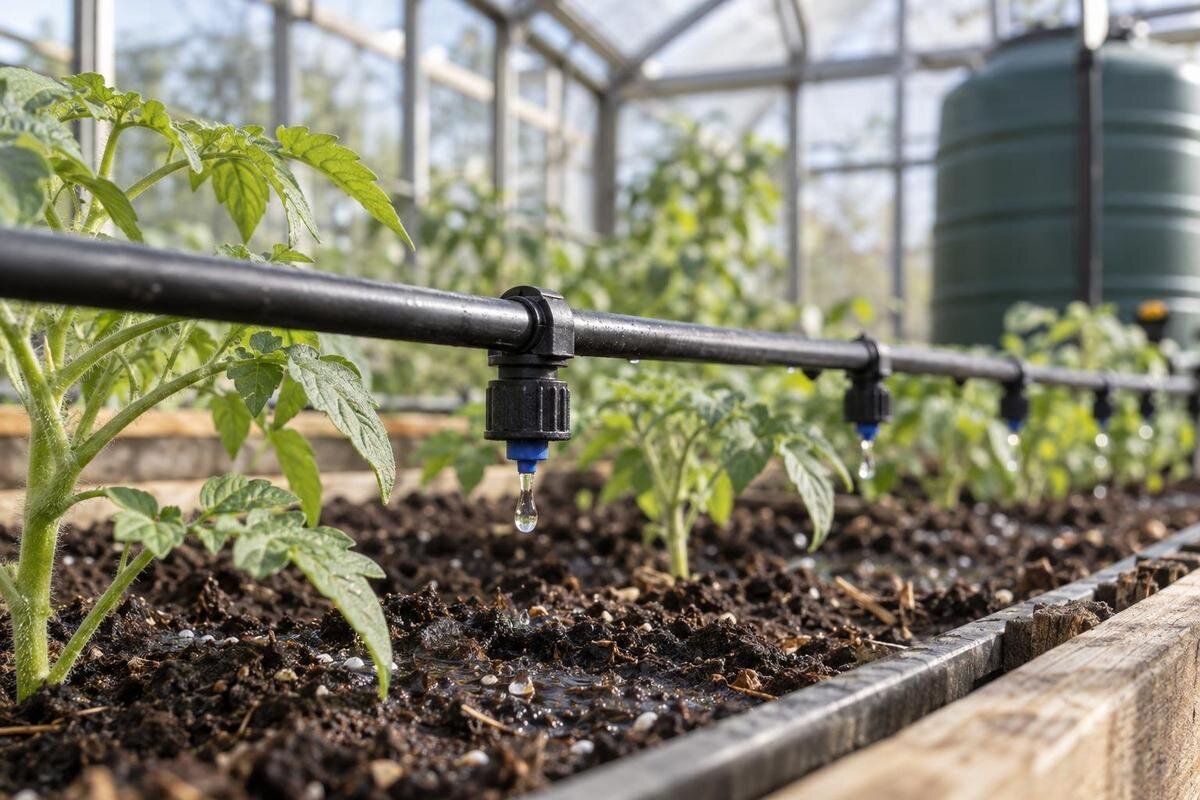
Greenhouse irrigation
Hard water is not automatically a problem for every greenhouse irrigation system, but dissolved minerals can leave scale as water evaporates. Drip emitters have narrow internal passages, so gradual deposits may reduce flow before a blockage is obvious. The useful response is to test the water that actually feeds the system, check for other causes of low flow, then maintain components only by the equipment maker’s instructions. A hardness result alone does not identify a suitable treatment or prove that scale caused the problem.

How hard water affects drip emitters
Hard water contains relatively high levels of dissolved calcium and magnesium. While in solution, these minerals are not particles that a conventional screen filter can simply catch. Water evaporating from an outlet or damp tubing can leave mineral residue; deposits may also form when water chemistry changes. Drip emitters have narrow internal paths, so build-up can gradually lower flow or change its pattern before an emitter appears fully blocked. A partly restricted outlet may still drip, while a damaged one can sometimes deliver too much. How quickly deposits form depends on the source and operating conditions: hardness is a risk clue, not a timetable or guarantee of failure.
A pale crust at an outlet may fit mineral scaling, but its appearance alone cannot confirm the cause. Dried fertiliser residue and other deposits can look similar, and material may build up inside an emitter where it is not visible. Water hardness describes mainly calcium and magnesium; alkalinity is a separate measure, and neither result alone gives a complete diagnosis of scale risk. Do not treat the first white mark as proof of hard-water damage. Combine a water test with a repeatable flow check and inspection of the rest of the line.
Low flow is not always a mineral blockage
Grit entering from a tank, sediment, algae or biofilm, root intrusion at an open line, kinked tubing, a blocked filter or a problem with supply pressure can all reduce delivery. If trouble began after fertiliser was introduced, residue or a reaction in the system may be involved. These causes can coexist with hard water. Replacing emitters before checking the filter and line may leave the underlying problem untouched, so work through the equipment in the order shown in its system diagram.
Look at the pattern, but do not diagnose from it alone. One poorly flowing outlet among otherwise similar emitters suggests a local blockage or damage; many weak outlets across a line or zone point towards something shared, such as the supply, filter or pressure. Weak flow at the far end can have several explanations, including a kink or accumulated debris. Compare like-for-like emitters under the same operating conditions, then check the source, filter and tubing before opening fittings.
Test water before choosing a treatment
Begin with total hardness in the water that feeds irrigation, and note the units on the result. Kits may report mg/L or ppm as calcium carbonate, or use another scale; compare results only when the units match. Ask for alkalinity as well: it describes the water’s capacity to neutralise acid, rather than its calcium and magnesium content. It helps a specialist interpret the chemistry but is not interchangeable with hardness. pH indicates how acidic or alkaline the sample is, while electrical conductivity (EC) gives an indication of dissolved salts overall. Neither identifies those salts or confirms scale by itself. Check a kit’s stated range and read the result within the time specified in its instructions. A reading at the top of the scale may mean that the kit cannot distinguish higher values. If a result is outside its range, or restrictions continue despite correct care, use a water-testing laboratory that can report the relevant measures and explain its method.
Test the actual supply rather than relying solely on a general report: stored water, blended sources and treatment at the property can differ from the incoming supply. Hardness alone is not enough to choose a softener, acid dosing or another treatment. Some domestic ion-exchange softeners exchange calcium and magnesium for sodium, so check whether the resulting water is appropriate for your crops and irrigation equipment before using it. When planning a watering system for a Bloomcabin Prestige Greenhouse, establish which supply it will use before ordering treatment equipment. Give the supplier the water results and the irrigation specification together. Ask what problem the proposed treatment addresses and how its effectiveness will be checked; a lower hardness reading is not, by itself, proof that every cause of blockage has been resolved.
Collect a sample from the irrigation supply
Use a clean container and follow the test maker’s instructions, particularly for sample volume, flushing and storage. For a direct mains-fed setup, sample from the intended irrigation take-off if that is what will supply the system. For a tank, sample from the outlet used for irrigation. If two sources will be blended, test the blend as well as recording which sources went into it. Take a baseline sample before adding fertiliser or other products, and write down the date, source, recent refill or rainfall, and any water treatment.
One result is a snapshot, not a permanent property of every source. Repeat a test if the source changes, a tank is cleaned or replenished, treatment settings change, or the symptoms do not match the original reading. For a new Spacious Greenhouse, mark the intended tap or tank outlet on the irrigation plan and label samples to match it. This avoids confusing a convenient sampling tap with the supply the emitters will actually receive. Keep untreated, treated and blended results clearly distinguished. If a laboratory is testing the water, obtain its sampling instructions before collecting it: it may require its own container or particular handling. Record where each sample was taken and whether it represents normal operation, a recent refill or an unusual event.

Compare emitter output in a repeatable way
To check whether emitters are delivering consistently, choose several of the same model along one line: near the inlet, around the middle and towards the end. Run the system under the conditions recommended for it, collect output in identical vessels over the same timed interval, and compare the amounts. Include any suspect outlet as well as apparently normal ones. Keep the outlets in their usual positions and do not disturb connections merely to make collection easier. If a controller cycles the supply, compare the same part of its cycle and allow any start-up period specified by the manufacturer. Record the collection duration and measured volume for each location, rather than relying on a quick visual glance. Repeat an unexpected result to check that it was not caused by a missed drip or displaced vessel. Do not compare different emitter types or rates as if they should produce identical quantities.
A measured difference tells you where to investigate, not what caused it. Check the tubing for kinks or loose connections, inspect the filter and compare measured supply conditions with the equipment instructions. If the maker recommends using a suitable pressure gauge, follow its directions rather than guessing from the water stream. A reading taken while the system is off does not establish the pressure available during watering; record whether the system was running and which zones were open. When laying out irrigation in a Classic greenhouse, mark the inlet, branches and accessible test positions on the site plan. This makes it possible to return to the same points after maintenance. Compare results with the emitter manufacturer’s stated operating range and tolerances, rather than inventing an acceptable difference between outlets.
Choose a filter for the particles present
A conventional irrigation filter removes suspended particles within its rated range; it does not remove dissolved calcium and magnesium ions that cause water hardness. It may help with grit, but it cannot by itself soften hard water or undo mineral scale inside an emitter. Check the irrigation maker’s specified filter type and rating, including any instructions for the emitter model. Do not choose a finer element by guesswork: its effect on flow, cleaning frequency and compatibility needs to be considered for the whole system.
Before buying, check the filter’s stated flow range, connection type and maintenance requirements against the system documentation. Allow room to remove its cover or element, not merely enough space to fit the assembled housing. In a Lean-To Greenhouse layout, show the filter’s service space alongside beds, shelving and the access route so it will remain reachable as plants grow. Check whether replacement elements are available and whether the manual explains how to recognise a dirty or damaged element. When servicing an existing filter, note the material it has collected: recurring grit warrants investigation of where it enters the supply. If the irrigation maker does not specify a filter, ask the maker or a qualified installer rather than borrowing a rating from another system.
Flushing lines and cleaning emitters
Flushing can carry loose sediment out of lines when the system has a flush point and its instructions call for it. It may not remove mineral scale bonded within a narrow emitter passage. Follow the manual for whether to flush, which outlets to open, how often, and how to isolate the supply. Do not improvise by pulling fittings from a pressurised line. If symptoms remain after an approved flush, recheck output and inspect the filter before deciding that an emitter needs to be dismantled.
Clean removable emitters only by the maker’s stated procedure and with products it expressly permits. Avoid needles, wire, vinegar, descaler, bleach and household cleaners unless the instructions explicitly approve that exact method: a passage or seal can be damaged, and residues may later enter growing media. Some emitters are not designed to be opened. If replacement is recommended, match the original type and operating requirements. For a watering layout in a limited-edition greenhouse, keep serviceable fittings reachable without dismantling shelving or moving established plants. After approved cleaning or replacement, repeat the output check under the original test conditions. Record whether delivery improved and whether the fault returned; a temporary improvement does not establish that the underlying cause has been removed.
Check fertiliser changes and stored water
Note whether the problem appeared after changing fertiliser, stock solution, injector settings or water source. Fertiliser salts can leave deposits or interact with other dissolved substances, so that pattern needs investigation rather than an automatic acid rinse. Check the product labels and irrigation maker’s compatibility information for the exact materials and sequence you use. If the cause remains unclear, ask the fertiliser supplier or irrigation manufacturer to review the water result and product details. Never combine cleaners, fertilisers or acids on the assumption that mixing will clear a blockage.
Collected rainwater is not automatically free of clogging material: a tank may hold roof debris, sediment or biological growth, while a blended supply has the properties of its actual mix. Test water at the point of use and inspect screens or tank outlets according to their instructions. For a collection scheme associated with a T-Shaped Orangery Greenhouse, confirm which gutters, tanks and connections are supplied, then draw the route from collection to irrigation separately. Include access for tank inspection and filter maintenance in that plan. If sediment repeatedly reaches the filter, ask the tank or irrigation supplier to assess the collection and outlet arrangement. Switching sources may change the blockage risk, but it does not remove deposits already present in the lines; check output again after any source change.

Keep a record of water tests and flow checks
Set inspection timing from the irrigation manufacturer’s maintenance schedule rather than a generic calendar. Recheck after changing the water source, treatment, fertiliser or filter, and compare output if one plant or container stays consistently drier than others. Keep a log of the date, test values and units, source, emitter type, test positions, flow observations, filter service, and any cleaning or replacement. Note whether the system was operating under its usual conditions. A rough sketch of installed lines makes later comparisons more useful than a note saying only ‘low flow’.
For irrigation installed in a Pyramid-type greenhouse, label the actual lines and emitter positions on the layout so each observation has a clear location. Keep the last satisfactory measurements as a baseline, alongside the first date a restriction was noticed. Record unsuccessful maintenance as well as successful work: knowing that an approved flush made no difference can be useful evidence. When several emitters fail together or the same blockage quickly returns, share the log, water report and system diagram with a qualified irrigation professional or equipment maker. Include photographs of visible deposits and the affected components, without treating the photographs as a chemical diagnosis. Ask for a clear explanation of the suspected cause and how the proposed maintenance or replacement will be assessed afterwards.
Check irrigation compatibility before buying equipment
Before purchasing replacement emitters, a filter or water-treatment equipment, identify the existing system make and model, rated flow and operating conditions, filter specification, and any compatibility limits in its manual. A connector that appears to fit is not proof of correct flow or a suitable seal. If the original component cannot be identified, send the manufacturer or supplier clear photos and model details before ordering. Do not assume that two visually similar emitters have interchangeable internals. For treatment equipment, provide the water-test results with their units and ask about output-water quality, maintenance and compatibility.
If you are also buying a greenhouse, treat the structure and irrigation equipment as separate purchase decisions. A greenhouse with built-in storage is a greenhouse option, not evidence of an included water tank or watering system. Confirm the actual specification before allocating space to those items. On the layout, distinguish the route for supply tubing from the places needed to inspect filters, reach line ends and replace emitters. Consider whether planned benches or stored equipment would obstruct those service points. Obtain an itemised irrigation specification identifying what is included and what must be purchased separately, together with the relevant operating and maintenance instructions. This gives you a record of the installed components to use when ordering replacements, rather than relying on appearance or a greenhouse category name.
Frequently asked questions
Does hard water always block drip emitters?
No. Hard water can leave mineral deposits, but blockage depends on the water, system and maintenance. Low flow may also come from grit, algae, a kinked tube, a dirty filter or a fertiliser residue. Test the water and compare emitter output before deciding that hardness is the cause.
Will a standard irrigation filter remove water hardness?
No. A conventional screen or particle filter can catch suspended material within its specified range, but dissolved calcium and magnesium pass through it. Choose a filter to suit the irrigation equipment and particles present; do not rely on it to soften water or remove scale already inside an emitter.
Which water tests are most useful?
Start with total hardness and note the units, then check alkalinity as a separate measure. pH and electrical conductivity can add context but do not replace those results. Test the supply that actually feeds the system, including stored or blended water if that is what you use.
Can I soak emitters in vinegar or descaler?
Only if the manufacturer explicitly approves that exact cleaning method for your emitter. Acids, descalers and household cleaners can damage parts or leave residues. Follow the equipment instructions instead, and replace an emitter if the manufacturer says it is not serviceable.
Is rainwater guaranteed to prevent blockages?
No. Its mineral content may differ from your other supply, but stored rainwater can carry debris, sediment or biological growth. Test it at the point of use, inspect the tank and screens according to their instructions, and test a blend if you mix sources.
Hard water is one possible cause of restricted emitters, not a diagnosis by itself. Test the water used, compare flow at repeatable points and inspect the equipment according to its instructions. Those checks help distinguish loose debris and line problems from possible mineral deposits, and show when a specialist assessment or replacement part may be needed. Keeping the original test results, units and irrigation diagram makes later maintenance decisions more reliable and helps avoid unsuitable cleaning or treatment.
