
Should You Use a Heated Propagator or Greenhouse for Seeds?
Starting seeds
Choosing between a heated propagator and a heated greenhouse is mainly a question of scale and what seedlings need after they emerge. A propagator concentrates warmth around a small number of trays; greenhouse heating changes the temperature of a much larger growing space. Neither guarantees good germination on its own: seed type, compost moisture, light and air movement still matter. Compare how many trays need warmth at once, for how long and where the plants will go next. The right answer may be a small heated zone inside a cooler greenhouse rather than heating the entire space.

What a heated propagator warms
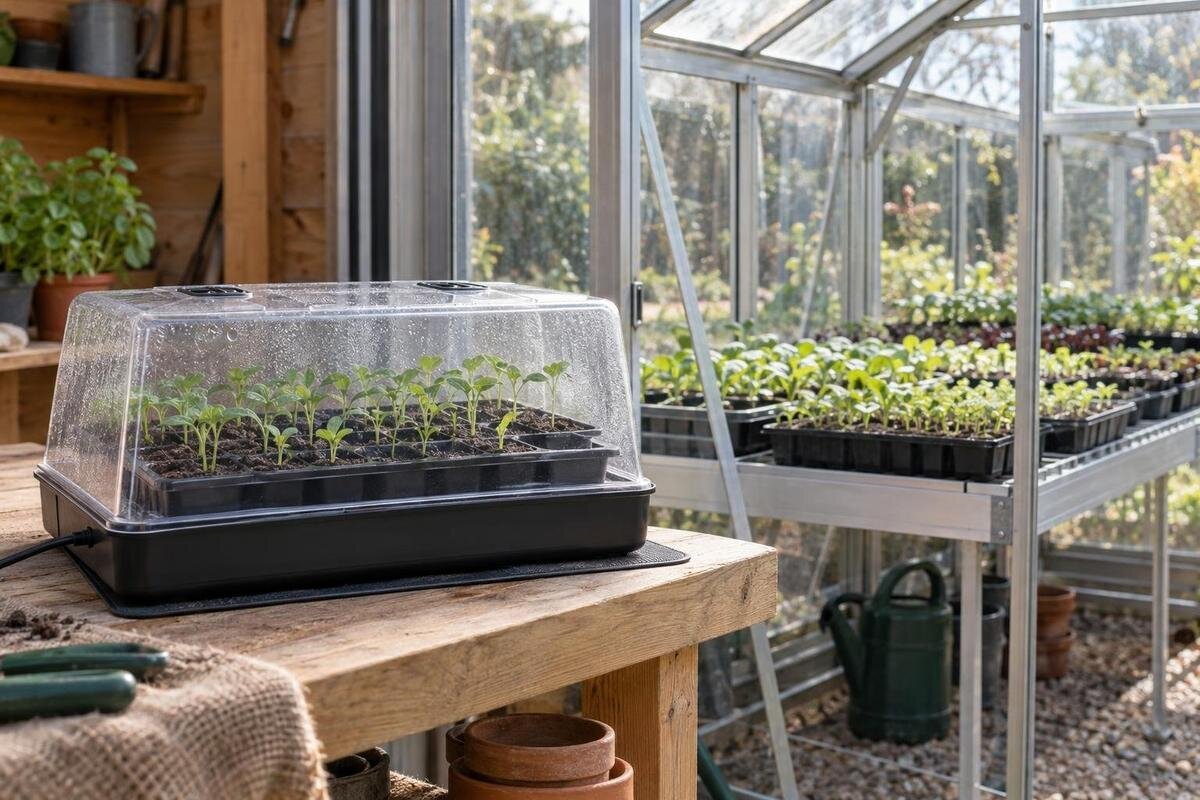
An electric propagator creates a warmer local environment for seeds, usually around a tray or the compost in it, often under a clear cover. It warms a limited sowing area rather than the greenhouse as a whole. That distinction matters because germination responds to conditions around the seed, not simply a reading on a room thermometer. Propagators differ: some include an adjustable thermostat, while others supply heat without a user-set temperature. Check the instructions for the exact model before assuming it offers precise control, even heat across the base or space for a particular tray. A thermostatically controlled unit regulates its heat output according to a sensor reading; an unregulated unit does not maintain a chosen temperature automatically. Neither should be assumed to cool a tray that becomes too warm in sunshine. Check where the sensor measures temperature and whether the manufacturer's stated operating conditions suit the place you intend to use it. These differences matter more than the word heated on the packaging.
Follow the seed packet or reliable crop-specific guidance for preferred germination conditions, then check the temperature beside the tray or in the compost using a suitable thermometer as directed. The surrounding room or greenhouse may be cooler than the seed zone. Keep compost evenly moist without leaving it waterlogged; a cover can slow moisture loss but may also retain humidity. Use vents in line with the model and crop instructions. A propagator supplies warmth, not light or growing space, so it is not a complete growing environment once seedlings emerge.
Heating a greenhouse means managing a larger space
A greenhouse heater warms a much larger volume of air, so its task depends on the enclosure as well as the target conditions. Heat escapes through the covering and any gaps, and the rate changes with outside weather, ventilation and how often doors are opened. A bright afternoon does not guarantee a suitable temperature overnight. Floor area is only one part of the picture; internal height, construction and heat loss matter too. This is why you cannot compare a greenhouse with a propagator simply by looking at their thermostat settings.
Heating the whole greenhouse normally calls for a heater, temperature control, a sensor and a suitable power supply. The equipment needed depends on the structure and the conditions you intend to maintain. The aluminium greenhouse range is listed from 40.6 to 302.3 ft², but that floor-area range does not state heat loss, heater capacity or usable bench area. Follow appliance guidance, and have fixed electrical requirements assessed by a qualified professional rather than adapting an installation yourself. Plan ventilation as well as heating, since a warm enclosure still needs to be managed for the plants inside.
Estimate peak tray and bench space
Plan for the busiest point in the sowing calendar, not just the first batch. Include trays that will be in use at the same time, since one sowing may still be germinating when the next is ready. Allow room to lift and carry trays, check labels and reach them for watering. For a propagator, check the usable base dimensions and how many trays fit without blocking vents or controls; a broad description such as large does not tell you whether it suits your containers.
In a greenhouse, distinguish the building’s floor area from the space available for propagation. Benches, paths, doors and other plants all take up room, and access matters when you are carrying wet trays. The Lean-To Greenhouse range is listed from 40 to 154 ft²; those figures help compare building sizes, not bench length or seed-tray capacity. Sketch the bench runs and mark where trays will sit at the busiest time of year. This can reveal a space problem before you commit to heating more of the greenhouse than your crop needs.
Plan for care after germination
Once seeds emerge, the job changes. Young plants need suitable light, airflow and room to develop, and their preferred conditions vary by crop. Keeping every tray at its germination setting for longer is not automatically helpful. If light is inadequate, overly warm conditions can encourage soft, stretched growth in some seedlings. Read beyond the germination instructions to the crop’s seedling-care guidance so you know when to reduce heat, remove covers or move the plants. Emergence may also be uneven: one tray can contain established seedlings while another has yet to sprout. Separate trays or removable individual covers can make those stages easier to manage than a single lid over the entire batch. Allow for that flexibility when comparing equipment. A unit that holds all your seed trays at sowing time may still be awkward if you cannot adjust conditions for each batch as it develops.
Before sowing, identify where seedlings will go next: perhaps a bright windowsill, an unheated greenhouse or a heated growing area, depending on the crop and conditions. A sudden move from warm, humid cover to colder, drier air can check growth, so adjust covers and heat in line with crop guidance rather than making an abrupt change. You will also need room to space, water and eventually pot on the plants. The limited-edition aluminium greenhouse range is one option to compare if you plan to grow seedlings on in a greenhouse; check the chosen model against your intended bench positions and access.

Compare electricity use in real conditions
A propagator has an advantage when the requirement is only a few trays: it heats a smaller zone, so it will generally need less energy than heating an entire greenhouse for that same small batch. That is a comparison of scale, not a guaranteed saving. Actual use depends on how long the equipment runs, the conditions outside, the temperature you need and how much heat the greenhouse loses. A greenhouse heater may make more sense if the space is used regularly for many plants, rather than switched on solely for a short germination period.
Do not estimate a bill from the heater’s rated wattage alone. A thermostatically controlled appliance may switch on and off, so actual use depends on the period and conditions. Compare energy use over similar durations and weather, using a suitable energy meter only where the equipment and its instructions permit. For fixed systems, ask a qualified professional about measuring use safely. Then apply your own electricity tariff to the measured kilowatt-hours. Avoid comparing a warm spell’s greenhouse use with a cold spell’s propagator use and treating the difference as a dependable forecast. Keep purchase costs separate from running costs, too. If you already own greenhouse heating equipment, that changes the immediate spending required, but not the electricity needed to operate it. Conversely, buying a propagator adds an equipment cost even if its running demand is lower. Compare the extra cost of serving your seed batches, rather than assigning all existing greenhouse costs to propagation when the heating also serves other plants.
Match warmth to the seeds you are sowing
Seeds do not share one ideal germination temperature. Check the sowing instructions for each species and variety, and note whether the advice relates to compost or ambient air. Some crops germinate more readily with extra warmth; others can be sown without it under suitable conditions. A propagator can help meet a specific warm requirement, but it should not become the default for every packet. If seeds with very different needs share one unit, a single setting may suit some and disadvantage others. Grouping trays by similar requirements is more useful than simply filling every available space.
Plan successive batches around those differences: label trays, keep their requirements visible and avoid moving one into a colder environment just because the next sowing needs a different setting. If a greenhouse will serve as a larger nursery, compare internal plans and access; the T-Shaped Orangery Greenhouse is one named format to review against measured bench positions. Its name does not tell you how much usable space remains after paths and other plants are allowed for. Separate propagators or zones may be more practical than maintaining one greenhouse temperature for crops at different stages.
Monitor conditions at tray level
A thermostat controls a heater according to the reading at its sensor; it does not prove that every tray is at that temperature. Sunlight, bench position, doors and air movement can create different conditions within a greenhouse. Use a separate thermometer at tray height to check the air around seedlings. To check the temperature of the compost, use a thermometer or probe intended for that purpose, following its instructions. The air under a propagator lid and the compost need not have the same temperature. A minimum-and-maximum record over a few days is more informative than a single reading when conditions are changing. Record which measurement you took, where the tray stood and whether its cover was on. Otherwise, a compost reading from one batch and an air reading from another can look comparable when they describe different conditions. Consistent observations make it easier to judge whether the chosen system meets your sowing requirements.
Use readings to spot patterns: note overnight lows, daytime peaks and what happens after airing or watering. If the greenhouse warms quickly in the sun, ventilation may be needed even when nights remain cool; manage it in keeping with crop guidance and the greenhouse’s instructions. Product size alone cannot determine the control system. The Pyramid-type greenhouse range is listed from 60 to 203 ft², yet floor area does not specify internal volume, heat loss or the heater required. Treat measured conditions and the full product specifications as separate checks.
When whole-greenhouse heating may make sense
Heating the whole greenhouse becomes more plausible when many trays need similar conditions at once, sowing continues over a long period, or plants will remain in the same controlled space after emergence. It may also support uses beyond germination, so the decision can be about the greenhouse’s overall growing season rather than seeds alone. A large heated area used for just a few trays on a few occasions is harder to justify. Note which plants benefit, how long they need the space and whether another use keeps it productive between batches.
Set that against equipment and running costs, available bench space and the routine needed to monitor and ventilate the greenhouse. If only the trays need warmth, a propagator in a greenhouse that remains unheated may be more proportionate, provided the conditions around it suit the unit and plants. The aluminium greenhouse with built-in storage is listed in sizes from 59.4 to 302 ft²; allow for the storage and circulation shown in its plan rather than treating all floor area as propagation bench. Consider the greenhouse’s wider use before choosing to heat the entire space.

Check the equipment requirements before buying
Write down what each option actually requires. For a propagator, check the tray footprint, whether a lid is included or compatible, what temperature control is provided and what the manufacturer says about use and cleaning. For a greenhouse, identify the heater type and rated input you are considering, how it is controlled, where its sensor can sit, what ventilation is available and what power provision is needed. Establish which controls and sensors are included and which must be bought separately; do not assume that a heater listing includes a complete temperature-control system. Include the supporting equipment in your comparison. Trays need suitable support and a practical way to manage watering without wetting electrical equipment. If the available daylight will not meet the seedlings’ needs, assess suitable growing lights as a separate requirement: neither a heated base nor a greenhouse heater supplies light. Check that any equipment used together is compatible with its intended surroundings and the manufacturers’ instructions.
Compare both options against the same growing plan: number of trays, expected overlap, germination conditions, space after emergence and how long heat is likely to be needed. Include a way to monitor conditions and keep labels and watering accessible. The Bloomcabin Prestige Greenhouse is listed in sizes from 40.6 to 302 ft², but the area band alone cannot establish bench layout or heating requirements. Use the current technical details for the structure and heater rather than treating a model name or floor area as a guide to either.
Using a propagator in an unheated greenhouse
A mixed approach can separate seed warmth from the greenhouse’s general temperature. A propagator inside an unheated greenhouse, or another sheltered growing space, can warm a small set of trays while leaving the surrounding air cooler. That may reduce the need to heat the whole building, but it does not insulate seedlings from conditions outside the propagator. Check that its instructions permit use in that environment, and monitor both the tray and the surrounding space. Decide in advance where seedlings can go when the covered, warm germination stage ends.
Choose this arrangement only if the larger space can suit the crop and the power supply is appropriate for the equipment. If you genuinely need substantial greenhouse area for continuing propagation and other plants, a larger enclosure may fit the plan; the Spacious Greenhouse listing covers 506 to 753 ft². That footprint says nothing by itself about heat retention or suitability for a particular heater. The key comparison remains the size of the zone you need to keep warm and how much of the wider space you will use after germination.
Frequently asked questions
Is a heated propagator better than heating a greenhouse?
Neither is better for every situation. A propagator is usually the more practical choice when you only need warmth for a few trays. Heating the greenhouse may make more sense if many batches need similar conditions and the space will be used for growing on as well.
Can I use a heated propagator in an unheated greenhouse?
Often, but check the propagator’s instructions for its permitted surroundings and monitor conditions both inside it and around it. The tray may be warm while the greenhouse air is cold, which can affect emerging seedlings when they are uncovered or moved.
Do all seeds need a heated propagator?
No. Germination requirements vary by crop and variety, and some seeds can be sown without extra heat. Follow crop-specific sowing guidance rather than using a propagator for every tray by default.
Should I keep the propagator switched on after seeds germinate?
Not automatically. Seedlings may need different conditions from seeds, and those needs vary by crop. Follow the seedling-care guidance, then adjust heat and covers as appropriate while making sure the plants have suitable light and room to grow.
Will heating a greenhouse make seeds germinate more reliably?
It can help maintain suitable warmth when a crop needs it, but heat alone does not ensure germination. Seed quality, moisture, sowing depth and other growing conditions also matter. Monitor the seed zone rather than relying only on the greenhouse thermostat.
For a few trays, a heated propagator is usually the more focused choice; for repeated batches and continued growing-on, greenhouse heating may be worth considering. In either case, base the decision on the crops’ requirements, the space that needs warmth and the conditions seedlings will need after they emerge. A well-planned smaller heated zone can be more useful than warming space that the growing schedule does not need.
