
Insect Mesh on Greenhouse Vents: Balancing Airflow
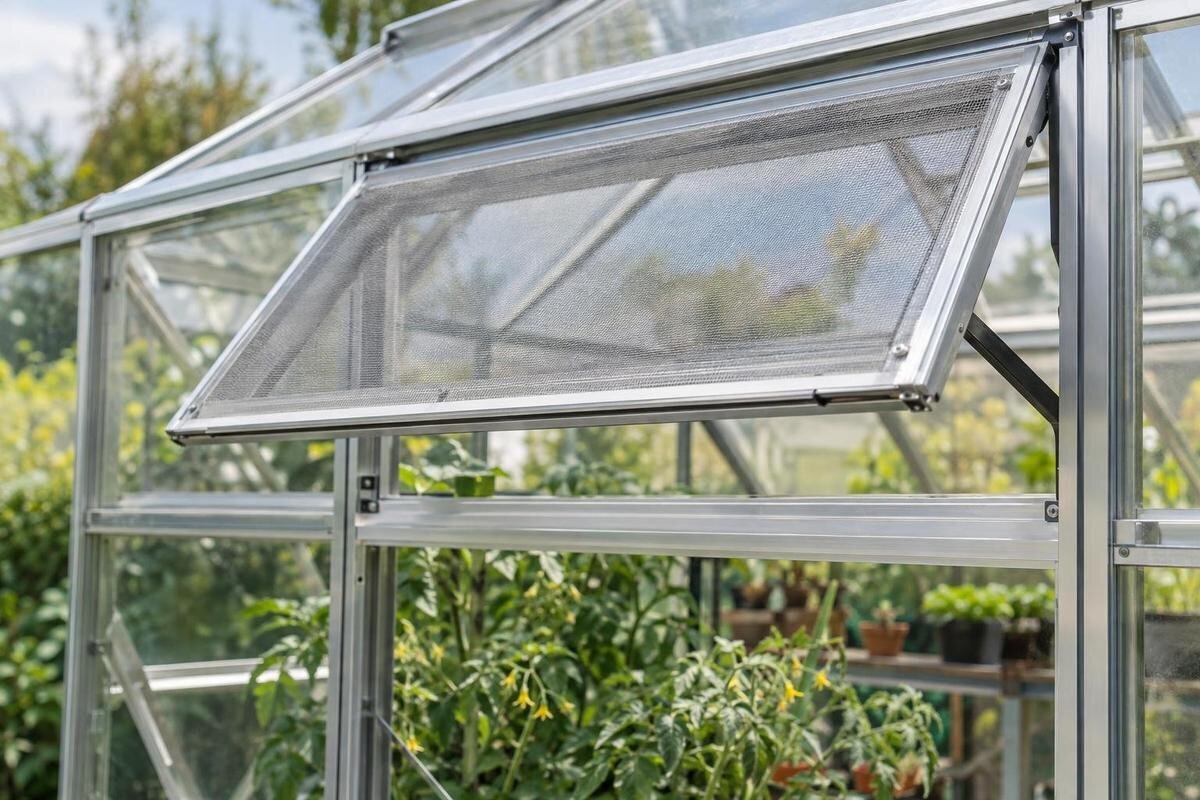
Greenhouse ventilation
Greenhouse vents can be entry points for pests, but covering them with insect mesh can also slow the air moving through the structure. The right choice depends on the pest you want to exclude, the mesh opening, the screened vent area and whether the screen fits the greenhouse without obstructing moving parts.

Before buying insect mesh 1
What insect mesh can and cannot exclude
Insect mesh is a physical barrier, not a treatment for insects already inside. Whether it excludes a particular pest depends on the clear aperture, the pest’s smallest relevant mobile stage and whether the mesh remains intact. The adult you notice is not always the only stage that matters: smaller immature insects may pass through an opening that stops the adult. A pest’s wingspan or overall length is therefore a poor guide; the useful question is whether its body can pass through the mesh. Finer mesh may exclude a wider range of small insects, but it can also restrict airflow, so identify the target before comparing products.
Coverage matters as much as aperture. Mesh over a vent cannot prevent entry through an open door, a torn panel, a loose edge or another unprotected opening. Pests can also arrive on plants, cuttings, compost or tools, so screening is one part of prevention rather than a guarantee that a greenhouse will stay insect-free. Walk around the structure and note every route that may need a barrier; distinguish vents, which must keep working, from access openings. Decide which pests and routes matter most, then plan protection for them rather than assuming that a single sheet over one vent secures the whole greenhouse.
Choose the mesh for the pest you have identified
Before selecting mesh, identify the pest as accurately as practical. Leaf damage alone rarely shows which insect is responsible, and tiny pests can be confused with harmless visitors. Inspect affected plants where the insect or signs of feeding are visible, and use a clear close-up photograph or a sample for identification if necessary. Sticky cards can indicate that flying insects are present, but they do not reveal every pest or prove that the insect caught is causing the damage. If you do not know whether the problem is thrips, whitefly, aphids or another insect, choosing very fine mesh by guesswork may restrict ventilation without addressing the right target or route.
Ask the mesh supplier for the clear aperture: the size of the opening between the threads. Where possible, compare it with guidance for the pest and its smallest relevant stage. A mesh count on its own can mislead because counting conventions, units and thread thickness vary; two products described with the same count may not have the same opening or amount of open area. Look for an aperture stated in millimetres or micrometres and ask what pest the product is intended to exclude. If the seller cannot explain the measurement or its limitations, treat the exclusion claim cautiously rather than relying on a vague label such as fine mesh.
Before buying insect mesh 2
Fine mesh adds resistance to airflow
Each strand blocks part of the opening and makes moving air pass around the fibres. For a given screen area, a fine, tightly woven mesh generally presents more resistance than a coarser one; the result also depends on thread thickness, weave, the mesh’s condition and the pressure moving air. A vent can look fully open while airflow is lower once it is covered. Dust, pollen, leaves or a doubled layer can add to the restriction. Air movement also changes with wind and temperature differences, so the same screen may behave differently at different times. A visual estimate of uncovered area, or a general claim that mesh is breathable, cannot establish how a greenhouse will perform.
Look for a stated aperture and, where available, open-area or air-permeability information for the exact mesh. Ask whether the figures relate to a particular test condition and apply to the product being sold; do not treat mesh count as an airflow rating. There is no universal percentage to subtract from a vent opening, because screen construction and site conditions vary. If you are considering the T-Shaped Orangery Greenhouse, request the vent details for your chosen configuration alongside the proposed screen specification. Keep the two sets of information separate: open area describes the mesh, while the dimensions and movement of the vent determine where that mesh can be used. Neither figure alone establishes the ventilation available after fitting.
Check the greenhouse’s existing ventilation
Before adding mesh, note which vents open, how far they can open, where they are and whether plants, shelving or stored equipment obstruct them. Check the selected greenhouse’s manual for the intended use of each opening and any existing fan or automatic opener. An open door might create another route for air, but it also creates an unscreened entry for pests; do not count it as protected ventilation unless it has a suitable barrier. A screen only passes air through the opening it covers, so a small, partly blocked or rarely opened vent has less margin for extra resistance than a broad, unobstructed one.
Consider the whole air path rather than simply counting vents. Openings that allow air to enter and leave can work together; a screened vent at one end cannot automatically compensate for an exit that is shut, obstructed or poorly positioned. Wind direction and outside conditions change, so one observation on a breezy day can be misleading. When comparing configurations of the Pyramid-type greenhouse, ask for a drawing showing the ventilation openings in the version you intend to buy. Mark which openings would be screened and which would normally remain closed. This gives the supplier a specific arrangement to assess, rather than a general question about whether insect mesh is suitable for a greenhouse of that floor area.

Before buying insect mesh 3
Cover entry routes without obstructing the vents
Work from the perimeter inwards. Decide which vents need mesh and whether doors or other regular entry points need a separate compatible barrier. Check the joins between mesh, fixed frame, moving sash and corners: a fine aperture offers little practical exclusion if insects can pass around an edge. Inspect frame-to-glazing joints and other openings, but do not cover a gap that serves a designed drainage or ventilation purpose. A simple sketch or dated photograph of each opening and proposed screen boundary can help you compare a kit with the actual structure before ordering. Also confirm that the mesh still covers the air path when the vent is fully open; a screen aligned only when the sash is shut may leave a gap during ventilation.
The screen must not snag on the sash, hinges, handles or opener, or stop the vent reaching its normal open and closed positions. Ask whether it mounts to the moving sash, the fixed frame or a separate track, and how the corners are sealed; a kit designed for one arrangement may not suit another. Do not drill, attach material to glazing or alter a frame unless the manufacturer approves that method. If you are considering a greenhouse with built-in storage, include the doors and any openings serving the storage area in your entry-route sketch. Ask which spaces communicate with the growing area and which openings are intended for ventilation. Their role, rather than their appearance, determines whether they belong in the screening plan.
Confirm compatibility with the exact greenhouse model
Compatibility depends on more than the greenhouse name. Relevant details include the exact model and variant, vent shape and dimensions, frame profile, hinge direction, approved fixing surfaces and whether the screen needs to move with the vent. Configurations within one product family can differ, so do not assume that mesh cut to a rough opening size will clear seals, handles or moving parts. Ask the supplier for a compatible kit or confirmation against the model and vent type, together with a fitting drawing or instructions. These details help distinguish a screen designed for the opening from generic mesh that may leave gaps or interfere with normal vent operation.
Record the model as it appears in the documentation, the selected size or variant and which vents you want to cover. Clear photographs of the vents open and closed can make a compatibility question easier to answer. For the Bloomcabin Prestige Greenhouse, ask whether the proposed screen kit is supplied separately and whether confirmation covers your particular vent and opener combination. Request a parts list as well as fitting instructions: mesh, edge seals and retaining pieces may all be needed to make a complete barrier. A statement that a kit fits the product family is less useful than confirmation naming the relevant configuration. Keep that confirmation with the instructions so replacement parts can be identified later.
Before buying insect mesh 4
Compare conditions before and after fitting
If you already use the greenhouse, make a simple baseline before adding a screen. Record temperature and relative humidity at crop level during representative periods when the vents are in use. Note the time, outside weather, how far each vent is open, door position, wind and whether shading or a fan is in use. Keep the sensor in one place, away from direct sun or a wet leaf, and compare periods with broadly similar conditions; a hotter, calmer day will not isolate the effect of mesh. A written log or dated photographs of vent positions make it easier to see what changed. If you cannot delay fitting, start recording as soon as possible and note that the baseline is incomplete.
After fitting, repeat the observations under comparable conditions, with the same vent positions and equipment settings. These readings do not calculate air exchange, but they can flag an issue worth investigating. Note the mesh condition too: it may be folded, doubled at an overlap or partly blocked, making the installed arrangement different from the one you intended to test. If you are planning a purchase such as the Spacious Greenhouse, ask how a proposed screening arrangement can be assessed once installed. Agree which vent positions and measurement locations to record, especially if you intend to monitor more than one growing area. Retain the unscreened baseline alongside the later readings rather than comparing isolated daily maximum temperatures.
Recognise and investigate reduced airflow
Investigate a repeatable change rather than treating one unusually warm reading as proof of restricted airflow. First check whether the comparison is valid: have the crops grown taller, has watering changed, or is the sensor now exposed to direct sun? One sensor reports conditions where it is placed, not throughout the greenhouse. If only one growing area seems affected, look for a nearby blocked opening or dense foliage before blaming every screen. Plant symptoms such as wilting are not a reliable airflow test on their own, since water availability and direct sun can also affect plants. Separate a local obstruction, a measurement problem and a greenhouse-wide change so that any adjustment addresses the likely cause.
Start by checking that each vent reaches its normal opening position and that the mesh is not dirty, doubled or obstructed. Clean or refit it only as its supplier permits, then repeat the comparison. If the restriction persists, ask whether a coarser mesh is supported for the identified pest, or whether another model-approved arrangement is available; do not simply choose a larger aperture without checking the exclusion trade-off. For an existing Classic aluminium greenhouse, give the supplier photographs of the installed screens and a record of the vent positions during the problem. This helps distinguish a fitting fault from a limitation of the proposed mesh. Shading may reduce solar heat gain, but it does not restore air exchange.

Before buying insect mesh 5
Keep the mesh clean, secure and serviceable
Inspect the screen regularly during the period when pest exclusion matters and after weather or maintenance that could loosen it. Look for tears, stretched areas, loose edges, gaps at corners and contact with moving vent parts. Fine mesh can also collect dust, pollen and plant debris; a blocked surface may pass less air than when it was first fitted. Check that vents still move freely and that the screen remains in the same position when they are open. A quick check of joins and openings is more useful than assuming an intact-looking central panel means the whole barrier is secure.
Follow the screen supplier’s cleaning instructions, since unsuitable tools or cleaners could damage the fibres or alter the openings. If the screen is removable, keep track of which piece fits which vent and check it again when refitting; a panel placed back slightly out of position can leave an edge gap. When choosing screening for a Lean-To Greenhouse, ask how you will reach every panel for inspection and removal, including any edge that may be difficult to see. Check whether routine cleaning requires removing the whole screen or only releasing a retaining piece. Before ordering replacement mesh, establish whether the existing frame and seals can be reused or whether the supplier specifies a complete replacement assembly.
Balance pest exclusion with ventilation
The most protective mesh is not automatically the best choice if it leaves too little effective ventilation for the greenhouse. Start with the pest you need to exclude, then compare the supplier’s aperture guidance with airflow information for the mesh and the openings you plan to cover. A coarser screen may allow more air through but may not exclude the target; a finer one may provide a closer barrier while adding resistance. If several vents are available, ask whether screening more of the manufacturer-approved openings is preferable to relying on one restricted opening. Do not change the vent arrangement or assume that more screened area solves the issue without checking the model guidance.
Before buying, make a short record of the target pest and life stage, the mesh aperture and any airflow data, the exact vents to be covered, the approved fixing method and how the screen will be cleaned. If your shortlist includes a Limited Edition aluminium greenhouse, request a screening proposal for the configuration you are considering, rather than treating mesh as a later add-on. Compare proposals for completeness as well as aperture: a screen with suitable fabric still needs workable edge seals, access for maintenance and clearance for the vent. Where airflow information is missing, record that uncertainty instead of assuming equivalent performance. The final choice should address the identified entry route without leaving the intended ventilation difficult to use.
Frequently asked questions
What mesh size should I use for greenhouse pests?
There is no universal mesh count that suits every pest. Identify the target insect and its smallest relevant mobile stage, then compare that with the mesh’s stated clear aperture and the supplier’s guidance. A mesh count without a clear measurement or standard is not enough to judge exclusion.
Does insect mesh reduce greenhouse airflow?
It can. The mesh strands reduce the open area and add resistance to moving air. The effect depends on the mesh, the area screened, the vent arrangement and conditions such as wind. Do not assume a single percentage applies to every greenhouse.
Can I screen just one greenhouse vent?
That may help if it is the only opening used for ventilation, but pests can still enter through an unscreened vent, open door or gap. Map all the routes that matter, and make sure any screen continues to cover the opening while the vent is open.
How do I check whether a screen fits my greenhouse?
Use the exact model and variant, then confirm the vent shape, dimensions, movement and approved fixing method with the greenhouse manual or supplier. A similar-looking frame or a product name alone does not confirm that a particular screen will fit.
Will insect mesh keep every pest out?
No. It only acts as a barrier where it is correctly fitted and intact, and some pests may enter through other openings or arrive on plants and materials. Mesh is one part of pest prevention, not a treatment for an infestation already inside.
Treat insect mesh as part of the ventilation arrangement, not as an isolated accessory. Identify the pest first, confirm the aperture and model-specific fit, then use comparable temperature and humidity observations to see how the installed screen affects your greenhouse. A well-matched barrier should address the pest route you have identified while allowing the vents to keep doing their job.
