
Misshapen Greenhouse Strawberries: Pollination or Plant Stress?
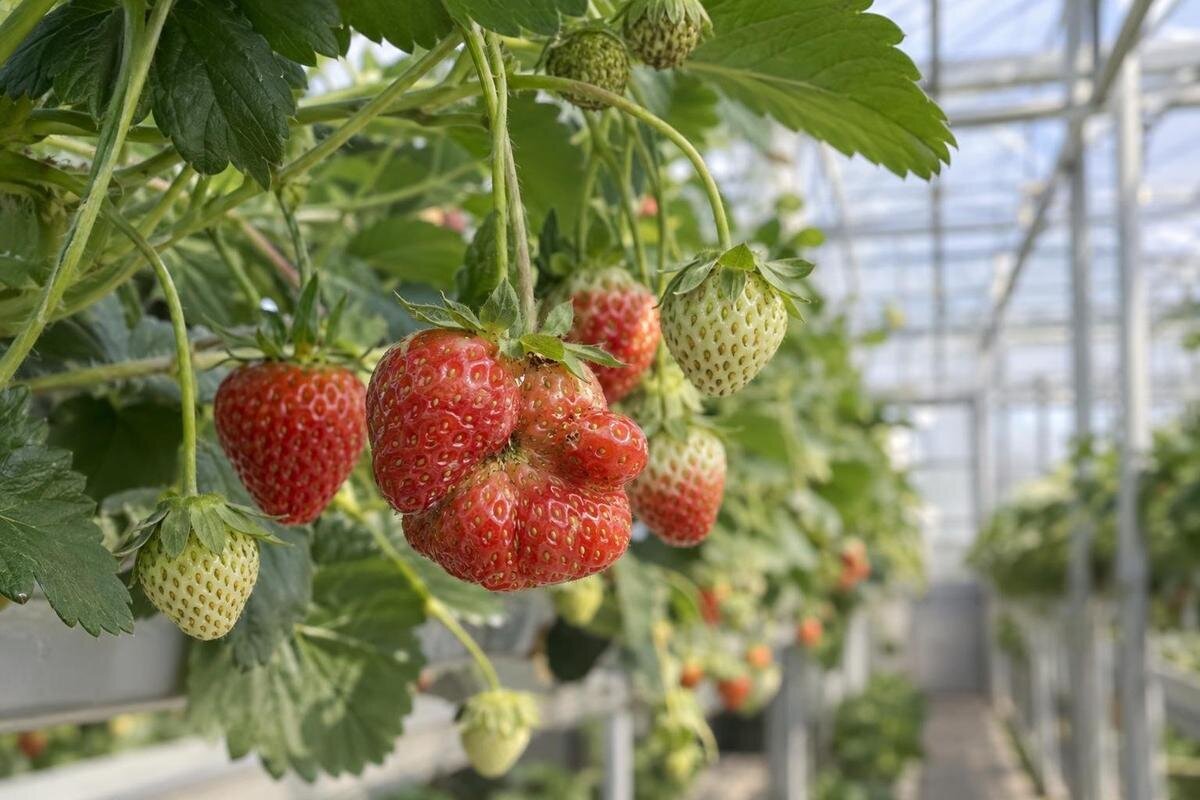
Strawberry growing under glass
Misshapen greenhouse strawberries can point to incomplete pollination, but lopsided fruit is not a diagnosis by itself. The shape develops over time, so useful clues include the distribution of achenes on the berry, the condition of flowers when they were open, and whether the same problem appears across a particular flowering period or greenhouse position. Cold, heat, uneven root moisture, flower injury and pests can overlap. Compare a group of berries and trace them back to the conditions during flowering rather than changing several growing conditions at once.

Why strawberries grow unevenly
A strawberry is an aggregate fruit. The red flesh is the enlarged receptacle, and the small specks across its surface are achenes, each a tiny dry fruit containing a seed. Pollen must reach the flower’s stigmas before fertilisation can happen; developing achenes then help stimulate growth in nearby receptacle tissue. If part of the flower does not develop normally, the adjoining flesh may remain smaller while the rest expands. Incomplete pollination can therefore make a berry lopsided or pinched rather than simply reducing its size evenly.
Not every uneven berry is a problem. Cultivars differ in outline, and berries in the same truss vary with their position and maturity; the first or largest fruits may not match later ones. Compare several ripe berries from the same cultivar and a similar part of the truss. A flat side or narrow tip is a clue worth checking, not a signature of one cause. Photograph the whole berry and a close view of its surface in consistent light, because shadows and viewing angles can make a natural indentation look like poor filling.
Patterns that can point to incomplete pollination
Poor pollination becomes more plausible when one area of the fruit is underfilled and the achenes over that area are fewer or visibly less developed than those elsewhere. The fruit may look flat on one side, uneven at the shoulders or pinched at the tip, or have an irregular outline. Look for the same pattern in several berries that formed from flowers open at about the same time; a shared pattern is more informative than one unusual specimen. Even then, cold injury, insects or damage to young fruit can interrupt growth in a similar patchy way, so treat the achene pattern as supporting evidence rather than proof.
Compare affected berries with well-shaped fruit from the same plant and at a similar ripeness. If the achenes appear fairly even around the surface but the receptacle has a scarred, sunken or one-sided area, investigate injury and local growing conditions as well as pollination. A poorly filled patch beside small achenes fits a pollination explanation, but does not rule out stress at bloom. Avoid relying on one online photograph: cultivar, berry stage and camera angle alter the apparent pattern. The most useful comparison is a set of labelled berries from one variety, examined at the same stage.
Inspect strawberry flowers during bloom
Ripe berries record conditions from earlier, when their flowers were open. On the next flush, check trusses while blooms are fully open and note whether flowers look intact, whether anthers appear normal, and whether insects visit. Visit more than once: a quiet moment does not establish that pollination is not happening. Strawberry flowers normally contain both male and female parts, and many are self-fertile, but pollen still has to reach the stigmas. Damaged, unopened or fading flowers are not a fair comparison with healthy open flowers; mark them separately in your notes.
Map flowers by plant and position: near the door, by the far wall, under dense foliage or at the end of a bench. If flower centres turn brown or black after a cold spell, frost injury is possible; a normal-looking bloom followed by uneven fruit makes pollination worth checking, though neither pattern is conclusive. If you are planning a growing layout, the catalogue includes a T-Shaped Orangery Greenhouse; consult its listed dimensions and access details to judge whether you can inspect the trusses you plan to grow. The shape name alone does not show how easy that will be.
Pollinator visits inside a greenhouse
Strawberries generally do not need a second variety beside them to set fruit: pollen can move within a flower or between flowers of the same cultivar. What matters is transfer, not a particular companion plant. In a greenhouse, observe insect activity at the blooms rather than assuming it from an open door; pollinators may visit one part of the crop more often than another. Dense foliage and closely packed pots can make flowers harder to reach. Air movement may also shake flowers, but still air alone does not diagnose a problem. Little visible activity is a clue, not proof that pollen was absent, while frequent visits do not guarantee every flower received enough.
For a small comparison on the next flush, label a few similar, newly open flowers and gently pass pollen across their centres with a clean, soft artist’s brush when the flowers are dry. Leave similar flowers untreated and compare fruit at harvest. This is only an indication because flowers and positions are never perfectly identical. Avoid damaging stigmas or petals, and do not treat hand pollination as a cure for heat or root stress. A Pyramid-type greenhouse is one catalogue format; its name does not tell you whether insects can reach crop rows, so check the actual opening and access details when comparing structures.

Temperature, dampness and ventilation at flowering
Temperature can disrupt fertilisation before any fruit is visible. A frost or cold snap may injure an open flower; unusually high heat can affect pollen and the period during which fertilisation can occur. A greenhouse can warm quickly in bright sunshine even when outdoor air still feels cool, while nights can stay cold. A forecast or a single midday reading can therefore mislead. Keep a minimum–maximum thermometer at flower height and note readings alongside flowering dates. No single temperature threshold diagnoses every variety or situation; the useful evidence is what the flowers experienced when they opened, not only conditions at harvest.
Air and moisture conditions are part of the same check, but humidity on its own does not prove poor pollination. Dense, stagnant growth, condensation or flowers that remain wet deserve noting, especially if they coincide with temperature extremes. Ventilation can help manage a greenhouse environment, but opening one vent does not guarantee uniform conditions throughout the crop. If reviewing models such as the aluminium greenhouse with built-in storage, check the actual specification for vent positions and growing space; the storage description alone says nothing about airflow. Record readings at plant height, not only near the roof or door.
Check watering, roots and plant balance
Misshapen fruit can also follow stress after pollination. Strawberries in pots, bags or troughs have a limited root volume, so drying out and then becoming saturated can interrupt steady development. Check moisture below the surface, drainage, root crowding and whether plants wilt during warm spells. Compare container-grown plants with any in a bed, or compare a pot near a water source with one farther down the line. If only one plant or container is affected, local root conditions are more plausible than a greenhouse-wide pollination problem, though that pattern alone does not prove the cause.
Nutrition is another possible influence, but fruit shape alone is poor evidence for a particular deficiency. Look for changes in leaf colour, new growth, flowering and overall vigour, then test the soil or growing medium before applying a substantial feed. Excess fertiliser is not a reliable fix for a misshapen berry and can upset plant balance. Plan access to containers and water points as part of the crop layout. The Bloomcabin Prestige Greenhouse with Metallic Base is a catalogue listing; use the exact product details and your site plan to work out whether the intended arrangement lets you reach and water each plant consistently.
Look for frost injury and feeding damage
Cold damage, insects and physical injury can imitate a pollination problem. After frost, the centre of an open strawberry flower may darken; fruit from an injured flower may fail to form or develop normally. Check for a group of affected flowers from the same cold night. On the berry, a scar, corky patch or puncture on one side makes injury to young tissue another possibility. Inspect buds, petals and flower stalks as well as ripe fruit. A surface mark is a clue, not proof of a particular pest or disease, so look for related signs elsewhere on the plant.
Capsid bugs and other sap-feeding insects can be among the causes of distorted strawberry growth, but a misshapen outline is not enough to identify one. Check young berries, buds, flower stalks and the undersides of leaves for insects or feeding signs. If damage is recurring, take a close photograph and seek a reliable local identification before choosing a control. Sample more than one area in a large growing space: the Spacious Greenhouse is listed in sizes from 506 to 753 sq ft, making it important to record where affected plants are located rather than rely on one plant near the entrance.
Compare fruit by flowering time and position
Look for a pattern in time and space. Mark the truss, plant and position for each affected berry, then note when the flowers in that group opened. Deformity across one flowering wave but not later ones can point towards an event during bloom, such as cold, heat or limited pollen transfer. A problem confined to one bench, edge or plant could instead reflect shade, local airflow, water delivery, root trouble or feeding damage. These are useful directions for inspection, not rules: several causes can occur together, and a greenhouse position changes more than one condition at once.
Compare like with like: the same cultivar, similar ripeness and similar position within the truss. Count how many berries are affected as well as photographing them; a lone irregular fruit is less informative than a repeated, location-specific pattern. If planning rows in a Classic aluminium greenhouse, the catalogue lists sizes from 40.6 to 302.3 sq ft. Use the selected dimensions to mark crop positions, then keep observations by row or zone rather than assuming one reading represents the whole space. The stated area is not evidence of a particular climate or crop performance.

Keep a record from bloom to harvest
Keep a compact log rather than relying on memory. For marked flowers, record the date they opened, the plant and location, minimum and maximum temperatures, unusual warm or cold spells, door or vent position, visible pollinator visits and any watering changes. A humidity reading is useful if available, but not essential. Photograph an open flower and later the fruit at comparable ripeness from the same angle; label images with the date and plant. The ripe berry may appear well after the decisive bloom, so notes made only at harvest cannot reconstruct exactly what happened.
Describe the light at each position rather than calling the whole greenhouse sunny or shaded: note morning sun, afternoon shade or changing shadows from nearby structures and foliage. A Lean-To Greenhouse, listed in sizes from 40 to 154 sq ft, still needs to be assessed at its actual site; the catalogue range does not show how much light reaches strawberry flowers there. This distinction is useful if one side repeatedly produces smaller or more irregular fruit. Keep observations for more than one flowering flush before changing several conditions at once.
Match the response to the evidence
Choose a response that fits the strongest evidence. If patchy achene development coincides with low pollinator activity, improve access where practical or hand-pollinate a small, labelled group. If fruit problems track a cold or hot flowering period, monitor and manage the flowering environment instead of assuming pollination alone is at fault. If the issue follows individual pots or plants, stabilise root-zone moisture and inspect the growing medium. If you see feeding signs, identify the cause before choosing a control. Make one manageable change at a time and assess the next flowers, because developing berries may reflect conditions from earlier in the season.
Repeated observations of inaccessible plants, difficult-to-manage hot spots or insufficient ventilation may justify reviewing the greenhouse itself; replacing it is not a treatment for deformed fruit. When comparing a Limited Edition aluminium greenhouse, check its exact dimensions and any ventilation information supplied, then assess them against the site and intended crop layout. The product name alone cannot establish suitability or performance. If one row or flower cohort is healthy while another is affected, test a local adjustment before redesigning the whole growing space.
Frequently asked questions
Why are greenhouse strawberries lopsided?
Part of the flower may not have developed evenly. Incomplete pollination is one possibility because developing achenes help nearby flesh grow, but frost, heat, feeding damage and root stress can also lead to irregular fruit. Check several ripe berries and trace them back to flowers that opened at a similar time.
Can strawberry flowers pollinate themselves?
Most strawberry cultivars are self-fertile, so a second cultivar is not normally needed for fruit to set. Pollen still has to reach the receptive parts of the flower, however. In a greenhouse, insect activity and conditions during bloom can affect how evenly that transfer happens.
How can I tell whether poor pollination is the cause?
Look for an underfilled patch that corresponds with fewer or less developed achenes, especially when several berries from one flowering period share the pattern. Check for cold injury, scars, insects and uneven moisture too. No fruit shape, by itself, confirms incomplete pollination.
Can heat or frost cause the same misshapen fruit?
Yes. Cold can damage open blossoms, while excessive heat can interfere with pollen and fruit set. Later root stress or feeding damage can affect fruit as well. Record conditions at flower height and compare them with the dates affected flowers opened, rather than relying on outdoor weather at harvest.
Should I hand-pollinate every flower?
No. First look for weak pollinator access or a consistent pattern linked to flowering time. To test whether pollen transfer may be limiting, gently brush a small, labelled group of newly open flowers and compare them with similar untreated flowers. The result is indicative, not a guarantee, because bloom conditions vary.
Incomplete pollination is a reasonable diagnosis when the underfilled part of a berry corresponds with poorly developed achenes and flowers from the same period had limited pollen transfer. But cold injury, heat, uneven root moisture, insects and local damage can create overlapping symptoms. Compare matched berries, trace them back to the conditions during flowering and record where they grew. If the pattern remains unclear, keep observing the next flush rather than forcing one cause from a single fruit.
