
A School Greenhouse for Classes and Holiday Care
School greenhouse planning
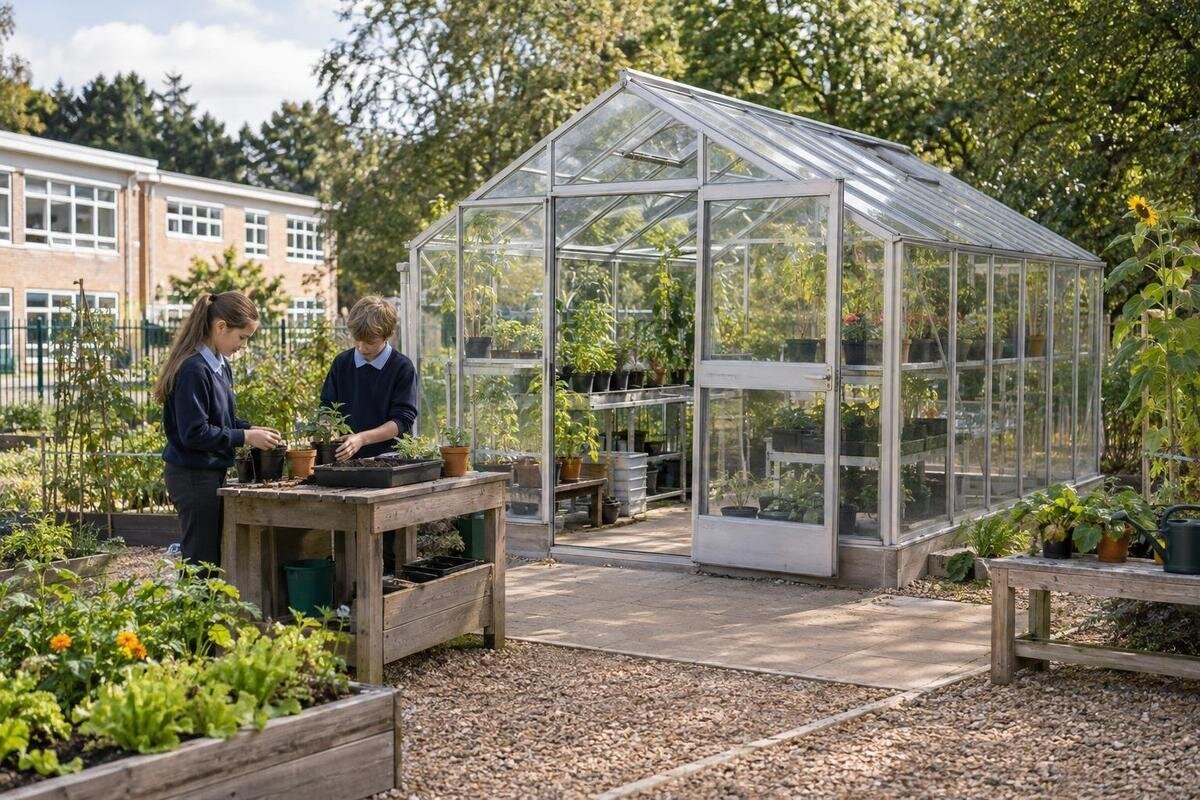
A school greenhouse can make plant science, measuring and food-growing practical, but a suitable structure alone will not make lessons run safely or keep plants alive through closures. Pupils need an organised route, clear supervision and activities matched to their age and timetable. Adults need to know who opens, checks and waters the space when the usual class is elsewhere. Plan teaching, safeguarding and year-round responsibility together, using the school’s own procedures before choosing a model.

Before choosing a model 1
Set learning aims and define the user group
Decide first whether the greenhouse is for timetabled lessons, a supervised gardening club or both; these uses can involve different pupils, staff and access arrangements. Identify the year groups, usual class size and how often each group will enter. Then choose a small number of learning aims, such as observing germination, recording growth, comparing growing conditions or taking part in food-growing. Decide whether pupils will handle soil and tools or mainly observe, since the preparation and oversight differ. Define what a successful session produces, perhaps a record or completed supervised task, rather than assuming every lesson ends in a harvest. This gives the project a teaching purpose and a realistic basis for planning.
Map a typical session with the teachers and support staff who will use the space. Include gathering the group, taking attendance, briefing pupils, practical work, cleaning up and returning equipment within the time available. If classes share the greenhouse, use a booking arrangement so one group does not arrive while another is still packing away. Name who decides whether a session can proceed when staffing, weather or maintenance prevents access. Staff and volunteers should take part only within agreed roles and the school’s safeguarding arrangements. A concise term plan, with a named owner and clear timings, is more useful than a long list of activities with no one responsible for delivering them.
Assess usable space for a teaching group
The area shown in a catalogue is not the same as safe pupil capacity. Work out usable space after marking benches, plant containers, circulation routes, entrance clearance, the adult’s teaching position and places to set down equipment. Use a dimensioned plan for the selected size, then plot the number of pupils and adults expected at one time. A demonstration, potting task and watering rotation use space differently, so test the busiest activity. The Prestige Greenhouse listing gives sizes from 40.6 to 302 ft², but that range cannot tell a school how many children fit safely. Ask for the drawing for the size under consideration and check it against the intended group and task.
Test the busiest moment, not an empty-room plan. Pupils may arrive with coats or materials, wait for instructions, move between stations and queue to clean up or return tools; a pinch point can undo an otherwise spacious layout. Mark door openings and routes on the plan, then rehearse entry and exit with staff before the first class. Include room for pupils who use mobility aids, need a seated task or require extra space, following the school’s access arrangements. If the whole group can enter only when split, write that into the timetable and supervision plan. Do not count on pupils waiting outside without a named adult and an agreed activity.
Before choosing a model 2
Choose a site with a controlled, accessible route
Place the greenhouse where staff can reach it without losing control of the class transition. Map the route from the teaching area, including gates, steps, uneven surfaces, vehicle movements, shared paths and points where an adult’s view of the group may be interrupted. Consult the school’s premises and accessibility leads about the route in wet weather and pupils’ individual access arrangements; the nearest location is not automatically the easiest to use. A predictable arrival point helps staff account for pupils before entering and after leaving. Consider how deliveries and maintenance visits will reach the site, and separate them from lessons wherever the school layout allows.
Measure the proposed plot and approaches, not just a product’s headline area. A Lean-To Greenhouse listing, for example, shows sizes from 40 to 154 ft²; those figures do not establish compatibility with a particular school building, boundary, gate or teaching route. If a chosen form needs to sit alongside existing structures, request a dimensioned site plan and confirm the relevant details with the supplier and premises team. Also decide where staff will supervise a queue and where soil, compost or watering equipment will be handled. A greenhouse that is difficult to reach under the school’s access plan can become a burden even if its listed size appears to fit the plot.
Apply the school’s safeguarding procedures to every session
Before pupils use the greenhouse, ask the designated safeguarding lead (DSL), or the school’s equivalent, to review access, adult roles and the arrangements for reporting concerns. Teaching and premises staff should assess the practical activity and agree supervision through the school’s planning procedures. Use the school’s current safeguarding policy and the guidance applicable to its setting, including relevant local authority or trust procedures. Do not assume a universal adult-to-pupil ratio: staffing needs to reflect pupils’ ages and needs, the task and the layout. Record who leads the session, checks attendance and responds to an incident. Keep practical safety measures in the activity risk assessment, and use educational visit procedures where applicable. Review the arrangements when staffing, access or activities change.
Control access outside lessons as deliberately as during them. Decide who holds keys, whether pupils may enter only with an authorised adult, and how staff will prevent unplanned visits; make the rule easy for staff to find. Manage volunteers, visitors and contractors under the school’s established approval, sign-in, supervision and suitability-check procedures, rather than giving informal access because someone is helping with plants. Keep entry and exit within the responsible adult’s view where possible, and avoid routines that leave a pupil out of sight. Follow school rules for communication, photographs and reporting. A notice on the door can explain a boundary, but it does not replace supervision or the school’s safeguarding process.

Before choosing a model 3
Assess tools, materials and greenhouse hazards
Write an activity-specific risk assessment for practical work. Consider glazing and doors, wet surfaces, trailing hoses, soil or compost spills, sharp tools, heavy pots, sun and high temperatures, as well as any product used to feed or protect plants. Choose tasks and equipment under school procedures and in light of pupils’ ages and needs. Adults should control how tools are issued, collected and stored. Keep chemicals and sharp items in an access-controlled place, use products only as permitted by school policy and their instructions, and explain what pupils should do if glass is damaged or a spill occurs. Children should not be expected to carry out repairs or handle unknown substances.
Storage should reduce clutter without creating a new access risk. Keep routine teaching materials easy for an authorised adult to issue, while sharp tools, chemicals and maintenance equipment remain secured according to school rules. A product page for a greenhouse with built-in storage identifies storage as part of that model, but does not specify how much it holds, whether it locks or whether it is suitable for hazardous items. Confirm the arrangement with the supplier and premises lead, then decide separately what must stay in a staff-controlled cupboard. Keep routes and exits clear instead of using every spare corner for pots and supplies. Agree how equipment is put away at the end of each session.
Arrange workstations for supervised group work
Lay out stations so the adult can observe the class and pupils can work without crossing unnecessarily. Keep a clear teaching position and simple circulation route; avoid placing tall crops, shelving or temporary equipment where they hide a pupil or block an exit. Divide soil preparation, watering, labelling and measuring into stations only if the group can move between them without unsafe queues. Use trays or labelled containers to keep small tools together, and set a predictable place for work in progress. If the greenhouse cannot accommodate the full group with clear sightlines, plan supervised rotations and an agreed activity for pupils working elsewhere.
Ask for internal drawings as well as an area figure when comparing options. The Classic Greenhouse range is listed from 40.6 to 302.3 ft²; the area does not show how many workstations, bench positions or accessible spaces a particular plan will provide. Mark adults, pupil groups, door openings, storage and routes to each station on the drawing, then ask the school’s accessibility or premises lead to review it. Check that the teacher can address the group without blocking movement, and that a pupil who needs a seated or quieter task still has a meaningful role. Confirm these details from the selected model’s documentation, not its category name.
Before choosing a model 4
Choose crops around lessons and school holidays
Choose crops around the teaching calendar and the care staff can provide. Record when seeds are sown, when pupils need to observe or tend them, and whether harvesting or maintenance falls during a weekend, half-term or summer closure. A succession of small, clearly assigned tasks may be easier to manage than a crowded planting plan in which every pot needs frequent attention. Select plants and activities after checking possible irritants, thorns, toxicity, allergies and food-handling arrangements with the school’s responsible staff. Follow school rules before pupils taste anything. If a harvest is part of a lesson, decide in advance who prepares it and how ingredients and hygiene will be managed.
When comparing a model such as the Limited Edition greenhouse, request details of ventilation, shading options, water access and the operating tasks relevant to the proposed crops. Discuss that information with the school garden lead before finalising the planting calendar. For each crop, identify the observations pupils will make and the care an adult must provide between lessons; these are separate commitments. Avoid sowing more trays than staff can manage simply because space is available. Keep a fallback activity for poor growth or a missed sowing, such as comparing earlier records or examining saved seed samples, so the lesson retains its purpose when plants do not follow the intended timetable. Review the crop plan before each new term.
Assign term-time care to named adults
Separate learning jobs from essential adult care. Pupils can sow, water or record measurements as supervised activities, but an adult still needs to check whether tasks were completed and respond when a plant, door or piece of equipment needs attention. List recurring checks, such as watering, looking for visible damage, putting tools away and leaving routes clear. State who completes each one and when. The routine will depend on the design, plants and season, so use the selected operating information rather than assuming a greenhouse looks after itself. Keep a simple record where staff can see outstanding jobs and pass them on at a change of class or shift.
Name a primary lead and an authorised deputy who knows the routine. Put key arrangements, handover information and escalation steps where relevant staff can find them, not only in one person’s diary. Grounds staff and teaching staff should agree their respective tasks so a missed lesson does not also mean a missed care check. When considering the Pyramid-type greenhouse, build the rota around the proposed planting and the operating information supplied for the selected model. Trial the routine once the space is in use and note how long checks actually take. A useful handover records what was done, what remains outstanding and who will act, rather than simply saying that the greenhouse was visited. Check that the deputy can cover the routine during an absence.

Before choosing a model 5
Plan holiday cover before each closure
Mark every closure period on the care calendar, including weekends, half-terms, school holidays and staff training days when normal routines stop. Name the adult responsible for each check and a backup, and confirm that they are authorised to enter and know the site’s sign-in, alarm and lone-working arrangements. Agree what a check involves and how it is recorded: whether plants need attention, doors and visible glazing appear intact, routes are clear, and problems are reported to the appropriate school contact. Never leave holiday care as “someone will pop in”. If a pupil activity is offered during a closure, treat it as organised provision and apply the school’s safeguarding and supervision procedures.
Plan for the named cover person to be unavailable and for conditions to change. Record who receives an urgent report about damage or a failed watering arrangement, and what the school’s premises procedure requires; do not expect a volunteer to make repairs. If considering the Spacious Greenhouse, listed from 506 to 753 ft², map the proposed planted areas and care tasks against the closure rota before committing. Decide which crops will remain, which can be harvested or cleared beforehand, and which sowings should wait until pupils return. Give the cover adult an up-to-date plant list and clear care instructions. If reliable authorised cover cannot be arranged, reduce or postpone planting rather than relying on pupils to enter at short notice.
Confirm approvals and responsibilities before ordering
Bring the people who control the land, buildings, budget and pupil access into the decision before ordering. Ask the school, responsible trust, local authority or landowner which permissions and internal approvals apply, and consult the relevant planning authority or a qualified professional where required; requirements depend on the site and proposed work. Have suitable building or installation professionals assess the site, foundation and any proposed water or electrical services. A product page cannot establish structural, electrical, fire or public-building compliance. Include delivery and installation access, future maintenance, cleaning, repair responsibility and the ongoing cost of the growing programme in the project plan, not only the purchase decision.
For a proposal involving a T-shaped orangery greenhouse, request a dimensioned layout showing entrances and the position of planned benches, storage and crops. Use it to review how staff would supervise each working area and how pupils would move between them. Obtain the exact model specification, operating information and installation scope, with clear responsibility for any work excluded from the supplier’s proposal. Ask the premises and safeguarding leads to review their respective parts of the plan, and have relevant professionals confirm technical matters. At handover, assign an owner, document key control and keep operating and maintenance information accessible to staff. Set a review date after the first term of use so the school can adjust arrangements in light of actual lessons and care routines.
Frequently asked questions
How many pupils can use a school greenhouse at once?
There is no class capacity that can be read from a product’s listed area alone. Count pupils and adults, then test the planned activity against usable work space, clear routes, supervision and the school’s access arrangements. If the whole group cannot work safely inside, plan supervised rotations.
Is there a set staff-to-pupil ratio for greenhouse lessons?
Do not assume a universal ratio for greenhouse lessons. The staff responsible for planning the activity should agree supervision under the school’s procedures, taking account of pupils’ ages and needs, the task, layout and available staff. Consult the safeguarding lead about safeguarding arrangements and record supervision in the relevant activity planning and risk assessment.
Who should care for the greenhouse during school holidays?
Name an adult who is authorised to access the site, and arrange a backup who knows the routine. Set out check dates, tasks and how to report a problem. Pupils should not be expected to provide informal holiday care; any organised activity during a closure needs the school’s usual safeguarding arrangements.
What should the safeguarding lead review?
Review who can access the greenhouse, how pupils travel to and from it, where adults supervise, how attendance is checked and how visitors or volunteers are managed. Agree the reporting route for concerns and incidents, and revisit the plan if the layout, staffing or activity changes.
Does a listed greenhouse size confirm that it is suitable for a school?
No. A listed area does not establish class capacity, accessibility, permissions or compliance with requirements for a particular school site. Ask the school’s estates team and relevant professionals to review the proposed layout, site work, installation details and ongoing responsibilities.
A school greenhouse works when it fits the school day as well as the plot. Set the pupil activities and safeguarding arrangements first, size the usable working space around those routines, and assign adults for term-time and holiday checks. Review the plan each term as staffing, crops or activities change. That gives pupils a clear place to learn while ensuring plants, access and responsibility are not left to chance.
