
How Large Should a Greenhouse Rainwater Tank Be?
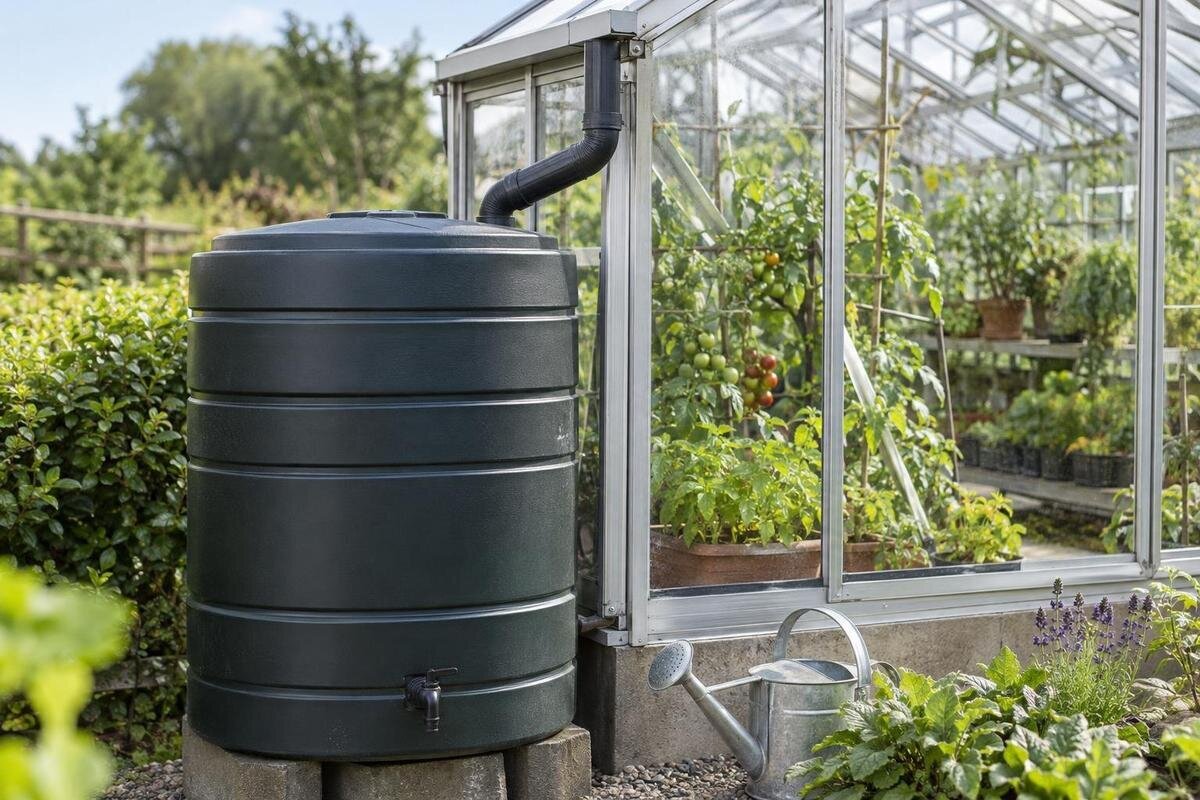
Greenhouse rainwater planning
The right rainwater tank size depends on two separate balances: what the greenhouse roof can collect and how much usable water the plants need between useful rainfalls. Work in litres, measure the connected roof area, use rainfall data by month and estimate demand during the busiest part of the growing season. Then choose the dry-spell reserve you want and plan where surplus water will go when the tank is full.

Tank-sizing checks 1
The two calculations behind tank size
Rainwater sizing combines collection and storage, which are related but not interchangeable. For a given rainfall period, estimate collection as connected roof catchment area in square metres multiplied by rainfall in millimetres; the result is litres before losses. One millimetre falling on one square metre is one litre. A collection factor represents the share of that potential runoff that actually reaches the tank. If you lack measured system data, state the factor as an assumption and test a cautious alternative rather than treating any percentage as a universal greenhouse value.
Storage answers a different question: how much water must be available to meet demand during a rainless spell? A roof may collect plenty across a year yet send much of it to overflow during wet periods. Conversely, a large tank cannot correct a continuing gap between total collection and total use. Check both the seasonal supply against demand and the reserve needed between useful rain events. The right capacity depends on the reliability you want, such as occasional supplementary watering or a defined period without rain, rather than on one headline greenhouse measurement.
Measure the roof area that drains into the tank
Use the roof’s horizontal projection as a first estimate of catchment area, rather than adding together the sloping surface areas of its roof planes. Rainfall is measured against ground area; for a straightforward pitched roof, its plan area is the relevant starting point. Divide a more complex roof into sections and include only those whose water will be routed to the same tank. Do not count side panels, doors or any roof section that drains elsewhere. Overhangs and unusual profiles may affect the area feeding a gutter, so use a dimensioned roof plan and trace the drainage route instead of estimating from a photograph.
A greenhouse size listing is not automatically a rainwater catchment figure. The aluminium limited-edition greenhouse range is listed in sizes from 40.6 to 302 ft², but those figures alone do not state how much roof is connected to a tank. For the exact model and size you are considering, check the roof plan, which edges discharge to a gutter, where the outlets sit and whether a suitable connection is specified. Count only roof sections that will actually feed the tank; exclude any unconnected section or area that sends water in another direction.
Tank-sizing checks 2
Use rainfall data by month
Annual rainfall totals are poor sizing inputs on their own because storage depends on when rain falls. Find monthly records from a nearby weather station or use a gauge at the greenhouse, ideally alongside records covering several years. Use the months in which you intend to water from the tank. The same annual total can produce very different results if rain arrives steadily in one case and in a few clustered events in another. For each month, multiply rainfall in millimetres by connected roof area and the chosen collection factor; this gives an estimate you can compare directly with demand in litres.
Monthly averages can still conceal a dry fortnight, while one unusually wet month can make collection look more dependable than it is. If you have a gauge on site, log rainfall with tank levels and any top-ups, but do not treat one season as a complete climate record. For a more cautious plan, test a drier-than-average period as well as the average. This helps show when you might need a backup supply or a reduced watering plan without pretending to predict the exact weather. Keep the rainfall period and demand period aligned when comparing the two.
Keep roof collection separate from crop demand
Plant demand is the outflow to size against, not the greenhouse footprint. List the beds, grow bags, pots and containers that the tank will serve; their rooting volume and growing conditions can make their watering requirements differ. Demand also changes as crops establish, fruit, finish or are replaced, and as the weather changes how quickly growing areas dry. One annual average may therefore understate the peak period when the tank is most useful. Include only water supplied from this tank. If another source covers some watering, keep its volume separate so you do not overstate rainwater use.
Do not turn a greenhouse’s overall dimensions into a crop-water estimate. The T-shaped orangery greenhouse is a named layout, not a figure for planted area or daily demand. Sketch the beds, borders and containers you intend to water, then note which ones share the rainwater supply. Measure actual use with a marked watering can or meter over representative weeks, especially during the period when demand is highest. Record any other draw, such as wash-down or seedling care, separately if it will use the same tank. That gives you a demand estimate grounded in your planting plan rather than an assumed rate for every square metre.

Tank-sizing checks 3
Choose the dry-spell reserve you want
Decide how many days without useful rain you want the tank to cover. A practical starting calculation is usable litres required = measured peak daily use × days to cover. Use demand from a representative busy period, not a quiet month when fewer plants need water. If you expect rain during the chosen interval, show that as a separate scenario; for a reserve intended to work through a dry spell, do not rely on rain arriving at a convenient time. Add any contingency volume deliberately and only once, rather than hiding an extra margin in several parts of the calculation.
Check usable capacity as well as the number printed for a tank’s total volume. Some water may sit below the outlet or be unavailable for the way you plan to draw it, so the nominal figure may not equal the litres you can use. Ask the supplier for the usable volume and any stated limitations, then compare that with your reserve calculation. A product description such as greenhouse with built-in storage should not be read as a rainwater-tank capacity claim. Treat greenhouse storage, rainwater storage and the amount available at the outlet as separate specifications unless the product details clearly say otherwise.
Check the monthly water balance
A simple month-by-month ledger gives an initial view of whether collection can meet seasonal demand. Start with the usable water already stored, add estimated collection, then subtract the month’s expected use. Limit the closing balance to the tank’s usable capacity and record any unmet demand separately. This monthly calculation is only an approximation: it can underestimate both overflow and shortages because it does not show whether rain arrived before or after watering. To test a proposed tank size more closely, repeat the balance in date order using daily rainfall and watering records. At each step, record water that exceeds capacity as overflow and demand that cannot be met as a shortfall. This shows whether wet-weather surplus is actually available for a later dry spell.
For example, suppose the measured connected roof area is 12 m² and rainfall over a chosen period is 40 mm. The Prestige greenhouse range is listed across sizes from 40.6 to 302 ft², so select the exact variant and use its measured roof catchment rather than the range itself. If, purely for illustration, you apply a provisional collection factor of 0.8, the estimate is 12 × 40 × 0.8 = 384 litres. If measured peak use is 15 litres a day, 14 days would require 210 usable litres. These assumed figures explain the arithmetic; they are not typical rainfall, plant demand or product performance. Actual yield also depends on when the rain arrives and how much water the tank can hold at that point.
Tank-sizing checks 4
Confirm gutters, inlets and overflow
Before choosing capacity, confirm that rain can reach the tank at all. Trace the roof edges and outlets on the exact greenhouse model, and check whether the intended sections discharge into a channel that can be connected to storage. Do not assume that gutters or a compatible connection are included or available; check current product information or ask the supplier. A filter or first-flush device may affect the volume captured and needs to be included in your estimate where relevant. The pyramid-type greenhouse name indicates a form, but does not establish the outlet arrangement or how each roof section drains.
Plan for water to leave safely when the tank is full. A tank sized for average use will still overflow during sufficiently wet periods, so identify a route that will not undermine a base, create a slippery path or send water towards a building. Consider where the overflow goes as well as where the inlet arrives, and keep the route accessible for inspection. If the drainage path, likely flow or connection to an existing system is unclear, have a competent drainage professional assess it. Do not assume that increasing tank capacity removes the need for an overflow plan.
Plan the tank position and access
Choose a position that works with both the inlet and the point where you will draw water, while leaving clear access around the tank. Measure its actual height, width and depth, including the space needed to open the lid, clean it and inspect connections. Check that it will not block a greenhouse door, vents, paths or access to beds. If you are considering more than one tank, confirm how the units are meant to connect and how the usable capacity is stated; do not assume that separate nominal volumes automatically behave as one accessible reservoir.
Allow for the full tank’s weight and use a base or installation method approved for the tank. Do not put that load on a greenhouse frame unless the manufacturer explicitly says it is designed for it; ask a qualified professional if the ground or support is uncertain. The spacious greenhouse range is listed from 506 to 753 ft², but that information does not establish how much clear ground remains for a separate tank. Measure the available space around the chosen greenhouse as well as the tank footprint, and include room for the overflow route and maintenance access.

Tank-sizing checks 5
Consider water quality and routine maintenance
Roof runoff can carry leaves, dust and other material into storage, so include debris control and cleaning in the plan. Check what screening or filtration the tank supplier recommends for the roof and intended use, and make sure the inlet and tank can be inspected. Remove accumulated debris and keep gutters, filters and overflow points clear according to the relevant product guidance. The classic aluminium greenhouse listing identifies a greenhouse model, but its name alone does not confirm the roof-covering material or whether collected runoff is suitable for every intended crop. Check the roof-surface specifications rather than inferring them from the frame description.
Decide what the water will be used for before relying on it. For plant watering, follow any guidance relating to the roof surface, tank and crops, particularly where the water will be used on edible produce. Do not assume that clear-looking rainwater is suitable for drinking or another use beyond irrigation. If you plan to use it for anything that requires a particular water quality, seek appropriate advice and treatment guidance rather than relying on appearance. Regular inspection also helps reveal a blocked inlet, sediment build-up or a leak before those problems distort your estimate of how much water is available.
Turn the estimate into a purchase specification
Before settling on a tank, write down the connected roof area, the rainfall figures used, the collection factor, measured peak demand and the number of dry days you want to cover. Add the required usable capacity, the tank’s physical dimensions, inlet position and overflow destination. For a lean-to greenhouse, map the roof edges and actual discharge route rather than assuming where water goes from the product name. Ask for the information needed to check the exact greenhouse, any guttering and the proposed tank together; the product category alone does not establish that a particular collection arrangement is compatible.
Use the balance to decide what needs changing if the numbers do not work. If seasonal collection is consistently below demand, a bigger tank cannot create more rainwater; consider another supply or a lower dependence on stored rain. If collection is ample but the tank spills before a later dry spell, extra usable capacity may help only if there is space and a safe overflow route. If the reserve is short, compare the extra capacity needed with the site limits and the level of backup you are willing to accept. Keep records through the first growing season and adjust the assumptions to match the tank’s actual behaviour.
Frequently asked questions
How do I calculate how much rain a greenhouse roof can collect?
Multiply the connected horizontal roof area in square metres by rainfall in millimetres. The result is litres before losses, because 1 mm over 1 m² equals 1 litre. Apply a clearly stated collection factor if some water will not reach the tank.
How many days of watering should the tank cover?
There is no universal number. Decide how long you want to manage without useful rain, then multiply that period by measured peak-season daily use. A longer reserve improves independence only if the roof can supply and the site can accommodate the extra storage.
Is annual rainfall enough to choose a tank size?
No. Annual totals hide when the rain falls. Compare monthly collection with demand and examine dry spells within the growing season; rain that arrives after plants need water cannot cover an earlier shortage.
Can I use the greenhouse floor area as the roof catchment area?
Not without checking. Estimate the roof’s horizontal projection, then count only the sections whose runoff is routed to the tank. Floor area, roof shape and connected gutter area are not interchangeable measurements.
Does the tank’s stated capacity equal the amount I can use?
Not always. Check whether the stated figure is nominal or usable capacity, and whether any water remains below the outlet or is kept as a reserve. Compare your required litres with the usable figure supplied for the tank.
A well-sized tank matches the roof’s seasonal supply to the usable water your plants need through the dry interval you want to cover. Monthly records help distinguish a collection shortfall from a tank that is simply too small to hold wet-weather surplus. When the calculations also fit the actual drainage route, tank dimensions and available space, the capacity is based on the greenhouse and garden you will really use.
