
Why Small Greenhouse Cucumbers Turn Yellow
Greenhouse crop care
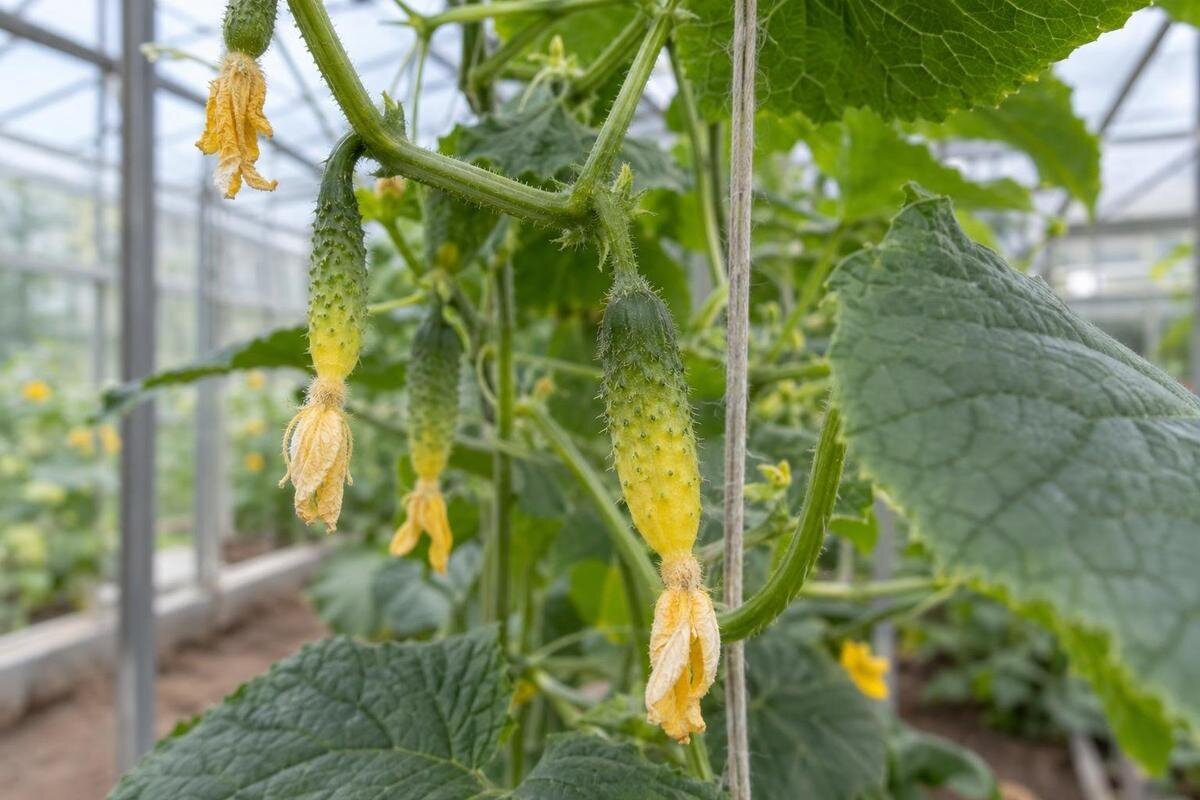
Small greenhouse cucumbers that turn yellow and stop growing are often failed young fruit, but colour alone cannot identify the cause. Check whether the cucumber ever began to lengthen, which variety you are growing, and whether the vine is carrying several fruits. Pollination needs, crop load, changing temperatures, light and root-zone moisture all matter; the pattern across the plant is more informative than one yellow fruit.

What yellowing on a tiny cucumber can mean
On a cucumber vine, the female flower is the one with a small swelling behind its petals; that swelling is the young fruit. After fruit set, it should begin to lengthen. If it remains almost the same size, turns yellow and then shrivels or drops, it has probably aborted. This can happen soon after flowering, when the plant stops developing that particular cucumber. Note whether the change begins at the flower end or affects the whole fruit, whether it is still firm, and how long after flowering it happened. Those details help separate a failed young fruit from one that was already approaching harvest.
Yellow colour alone cannot explain why a fruit changed. Some varieties are meant to ripen to pale or yellow, while a cucumber normally harvested green can also yellow if left on the plant too long. Check the variety’s expected size and colour, then see whether the fruit is still lengthening over the next few days. A tiny fruit that stalls and wrinkles is a different pattern from one that grew to near harvest size. When comparing photographs, include the same fruit and enough of the surrounding stem to recognise it again. Record its approximate length as well as its colour: this keeps the question of whether it is growing separate from the question of whether its appearance is normal for the variety. A close-up photograph can help you track change, but one image cannot confirm the cause.
Check the cultivar before blaming pollination
Many varieties sold for greenhouse growing are parthenocarpic: they can develop fruit without pollination. For these cucumbers, a lack of bees is not a good explanation for failed fruit set, and hand-pollinating every flower is not a routine fix. Other varieties do need pollen. Some produce mostly female flowers and may need a compatible pollen-producing plant, unless they are also parthenocarpic. The seed packet or supplier’s growing instructions are the best place to check which type you have; flower numbers alone do not reliably tell you. Look for both the variety name and its pollination instructions rather than relying on a general description such as ‘greenhouse cucumber’. If you have lost the packet, check your order details or the plant label. When asking the supplier for help, make clear whether you need to establish the variety’s requirements or investigate why a known variety is failing.
If your variety requires pollination, a female flower may start to swell but fail to develop when pollen has not reached it. Few pollinators in a closed greenhouse, or poor conditions for flower and pollen development, can contribute. Compare several flowers: if almost every young fruit fails, check the cultivar’s pollination needs and whether insects can reach the flowers. If some cucumbers develop normally while others stall, pollination may not be the only factor. Follow variety-specific advice before trying to hand-pollinate.
A heavy fruit load can slow new cucumbers
A cucumber vine has a limited supply of light, water and energy to support its leaves and developing fruit. When several cucumbers are growing at once, the plant may fail to sustain some newer ones, particularly if older fruit has been left on the vine or growth has slowed. Check how many fruits are developing on each plant and harvest those that have reached the size recommended for the variety. Keeping up with harvesting can reduce competition; removing healthy leaves or flowers indiscriminately can create more stress rather than solve it.
Notice whether fruit loss follows a period of heavy cropping, and whether it is happening on one vine or throughout the greenhouse. Count developing fruit on each vine separately rather than treating the whole crop as one plant. This lets you compare a heavily laden vine with one carrying fewer cucumbers, without assuming that every plant has the same demands. A clear aisle and accessible beds make it easier to spot and harvest fruit before it becomes overmature. If comparing larger growing spaces, the Spacious Greenhouse range is listed at 506–753 sq ft. Use the individual layout information to assess beds and paths, including how you would reach fruit at the back of a bed. Consider the space occupied by mature plants, not just the room around newly planted seedlings. More floor area does not, by itself, reduce the fruit load on a particular plant.
Temperature and light affect fruit development
A greenhouse can shield cucumbers from some outdoor changes, but it can still become too hot in strong sun or cool considerably at night. Stress from high or low temperatures, or from sharp swings, can interrupt flower development and fruit growth. In varieties that need pollination, temperature stress can also make successful fruit set less likely. Dull conditions and limited light slow growth, leaving the plant less able to support the same number of developing cucumbers. These factors often act alongside crop load rather than as a single, obvious cause.
Use a minimum–maximum thermometer near the cucumber canopy and note readings when new fruit starts to fail. A reading elsewhere in the greenhouse may not reflect conditions where the vine is growing. Keep the thermometer’s position consistent so that your notes compare the same part of the crop, and record whether the day was bright or dull. This gives you a clearer account than describing the greenhouse simply as warm. If you are comparing a Lean-To Greenhouse, its listed size range is 40–154 sq ft. Assess the proposed site, available daylight and actual product details rather than assuming the format guarantees a particular temperature. On a layout sketch, mark where you intend to grow cucumbers and where nearby structures or planting cast shade. This makes the daylight question specific to the intended bed. Record conditions over time instead of reacting to one reading.

Uneven root-zone moisture can stress the plant
Cucumbers can struggle when the soil or growing medium repeatedly swings from very dry to saturated. A dry root zone can limit growth, while waterlogged roots may not function well. Check beneath the surface rather than judging moisture from the top layer alone, and look for blocked drainage or an irrigation line that is not reaching every plant. Containers can dry out differently from a greenhouse bed, so use the condition of the medium and the plant to guide checks instead of relying on a fixed watering schedule.
If the medium is dry, water consistently enough to moisten the root zone; if it stays wet, investigate drainage before adding more. Note whether yellow fruit appears after a change in watering, a warm spell or a period of dull weather. When checking several containers, note which are dry or wet rather than assuming they all need the same amount of water. With irrigation, check the delivery point at each plant as well as whether the system is running. For a separate layout decision, the aluminium greenhouse with built-in storage listings span 59.4–302 sq ft. Check the chosen configuration’s growing area and access to water when planning; a storage feature does not regulate soil moisture. Think through where watering equipment will be kept and how it will reach the beds without blocking the aisle. The practical benefit to assess is convenient access for routine care, not a promised change in fruit set.
Check roots and feeding before adding fertiliser
A few yellow young fruits do not, on their own, point to a nutrient deficiency. Nutrient problems are more likely to affect the plant’s wider growth, so look at the leaves, stems and overall vigour as well as the cucumbers. Root damage, restricted container space, poor drainage or a growing medium that has been exhausted can also interfere with uptake. At the other extreme, excessive feeding can harm roots, and too much nitrogen may encourage leafy growth at the expense of fruit. Avoid changing several feeds at once.
Review what the plant has already received and follow the instructions for any fertiliser or growing medium you use. Write down the product, dilution and application dates before deciding that the plant needs more. Include any feed supplied through irrigation so that it is not overlooked when reviewing the routine. If the problem affects the whole plant, consider a soil or growing-medium test rather than guessing from fruit colour. Root conditions depend on the bed or container, not just the greenhouse footprint: the Limited Edition aluminium greenhouse range is listed from 40.6 to 302 sq ft, but those overall areas do not describe the root space available to an individual plant. When drawing up a planting plan, show the actual beds or containers within that footprint, alongside the paths. This helps separate the space allocated to roots from the floor area needed for access and other uses.
Look for a pattern across the vine and greenhouse
Compare affected fruit with healthy fruit on the same plant and with cucumbers elsewhere. One or two stalled ovaries among steadily growing fruit may be an isolated failure; repeated loss across one vine suggests checking its load, light and root conditions. If plants in one part of the greenhouse are affected while others are not, note their position in relation to doors, vents, shade and nearby plants. A local pattern can point towards an environmental difference, though it does not identify the cause by itself.
Inspect leaves, stems and fruit for additional signs such as wilting, distortion, spots, soft patches, mould, sticky residue or insects underneath leaves. These clues may indicate a wider pest or disease problem, but they are not a diagnosis on their own. Note whether each sign occurs on the same plant as the yellow fruit; symptoms on a neighbouring plant should not automatically be treated as part of the same problem. Mark affected plants on a simple sketch so that you can distinguish a cluster in one area from scattered failures. A greenhouse can vary from one position to another; the pyramid-type greenhouse listings cover 60–203 sq ft. For layout comparisons, use the actual product details to identify ventilation openings and intended planting positions. A model name or floor area cannot establish conditions at each plant, so relate your observations to the growing area itself.
Recording fruit growth and changes in care
For each affected fruit, note the variety, when the flower opened, whether the fruit began to lengthen, and when yellowing appeared. Add the number of other fruits on that vine, recent harvests, watering and feeding changes, and minimum and maximum temperatures. A photograph of the whole plant shows its general condition; a closer image of the fruit and its attachment helps you compare later. Taken from the same angle over time, photographs can show whether the fruit is growing, stalling or simply changing colour as it matures.
Change one clear factor at a time where possible, then watch what happens to later flowers and fruit. If you alter watering, ventilation and feeding together, it becomes much harder to learn what mattered. Date any adjustment and distinguish fruit that was already yellow from fruit that began developing afterwards. Judge the response by those later fruits rather than expecting a previously stalled cucumber to provide the answer. When planning a new crop layout, the T-shaped orangery greenhouse is one catalogue format; use the specific product dimensions to map beds, paths and access rather than inferring the interior from its shape. Include a position from which you could photograph the same vine repeatedly without moving pots or disturbing foliage. The aim is to make observation and routine care practical, not to assume that a different structure will correct a plant problem.

Review ventilation and the greenhouse layout
On warm, bright days a closed greenhouse can overheat, while poor air movement can make conditions around dense foliage harder to manage. Use temperature readings at plant height to decide whether ventilation needs attention, and check that vents and doors are not obstructed. Ventilation can help manage excess heat, but it will not correct a pollination requirement, an overloaded vine or uneven watering. Avoid making a large adjustment on the basis of one yellow fruit; look for a repeated pattern and consider the weather at the time it began.
When comparing a greenhouse for growing, consider whether you can reach vents, inspect plants and harvest without disturbing the whole crop. The Prestige Greenhouse range is listed from 40.6 to 302 sq ft; listed area helps compare floor-space options, but it does not specify the opening positions or conditions at a particular plant. Check the details for the exact configuration and think through how beds, paths and ventilation will work together. On your plan, mark each opening and the route you would use to reach its controls. Allow for the position of supports and mature foliage when considering access, rather than assessing an empty greenhouse alone. In an existing greenhouse, identify whether the difficulty is an obstructed opening, awkward access or a crowded planting arrangement. Keeping those questions separate makes the layout review more useful than attributing every temperature problem to the structure’s size.
When to seek advice about repeated fruit loss
An occasional aborted fruit does not necessarily mean the whole crop is in trouble. If the vine otherwise looks healthy and new cucumbers are developing, keep harvesting at the variety’s recommended stage and watch whether the next fruit grows. Repeated failure across several plants, or fruit loss alongside wilting, leaf distortion, extensive spotting or rot, deserves a closer look. Those wider symptoms can have different causes, so avoid treating them all as a watering or feeding problem without checking the rest of the plant.
For persistent or widespread symptoms, take your notes and photographs to a horticultural adviser, plant diagnostic service or seed supplier. Summarise when the problem began, how many plants are affected and whether any fruit is developing normally. Include the cultivar name and describe the growing medium, watering and feeding routine, rather than presenting yellowing as proof of one cause. If greenhouse layout makes temperature checks or routine care difficult, compare practical options separately from the plant diagnosis. The Classic aluminium greenhouse range is listed from 40.6 to 302.3 sq ft; use the individual specification to assess usable growing space and openings, rather than treating floor area as a promise of a steadier climate. Keep a plant-care question distinct from a purchasing question: the first concerns the pattern of failed fruit, while the second concerns whether a proposed layout gives you suitable access to manage the crop.
Frequently asked questions
Do all greenhouse cucumbers need pollinating?
No. Many greenhouse varieties are parthenocarpic, which means they can form fruit without pollination. Other varieties need pollen to reach the female flowers. Check the seed packet or ask the supplier before hand-pollinating; the absence of bees is not automatically the cause of yellow fruit.
How can I tell fruit abortion from an overripe cucumber?
An aborted fruit usually stays tiny, stops lengthening, then yellows and may shrivel or drop. An overripe cucumber has generally grown much further before changing colour. Check the variety’s expected harvest colour and compare the fruit’s size over several days.
Should I feed the plant when its tiny cucumbers turn yellow?
Not on that sign alone. A few yellow ovaries do not prove a nutrient deficiency. Look at the leaves and overall growth, review recent feeding, and check the growing medium and roots. If a feed is needed, follow its label rather than increasing the dose by guesswork.
Can watering more often prevent yellow fruit?
Only if the root zone has been drying out. Check moisture below the surface and make sure excess water can drain; saturated roots can also stress a plant. Aim for steadier moisture, adjusting checks for the weather and whether the cucumber is growing in a container or a bed.
When should I seek a more specific diagnosis?
Ask a horticultural adviser, plant diagnostic service or seed supplier if many fruits keep failing, several plants are affected, or yellowing comes with wilting, leaf distortion, spots or soft, mouldy fruit. Share the cultivar name, photographs and notes on watering and greenhouse temperatures.
Treat yellowing as a clue that a young cucumber has stalled, not as a diagnosis in itself. Start by checking the variety’s pollination requirements and whether the fruit was still growing, then compare crop load, temperature, light and root-zone moisture with the plant’s overall condition. A consistent record makes it easier to spot a recurring pattern and choose a proportionate response, without applying fertiliser or changing the greenhouse on the strength of one fruit.
