
Can Water Barrels Keep a Greenhouse Warm Overnight?
Greenhouse heating
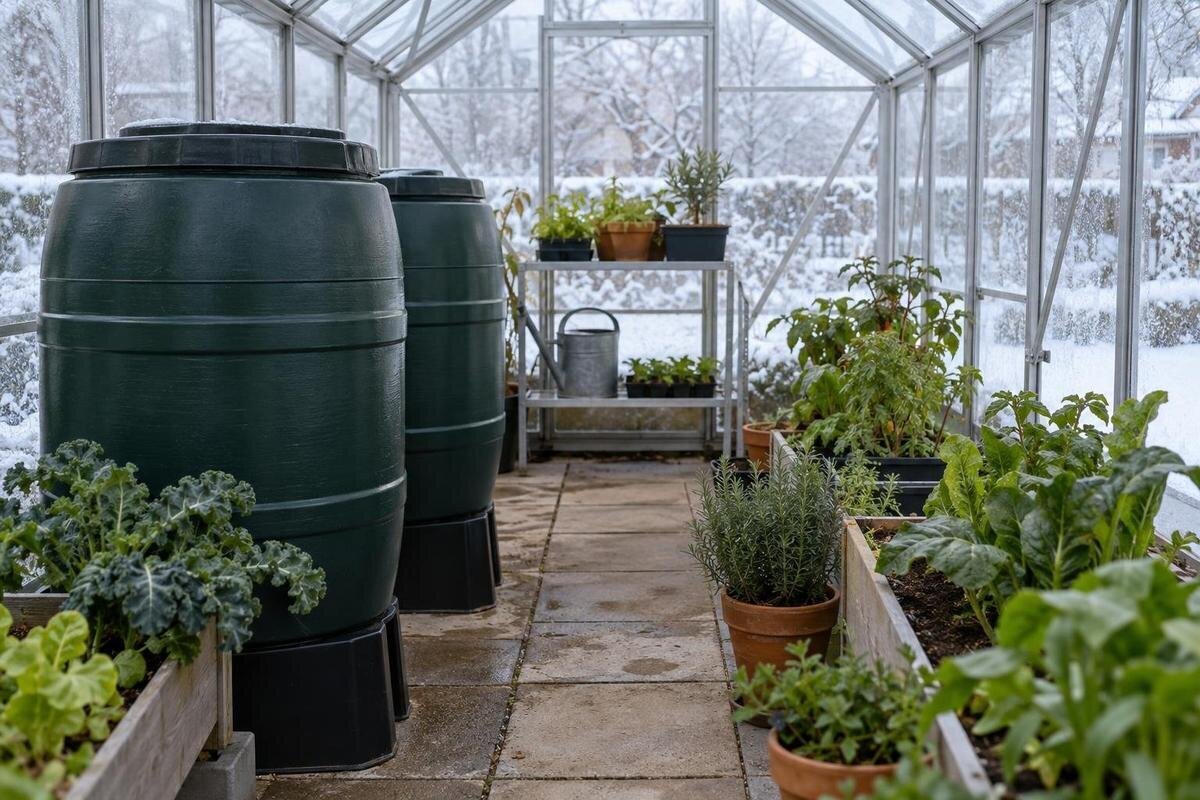
Water barrels can take in daytime heat and release some of it after sunset, so they may slow a greenhouse’s temperature drop. Whether that keeps plants above a useful minimum is another question: the water’s temperature change sets a finite energy limit, while glazing, air leakage, wind and night length determine how quickly heat escapes. A heat-capacity estimate, paired with temperature records, is a better guide than choosing barrel volume by guesswork.

What to check before buying 1
What water barrels can contribute overnight
Water acts as passive thermal mass: it can take in some heat while the greenhouse is warmer and release some as its surroundings cool. After sunset, a barrel can transfer heat to cooler air and surrounding surfaces. The rate depends on the temperature differences, the container and the exposed surface area; a barrel cannot hold a chosen air temperature by itself. As the water approaches the temperature of its surroundings, heat transfer slows. Its effect is usually to slow cooling or soften a temperature swing, particularly nearby. Plants at the other end may experience different conditions, so a warm reading beside the barrel does not prove the whole growing space is protected.
So, can barrels keep a greenhouse warm overnight? They can contribute, but the result depends on how much heat the water absorbed, how quickly the structure loses heat and the minimum temperature the plants need. A bright afternoon followed by a mild night is a different test from a dull day followed by frost. Even a large volume may be undercharged before sunset. Treat barrels as a possible buffer, not assured frost protection. Set a threshold for the plants and their growth stage using reliable horticultural guidance, then judge the measured temperatures against it.
Calculate the heat stored in water
One litre of water has a mass close to one kilogram, and water’s specific heat capacity is about 4.18 kJ per kg per °C. Estimate the energy released as: stored energy (kWh) ≈ volume (litres) × water-temperature fall (°C) × 4.18 ÷ 3,600. The divisor converts kilojoules into kilowatt-hours. For example, 200 litres cooling by 10°C gives about 2.32 kWh; the same volume cooling by 5°C gives about 1.16 kWh. This assumes the full volume experiences that temperature fall. Use measured temperatures rather than an assumed daytime peak.
Those figures describe heat in the water, not the temperature the greenhouse will reach. The water may not warm evenly, so a reading near the surface may not represent the centre. More importantly, not all the theoretical amount may be useful while keeping the air above a chosen minimum: transfer slows as the water approaches the surrounding air temperature. The Limited Edition greenhouse with built-in storage listing covers 59.4–302 ft², but its area range does not reveal heat loss or whether the selected base can support filled barrels. Check those details separately.
What to check before buying 2
Compare stored heat with night-time losses
Water capacity only makes sense beside overnight demand. For a simplified comparison, let H be the whole-greenhouse heat-loss coefficient in watts per kelvin (W/K), including heat passing through panels, frames and floor, as well as air leakage. If you have a defensible value for H, estimated heat loss is: energy (kWh) ≈ H × average inside–outside temperature difference (°C) × hours ÷ 1,000. A temperature difference of one degree Celsius equals one kelvin for this purpose. The formula assumes a steady average difference; it does not predict short-term temperature swings or give you H from floor area alone.
Take a deliberately hypothetical example, not a greenhouse specification: H = 50 W/K, an average 10°C indoor–outdoor difference and a 12-hour night imply about 6 kWh of heat loss. Two hundred litres cooling from 18°C to 8°C contain at most 2.32 kWh over that fall. That is under 40% of the simplified demand, before allowing for slower heat transfer or the point at which the water is no longer warm enough to maintain the chosen air temperature. The Prestige greenhouse listing spans 40.6–302 ft², so one assumed H cannot represent every size in that range.
How much daytime heat reaches the water?
Barrels can only release heat they received or absorbed earlier. Direct winter sunlight can warm the water through its container; heat can also arrive from greenhouse air and surfaces while those are warmer than the water. A barrel shaded by plants or shelving may charge poorly even if the air feels warm for a short time. Water responds more slowly than air, so a midday temperature peak is not a measure of the barrel’s stored energy. Record the water temperature before sunrise, during the warmest part of the day and after sunset. A small daily rise means little heat is available to release overnight.
Volume sets the theoretical capacity per degree, but the rate of charging and release also depends on the container’s exposed surface, construction, surrounding airflow and temperature difference. A large volume may have ample theoretical capacity yet warm slowly if little heat reaches it; water near the container walls may also be at a different temperature from water in the centre. The Spacious Greenhouse listing covers 506–753 ft², a published floor-area range rather than a solar-gain rating. For any chosen size, compare the recorded water-temperature rise with the space’s overnight losses; floor area alone cannot produce a reliable barrel count.

What to check before buying 3
What makes a greenhouse lose heat?
Night-time demand depends on how heat leaves: panels, frames, doors, joints, the floor and unintended air exchange all matter. The larger the inside–outside temperature difference, the faster heat generally escapes; wind can make draughts and leakage more consequential. A door or vent opened during the night changes the result, so record its position. Permanently blocking designed ventilation to retain heat can cause condensation and undermine the space’s intended air exchange. Look for obvious gaps, but follow the greenhouse maker’s guidance before changing seals or ventilation.
Product area is useful for comparing space, but it is not a heat-loss value. The Classic greenhouse listing gives a range of 40.6–302.3 ft²; the selected variant’s exposed surface, panel details, floor and leakage still affect demand. Ask the supplier for documented thermal information for the chosen configuration if available, rather than borrowing a figure from another size. If there is no reliable H, treat the worked example only as a scale check and use logged conditions to judge performance. A precise-looking calculation based on an invented coefficient would be misleading.
Barrel volume, position and floor loading
Choose volume by litres and usable temperature change, not by a rule such as one barrel per square metre. Doubling the water at the same temperature fall roughly doubles its theoretical capacity, but it does not automatically double overnight warming: the extra water may not heat fully, and its heat may reach only one part of the greenhouse. Place containers where they can receive useful daytime warmth without shading plants or blocking doors, vents, paths or routine work. Several spread-out barrels may produce a different local pattern from one cluster, so check the effect with sensors rather than assuming heat will spread evenly.
Water is heavy: 200 litres adds roughly 200 kg before the barrel itself, concentrated over its footprint. Check the selected greenhouse’s base, floor and supports with the supplier or a qualified installer before loading them; do not assume a bench or staging can carry that weight. Spills can create slip hazards and unwanted dampness, while open water may add humidity and condensation. The Lean-To Greenhouse listing spans 40–154 ft². For the chosen model, check that the actual plan leaves room for barrels, plants and safe access.
What to check before buying 4
Measure temperatures over several nights
Use a temperature logger or min/max thermometers in more than one place. Put an air sensor in the plants’ growing zone, away from direct sun, the barrel, cold glazing and a heater’s direct output; add another at a colder edge or low point if plants occupy it. Record water temperature with an appropriate thermometer, and outdoor air in a shaded, representative position. Keep sensors in the same places each night and check their stated accuracy if readings are close to a plant threshold. Logging at roughly 10–15-minute intervals can show when cooling begins and how long low temperatures last; a daily minimum alone cannot show that pattern.
Test for several nights, including one after a reasonably sunny day and one after a duller day. Note the starting water temperature, outside minimum, wind, cloud, door and vent positions, and any heater operation. Where practical, record a baseline before adding barrels, then compare it with nights under broadly similar outdoor conditions; exact matches are rare, so do not attribute every change to the barrels. The Classic Accoya / Limited Edition greenhouse listing spans 40.6–302 ft². Record the actual selected size and configuration rather than treating a product-family name as a temperature specification.
Compare readings with plant requirements
Before looking at a graph, write down the acceptable overnight minimum for the plants that matter most. It varies by species, acclimatisation and growth stage, so use reputable crop-specific horticultural guidance rather than a generic greenhouse target. Check that the sensor represents the relevant part of the plant: a central reading at bench height may not represent trays near the floor or pots beside perimeter glazing. In a space with distinct growing areas, add sensors where the plants actually sit and include the coldest likely position. This makes “warmer” a useful comparison against your own growing requirements.
Compare each plant-zone minimum with its chosen threshold, then check how long temperatures stayed below it and how quickly the space recovered after sunrise. Cooling water shows that stored heat is being released, but does not by itself show how much warmer the plants remain: a steady air temperature could mean that this heat is offsetting ongoing losses. Use the baseline and outdoor records to assess the difference. If the water barely warms by day, adding volume alone may not solve the charging problem. In a layout such as the T-shaped orangery greenhouse, test separate growing positions rather than assuming one central reading applies throughout. Repeat the check in the colder conditions that matter to the plants you intend to keep there.

What to check before buying 5
What to check when comparing greenhouse models
When choosing or adapting a greenhouse, compare the exact variant and intended growing area, not just a model-family name or headline floor area. Check the usable floor plan, door and vent positions, where barrels could receive sunlight, and whether they would obstruct access or planting space. Ask for documented panel or whole-structure heat-loss information for the chosen configuration if it is available, as well as guidance on a suitable base for filled containers. Do not infer insulation, thermal performance or load capacity from a catalogue photograph, product title or floor-area range.
The Pyramid-type greenhouse listing covers 60–203 ft²; like any published area range, it helps compare footprint but cannot prescribe a quantity of water. For the exact version, establish its exposed area, panel details, openings and site exposure, then relate those to measured overnight conditions. If your greenhouse is already installed, map usable floor space and cold points before buying barrels. If you are selecting a new one, resolve barrel placement, support and access questions before filling them. Choose around growing needs first, then use thermal evidence to decide whether water alone can meet the temperature requirement.
When barrels are not enough
If records show that plant-zone temperatures fall below the required minimum, barrels have not met the job under those conditions. Options include protecting a smaller area, moving the most vulnerable plants, reducing avoidable heat loss without compromising designed ventilation, or using an appropriately specified heater. Do not size equipment from water capacity alone: check documented heat output, electrical input or fuel use, control method and operating conditions for the heater you are considering. Ask a suitably qualified professional about installation, electrical or combustion questions; these checks depend on the particular equipment and structure.
For a running-cost estimate, multiply documented consumption in kWh by your current tariff per kWh. Multiplying a heater’s rated electrical input by its running hours is only a simple full-output estimate; thermostat cycling and conditions change actual use. Compare the heater’s documentation with your own bill rather than assuming a universal tariff or saving. Monitor the same plant-zone locations while it operates: a control setting does not prove every bench stays above the target. Barrels may provide a measured share of heat, but plan for the cold nights your plants must actually tolerate.
Frequently asked questions
Will water barrels prevent frost in an unheated greenhouse?
Not reliably. Barrels may slow cooling or raise temperatures near them after a sunny day, but a dull day, a long cold night or substantial heat loss can outweigh the stored warmth. Set a minimum for the plants you are protecting and check it with sensors in their growing area. If that minimum must be maintained, plan for a suitable backup.
How much heat is in 200 litres of water?
Use litres × temperature fall in °C × 4.18 ÷ 3,600 to estimate kWh. If 200 litres cool by 10°C, that is about 2.32 kWh in the water. It is an upper limit on the stored heat, not a promise that all of it will reach the plants before the greenhouse cools.
Does the colour of a barrel matter?
A dark exterior can absorb more incoming sunlight than a pale one when it is directly exposed, but colour cannot make up for shade or a short, cloudy day. Measure the water temperature at dusk and overnight to see whether it is actually charging and releasing heat.
Where should I put the barrels and thermometers?
Place barrels where they can receive useful daytime warmth without obstructing plants, access or ventilation. Put an air sensor at plant level, out of direct sun and away from the barrel, glazing and any heater. Add a sensor in a colder growing area if needed, and keep sensor positions consistent between tests.
Can barrels replace a greenhouse heater?
They are passive heat storage, so their capacity and release rate are limited. If monitored temperatures fall below the minimum required by your plants, assess heater options using documented output and operating conditions. Ask a suitably qualified professional about installation or electrical and combustion questions.
A barrel is useful only to the extent that it warms during the day and releases heat before the greenhouse falls below the temperature your plants need. Calculate the water’s theoretical capacity, compare it with plausible night-time losses, then check what happens in the actual growing areas over several nights. If those records show that passive storage is not enough, treat it as a contribution to a wider heating plan rather than relying on it as the sole protection.
