
White Deposits on Greenhouse Soil: Salts or Something Else?
Greenhouse growing guide
A white deposit on greenhouse soil can prompt an immediate urge to wash it away or stop feeding. Either response may be unhelpful if the material has not been identified. Minerals left by irrigation, soluble fertiliser residues, pale particles already in the growing medium and fine fungal growth can all look white when dry. The useful first step is to distinguish what is visible at the surface from what is happening around the roots. This guide covers visual clues, simple checks and suitable water and compost tests, then explains how to use the results before changing irrigation, feeding or the bed.

Identifying white deposits on greenhouse soil
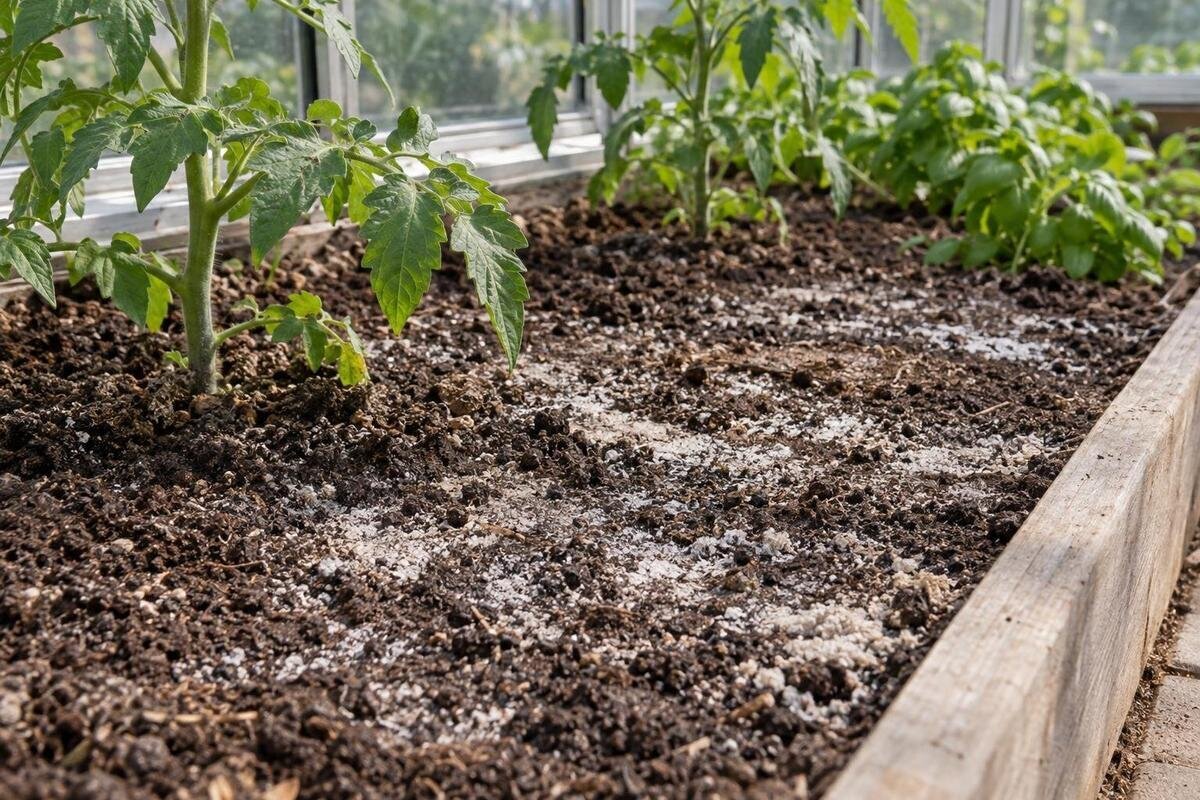
A white patch on greenhouse soil is not proof of salt build-up. It could be minerals left as irrigation water evaporates, fertiliser salts carried towards the surface, pale particles in the compost, or fungal growth on organic matter. Dry deposits can resemble one another, especially after the surface has dried. The visible layer may not reflect conditions deeper in the root zone: a crust can be local while the rest of the bed tests normally, and dissolved salts can be present around roots without an obvious white layer. The same patch may contain more than one material, such as organic growth over mineral residue. Colour alone cannot show whether a crop is at risk.
Record where the deposit appears and how it feels before disturbing it: a hard, brittle skin, loose powder or fine threads are different clues, not conclusive tests. Note whether it follows a bed edge, dripper or splash zone, whether it returns after watering, and which plants are nearby. Photograph it and keep any collected surface material separate from a root-zone sample; never taste an unknown deposit. If the patch varies across the bed, mark the affected area rather than mixing it into a general sample. When planning permanent beds in a larger structure such as the Spacious Greenhouse range, leave access to each bed edge. You should be able to inspect and sample the soil without standing on it or reaching through a crop.
How salts build up in covered beds
Soluble ions enter a covered bed with fertiliser, compost and irrigation water. As water is taken up by plants or evaporates at the surface, the ions do not evaporate with it. Over time, some can concentrate near the surface or at edges where moisture repeatedly dries. A visible deposit may therefore reflect several inputs, not just a recent feed. Greenhouse beds receive little direct rainfall, so outdoor weather cannot be assumed to wash residues down or out. This helps explain why a crust can recur in a sheltered bed even when the garden outside is wet. Uneven watering may leave only a few dry-down points marked, particularly around a repeatedly wetted emitter.
Keep a short record of feed products and label rates, dates, compost additions, irrigation sources and recent watering before changing the routine. A high dose is one possible source, but ordinary inputs can accumulate if they are not balanced by crop uptake and suitable drainage. Leaf-edge scorch, weak growth or wilting in moist compost may accompany salinity, yet each symptom has other possible causes. Keep separate records for beds that receive different feeds or water. When comparing sizes in the Classic aluminium greenhouse range, plan the growing area alongside the paths and drainage arrangements. Decide where excess irrigation water will go before fixing beds in place; the footprint alone does not establish whether the ground beneath a bed drains adequately.
Hard water can leave mineral residue
Hard water can leave a chalky or crystalline mark after droplets evaporate, especially where water repeatedly splashes or runs over the same patch. This is mineral residue, but it is not the same diagnosis as excessive fertiliser salts in the root zone. Hardness describes the calcium and magnesium content of water; alkalinity describes its capacity to resist changes in pH, often because of bicarbonates. The measures can be related in some supplies, but they are not interchangeable. Kettle scale or a white mark on a pot can suggest that water leaves minerals behind, but neither tells you how the greenhouse compost will test.
Test the actual irrigation source rather than relying on appearance. If you use tap water and stored rainwater, sample them separately; the collection surface and storage can affect the water that reaches the bed. Water EC, hardness and alkalinity answer different questions, so choose a test that reports the measure needed for your crop or ask a laboratory to interpret it. When considering a Lean-To Greenhouse, include the route from each water source to the beds in your layout. Clearly labelled outlets or watering cans help you keep supplies separate and record which one was used, especially when switching between tap water and rainwater.
White surface growth may be fungal
Fungi can produce fine white threads over compost, bark or other organic particles, while mineral deposits tend to look powdery, crystalline or crust-like. A hand lens may reveal a web of hyphae rather than grains, although a mixed patch can contain both organic growth and residue. Surface fungi often use decaying organic matter; their presence by itself does not establish disease in the crop. Green films are more commonly associated with algae, so a white surface should not automatically be labelled as algae either. Texture is a first clue, not a reliable basis for treatment.
Check the moisture pattern and growing medium before applying anything. A persistently wet surface, fine organic material and limited air movement can favour visible fungal growth, whereas a hard mineral skin may follow repeated drying. Do not spray fungicide, add lime or scrape deeply on the strength of colour alone; those actions can affect the crop or change the substrate without addressing the cause. If containers are part of your plan for a model in the limited-edition aluminium greenhouse range, allow room to inspect pots and their saucers. Tightly packed pots can conceal standing water or a recurring patch, making it harder to distinguish a problem in one container from a pattern across the growing area.

Examine a small sample away from the bed
A small solubility check can help distinguish a mineral-looking deposit from fibrous growth, but it cannot identify a particular salt. Put a pinch of dry material in a clean, clear container with a little distilled or deionised water, stir gently and observe whether it disperses, dissolves, floats or remains as fibres. A readily soluble fraction is consistent with some mineral or fertiliser residues; material that stays fibrous may be organic. Carbonate-rich residue may not dissolve readily in plain water, and compost particles can complicate the result. Treat this as a clue, not a substitute for a proper water or substrate test.
Use a sample taken away from live stems and roots, and do not return it to the bed. Avoid vinegar, bleach or strong household cleaners as identification tests: a reaction is not a reliable crop-safety result, and chemicals can contaminate a sample. Compare the deposit with a clean pinch of unused compost if available; pale sand, perlite or other amendments may be visible without having formed at the surface. Keep photographs and label samples by bed and date. In a layout for a T-Shaped Orangery Greenhouse, allow space for a small, washable work surface if you intend to examine samples inside. Keep it separate from feed mixing and potting so spilled material does not confuse later checks.
Test the irrigation water separately
Start with the water because it can be tested separately and may be the common input across several beds. Collect it from the outlet or tank actually used for irrigation, in the container and manner specified by the testing service; do not sample from a dirty watering can. If supplies are mixed, test each source before blending. Electrical conductivity (EC) indicates the combined conductivity of dissolved ions, while hardness and alkalinity describe different properties. A water pH reading alone cannot tell you whether the supply carries a high salt load or may influence growing-medium pH over time.
Ask for crop-relevant interpretation, particularly if you use a well, borehole, tank or seasonal source. A supplier’s water report can provide useful background, but it may not represent stored or blended irrigation water in your greenhouse. If the supply passes through a household water softener, note that and check the irrigation-water result: softened water is not automatically low in dissolved ions or suitable for every crop. Record the date and source so later results can be compared like with like. A home meter can show trends when used as instructed, but it does not identify the ions responsible. Do not make treatment changes from an unexplained reading.
Sample the growing medium, not just the crust
Test the growing medium separately from the water and the visible deposit. For an affected bed, follow the laboratory’s sampling instructions and take small portions from several representative spots at the depth where most roots are active. If the question is root-zone salinity, avoid mixing the white surface layer into that sample. Sample an unaffected bed separately where comparison would help, and keep containers or grow bags distinct from in-ground soil. A handful from the most visibly crusted point can exaggerate a local patch, while one random handful can miss a problem elsewhere.
Ask the laboratory which test suits the medium and crop, or use a kit whose instructions specify the extraction method. Compost, potting mix and mineral soil may not give directly comparable results when different amounts of water or different extraction methods are used. Label each sample with the bed, crop, depth, irrigation source and recent feeding history; record any recent heavy watering or feed as well. For a mixed growing system in a pyramid-type greenhouse, mark beds, pots and grow bags separately on your plan. Assigning each area a simple reference makes it easier to match a laboratory result to the right medium, rather than treating the whole greenhouse as a single sample.
Read pH and electrical conductivity correctly
pH and EC answer different questions. pH indicates whether a solution or growing medium is acidic or alkaline; it is not a measure of how much soluble salt is present. EC reflects the combined conductivity of dissolved ions, so a high result can support a salinity concern but cannot show whether the ions came from feed, compost or irrigation water, or which nutrients are present. A normal pH does not rule out high salts, and a high pH alone does not prove that the white surface is carbonate. Interpret both results in relation to the crop and the test method.
Do not compare an unlabelled meter result with a threshold intended for a different extraction method or crop. Use crop-specific guidance or ask a horticultural laboratory to decide whether the numbers are meaningful for the plants in the bed. A nutrient test may be needed if the concern is a particular element; EC cannot diagnose a deficiency or excess of one nutrient. Keep meter instructions, calibration records and sampling equipment together. If considering the greenhouse range with built-in storage, check the storage conditions and usable space against the equipment manufacturer's requirements. Built-in storage is worth assessing for this purpose, but its presence alone does not establish that sensitive test equipment can be kept there.

Choose a remedy only when the results support it
Choose a response from the paired results, not the crust alone. If irrigation water has high dissolved salts, repeated flushing with the same water may add more. If the water is suitable but a root-zone test shows elevated EC, review recent feeds, compost inputs, irrigation pattern and drainage using crop-specific advice. Where salinity is confirmed, leaching may be appropriate only if the bed drains freely, suitable low-salt water is available and the resulting runoff can leave the growing area safely. Waterlogging the bed or returning concentrated drainage towards the roots can prolong the problem.
If tests do not show high root-zone EC, do not flush or replace soil just because the surface is white. For confirmed surface growth, address the conditions that favour it and remove only material that can be lifted without disturbing roots. Mineral residue can be wiped or skimmed after a sample has been saved, but may return if its source remains. Avoid blind acidification, extra fertiliser, lime or fungicide. If results conflict, repeat the relevant test using the specified method or ask a horticultural laboratory before making a large change.
Reduce the chance of deposits returning
Prevention depends on the source identified by testing. Use feed at a crop-appropriate rate and stage, and record the product, dose and date so additions do not overlap. Check compost information where available; do not assume that any material labelled compost is low in soluble salts or nutrients. Water evenly enough to reach the root zone without routinely leaving the surface saturated, and make sure excess water is not trapped in a tray or returned to the bed. When planning a growing system for the Prestige Greenhouse range, consider how you will maintain it between crops. Removable containers offer a different cleaning and renewal routine from permanent beds, so allow space to lift pots out and handle spent growing medium without obstructing the entrance.
Retest if a persistent deposit returns, after a meaningful change of water source or feeding regime, or when crop symptoms warrant investigation. Use the same sampling and extraction method so that results can be compared, and keep water tests, substrate results and observations together. A thin mineral mark that does not recur and is not accompanied by concerning crop changes may need observation rather than immediate treatment. Repeat deposits, by contrast, are a reason to check inputs and root-zone conditions. The goal is not a perfectly bare surface; it is a growing medium and water programme suited to the crop.
Frequently asked questions
Does every white crust mean I have used too much fertiliser?
No. Mineral residue from irrigation water, salts from compost or fertiliser, pale particles in the growing medium and surface fungal growth can all look white. A crust cannot show which source is responsible or whether the root zone has excess salts.
Can I identify hard-water residue just by looking at it?
Not reliably. A chalky mark may be left by water as it evaporates, but it can resemble fertiliser residue or other minerals. Test the irrigation water and the growing medium separately; hardness and alkalinity tests provide different information.
Will a pH test confirm salt build-up?
No. pH measures acidity or alkalinity, whereas electrical conductivity (EC) indicates the combined conductivity of dissolved ions. EC does not identify which ions are present, so interpret it using the crop and the test method.
Should I scrape off the crust straight away?
Photograph it and save a small sample first. Removing a shallow layer may clear a surface deposit, but it will not correct the cause if salts are still accumulating. Avoid digging deeply or disturbing roots before you know what you are dealing with.
Is white mould on compost always a plant disease?
No. Fine fungal threads may be growing on decomposing organic matter, and their presence alone does not establish that the crop is diseased. Check the surface and plants for other signs, and do not apply fungicide based on colour alone.
A pale crust is a reason to investigate inputs, not a verdict about the soil. The most useful diagnosis combines a separate sample of the deposit, a test of the irrigation water and a properly collected root-zone result. If measurements point to excess dissolved salts, address the source and drainage conditions; if they do not, avoid drastic flushing or replacing soil on sight. Consistent observations and comparable test methods help show whether a change has improved conditions or simply moved the deposit. A spotless surface is not the aim: a stable growing medium suited to the crop is.
