
Buying a Wood-Burning Sauna: Heater, Flue and Site Planning
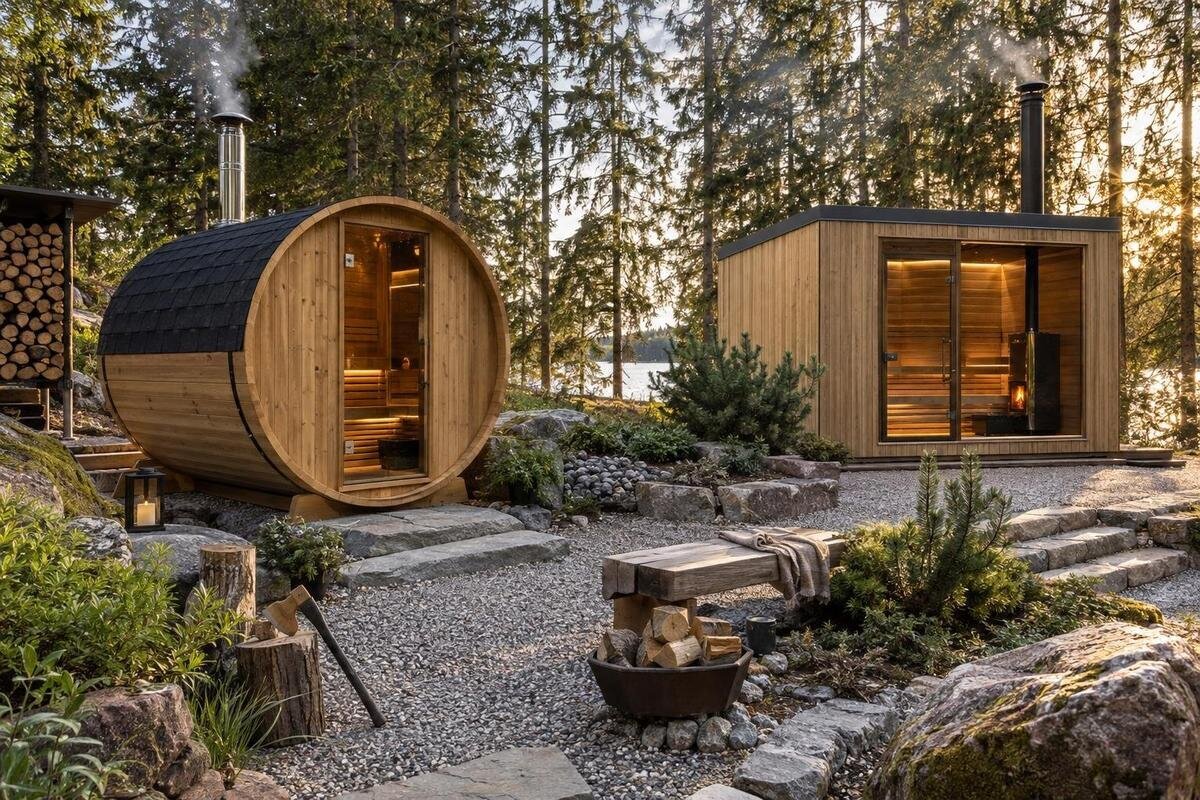
Sauna buying guide
Buying a wood-burning sauna means planning more than a cabin and a stove. The sauna’s internal volume, the specific heater, its approved flue system and the intended site all affect one another. A preferred location may not suit the flue route, while a heater that is not approved for the sauna is not a safe shortcut. Work through the three decisions together, then compare complete, documented setups before placing an order.
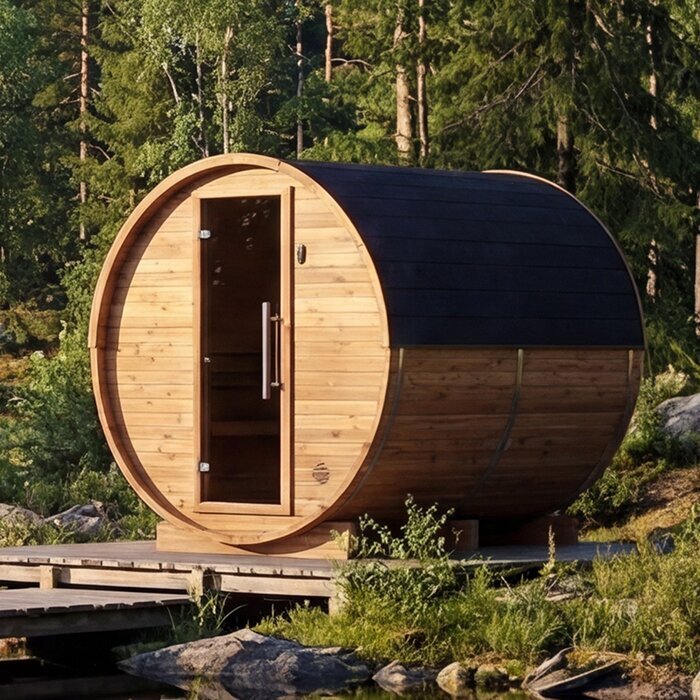
Choose the sauna and heater as one system
Decide at the outset that wood is the intended fuel, and make that clear in every enquiry. Treat the sauna, heater and flue as one specification. A stove’s nominal output is useful only if it suits the sauna’s design and can be paired with an approved flue arrangement. Check that the sauna manufacturer permits the specific type and model of wood-burning heater, and that the heater maker lists the sauna configuration as suitable. Similar-looking cabins are not evidence of compatibility. A sales photograph or broad package description does not confirm a match; ask for the relevant instructions or a written answer that names the exact sauna and heater models.
Pin down who is responsible for making that match. The sauna supplier may recommend a heater, the heater supplier may specify a compatible flue, and an installer needs to assess the proposed site; do not assume one party covers all three. If a sauna is supplied without a heater, that does not make any stove a suitable add-on. If a heater is offered, confirm its exact model and every included part. Ask whether a change to the sauna version, heater or flue means the compatibility check must be revisited. Keep the documents with your order so a late substitution is not treated as like-for-like without review.
Match heater capacity to the sauna’s actual interior
Use the heater maker’s sizing method for the sauna’s actual internal dimensions, not an estimate from the external footprint. Ask which factors the maker expects to be included: ceiling profile, glazed areas, insulation, construction details and openings can all affect the assessment. Do not convert a model code into metres or assume two cabins in the same broad style have the same heated volume. If the heater is specified for a room-volume range, ask the supplier to show how the exact sauna fits that range using the maker’s method, rather than a generic rule of thumb. When reviewing Thermowood barrel sauna S 140, request its current dimensions and heater-use guidance; the name alone gives neither.
Ask how doors, glass and other design features are treated in the selection. A calculation based only on a headline cabin size can miss assumptions in the manufacturer’s guidance, so request the stated volume basis and any adjustment the maker requires. Confirm that the quoted sauna version is the one used for the assessment; a different layout or glazing option may change the details. Avoid choosing a larger or smaller heater on intuition. The suitable choice is the one supported for that exact sauna, with its operating and installation instructions available before purchase. If nobody can confirm the match in writing, pause rather than accept an estimate without a clear basis.
Consider the routine of using a wood-burning heater
Wood heating brings a routine that should suit the people who will use the sauna. Consider sourcing and storing the fuel specified by the heater maker, carrying it to the stove, tending the fire and dealing with ash as directed. The practical question is not just whether there is room for a heater: is there a dry, convenient place for suitable fuel, and can someone manage the tasks when the sauna is needed? Decide in advance who will take responsibility before and after use, including when the person lighting the fire is not the only person using the sauna. Build those tasks into your choice rather than assuming they will be minor.
Map the route from fuel storage to the firebox, along with the access needed for cleaning and maintenance. Keep ordinary movement and the entrance clear of anything that conflicts with the heater’s specified arrangement. Ask the seller or installer what access and protective components are needed for the chosen model, and read the operating guidance for fuel and ash handling instead of inferring details from an image. When considering the HC150 Thermowood barrel sauna, request the layout and heater-use information for that exact version before deciding whether its planned stove position suits your routine. The model name alone does not establish that a wood burner is included or permitted.
Check what the order includes
Ask for an itemised scope covering the sauna and heating equipment. A quote may describe the cabin, heater and flue separately, so establish exactly which sauna version and heater it covers. Confirm whether the package includes the stove, a guard or other specified protective parts, stones where the heater requires them, flue sections, a terminal, supports, weatherproofing components and anything else required for the approved configuration. These are points to verify, not assumptions about what a package contains. Mark which items are optional, which are required for the agreed setup, and who is responsible for each purchase. The phrase ‘heater included’ is not a complete flue specification.
Read the order description line by line, especially if different suppliers provide the sauna and stove. Record whether delivery, assembly, site preparation and flue installation are included, excluded or quoted separately; the distinction affects your budget and the work you must arrange. Ask who checks compatibility if a component is substituted after the quote. For a model page such as Thermowood barrel sauna HC 225, pair the exact sauna name with the proposed heater and request a written inclusion list. Ask for component names or model references where relevant, rather than relying on a vague description such as ‘flue kit’. A product listing is not proof that a stove, chimney parts or installation form part of the order.
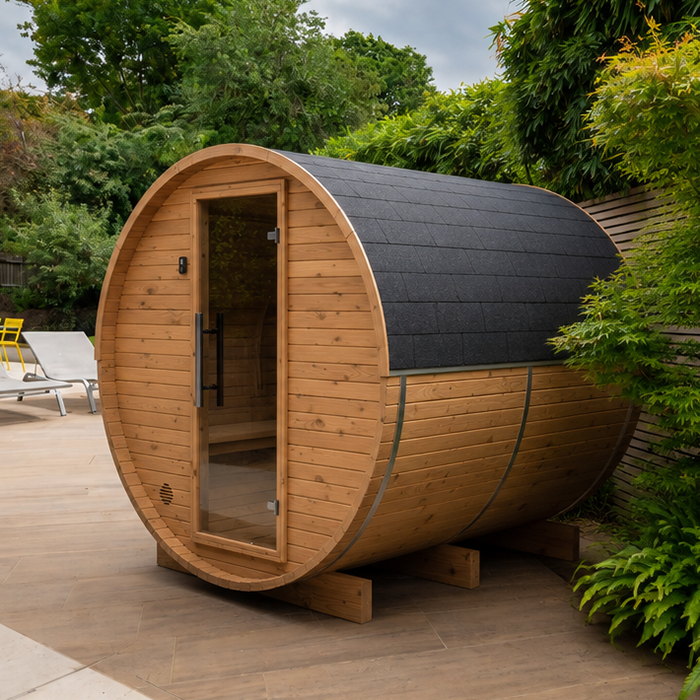
Plan the flue route before fixing the sauna’s position
Mark a possible flue route on a site sketch before fixing the sauna’s position. It must be allowed by the heater and flue manufacturers and assessed for the actual building and surroundings. Check where a roof outlet would sit in relation to the roof structure, eaves, nearby buildings and overhanging branches. Include nearby windows and the planned roof or wall penetration on the drawing, even if the position is approximate. If another route is proposed, ask whether that arrangement is approved for the exact heater. These are questions for the manuals and an experienced installer, not a do-it-yourself route plan. A line that looks clear on paper does not confirm that it can be installed safely or in line with applicable requirements.
The flue route can affect which way the sauna faces and how close it can sit to other structures or openings. Have an installer consider the full route, its support, weatherproofing and maintenance access before you order a cabin with a fixed layout. Do not assume an existing chimney, wall opening or generic flue kit will suit the new heater. For Thermowood barrel sauna N 210, ask the supplier whether that exact sauna version permits the proposed stove position and outlet, and get the answer before settling the site. If the route changes later, confirm the revised combination instead of relying on the earlier quote.
Specify a compatible flue system
Treat the flue as a matched system, not a length of pipe bought after the stove. Identify the heater maker’s approved flue components and the complete set of parts needed for the proposed route. Depending on that specification, the order may need components for the connection, passage through a structure, support, weather protection and termination; the manufacturer’s list, not a generic checklist, decides what applies. Ask whether the supplied kit covers the whole route, whether adaptors or other parts are separate, and who confirms that all pieces are compatible. Record component names or model references against the quotation so there is no ambiguity when it is time to order.
Have the installer review the proposed components and the sauna’s construction information before purchase. They should establish the applicable clearances and protective arrangements from the manufacturers’ instructions, rather than guessing dimensions or substituting materials. Ask how the finished route can be inspected and maintained, and whether access must remain clear once the sauna is in place. If you are considering Thermowood barrel sauna N 250, use the exact cabin identity in the discussion with the flue supplier: its model label does not establish an approved outlet or a flue kit. Keep the final component schedule with the order and give the same version to everyone involved.
Check the site, base and access
Measure the proposed area against the manufacturer’s external dimensions and orientation, then add the practical space needed to deliver, assemble and use the sauna. The clear area should account for its entrance, door movement, access to the heater and any maintenance specified by the supplier; the footprint alone is not the whole site plan. Confirm the delivery and assembly route with the supplier, including narrow gates, steps, overhead obstructions and the room needed to move components into position. Work from a current drawing or written dimensions: a photograph cannot be scaled reliably. Check the route before placing the order and before arranging ground works.
Ask what base or support arrangement the exact model requires, and have the ground or any proposed deck assessed by a suitable professional if there is doubt about level, drainage or capacity. Do not assume a patio, lawn or existing deck is suitable just because it looks firm; the answer depends on the product and site. Consider where rainwater runs and whether the position leaves access for flue maintenance. For Thermowood barrel sauna LC 260, request the actual footprint and support requirements instead of interpreting its model code as a size. Tell the supplier about tight access or obstacles before agreeing delivery arrangements, and confirm site-preparation needs before committing to ground works.
Consider smoke, neighbours and daily access
Consider where smoke could travel in ordinary and changing wind conditions, including towards house windows, doors, air intakes, outdoor seating, neighbouring properties and nearby trees. A spot that looks clear in still weather may behave differently later, so one visit does not prove the proposed outlet will be suitable. Ask an experienced installer to assess the terminal location against the heater instructions and surroundings. Check relevant local requirements with the appropriate authority or adviser; do not rely on a distance copied from a different stove or site. A site sketch and photographs can help the installer understand what surrounds the proposed position.
Plan everyday movement as well as the flue. Someone needs a convenient route to bring in suitable fuel and manage the heater and ash as its manual directs; that route should not make the entrance awkward or interfere with normal access. Think about smoke near neighbours’ windows and outdoor areas at different times, and raise concerns before fixing the location. For Thermowood barrel sauna HCF 300, ask for model-specific guidance on the permitted stove position and flue options. The listing name cannot answer questions about smoke, wind or the suitability of your particular site.
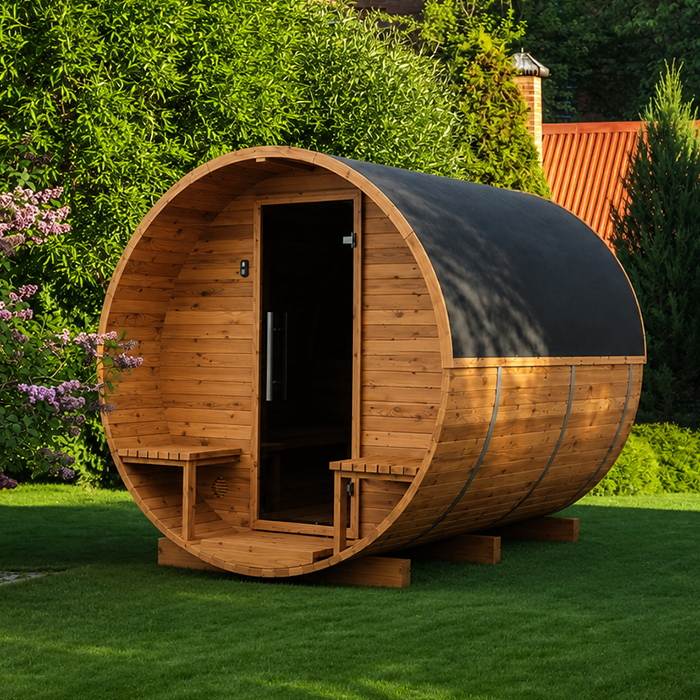
Confirm requirements and responsibilities before ordering
Before ordering, check what planning, building-control or fire-safety requirements may apply to your particular site and proposed installation. Requirements can depend on the circumstances; this guide cannot establish them for your address. Do not assume that a small sauna or a garden setting removes a requirement. Contact the relevant local authority or a suitably experienced professional if the position, flue route or nearby buildings raise questions. Ask the supplier for documents that apply to the exact sauna and heater, and make sure the installer has the instructions before agreeing a design. This matters especially when the plan involves a nearby building or a roof or wall penetration.
Agree responsibilities in writing: who verifies the sauna–heater pairing, supplies and checks the flue, prepares the site, carries out installation, and deals with any required notifications or checks. Keep the model and version details consistent across the quote, manuals and order. For Thermowood barrel sauna LCF 300, ask for site and heater guidance that refers to that exact model; its code is not a substitute for technical information. Review the seller’s terms for delivery, assembly, after-sales support and any limits on the package. Do not infer these terms from the product photograph or assume another supplier covers them.
Compare complete specifications, not package names
Use one written comparison sheet for every sauna you are considering. Record the exact sauna version and dimensions, heater make and model, the maker’s stated suitability, the sizing basis, every flue component, the assumptions about the site, and what the supplier and installer each undertake. Include delivery access, assembly, site preparation and any separate installation work. This makes gaps visible: two quotations that both say ‘wood-burning sauna’ may not cover the same heater, flue parts or services. Compare the documented configuration rather than a headline package name, a model code or a feature shown in an image.
Before placing the order, check that the selected parts still match the site plan and that an installer has reviewed the intended flue route for the exact sauna and heater. Ask for unresolved points to be answered in writing, and pause if nobody can confirm a compatible combination or identify the required components. Do not plan to change the stove, outlet or flue after delivery without checking the revised arrangement with the manufacturers and installer. A clear specification lets you compare like with like, understand what remains to be arranged, and avoid discovering a basic mismatch once the sauna is on site.
Frequently asked questions
Can I choose the sauna first and add a wood-burning heater later?
It is better to confirm compatibility before ordering. The sauna and heater manufacturers need to support the exact combination, and the flue route must suit both the heater and the site. A stove that fits physically is not necessarily an approved choice.
How do I know what size heater is suitable?
Use the heater manufacturer’s sizing guidance for the sauna’s actual internal dimensions and design. Ask the supplier to show how the specific model fits the stated range, including any factors the manufacturer asks you to consider. Avoid choosing by eye or using a general rule.
Does a wood-burning sauna listing include the stove and flue?
Do not assume that it does. Ask for an itemised list showing what is included, what is optional and what must be supplied separately. Confirm whether the stove, compatible flue components, delivery, assembly and installation are covered by the order.
Can the flue go through a wall instead of the roof?
That depends on the heater, the approved flue system, the sauna and the site. Ask the manufacturers and an experienced installer to confirm which route is permitted for the exact setup before you decide where to place the sauna.
Do I need permission to install a sauna?
Requirements can depend on the site and the proposed work, so this guide cannot determine what applies to your address. Check with the relevant local authority or a suitably experienced professional before ordering if you have questions about the sauna, flue route or nearby buildings.
Keep the purchase decision anchored to the exact combination: sauna, compatible heater, complete flue and a site reviewed by a suitably experienced professional. A written specification can reveal whether a preferred model is supported for wood burning, what has to be bought separately and whether the flue route changes the location. Once those points are settled, compare layouts and finishes within the options that meet the plan. That is more useful than choosing a cabin first and trying to make an unconfirmed stove arrangement work afterwards.
