
Internal or External Feed for a Wood-Fired Sauna Heater
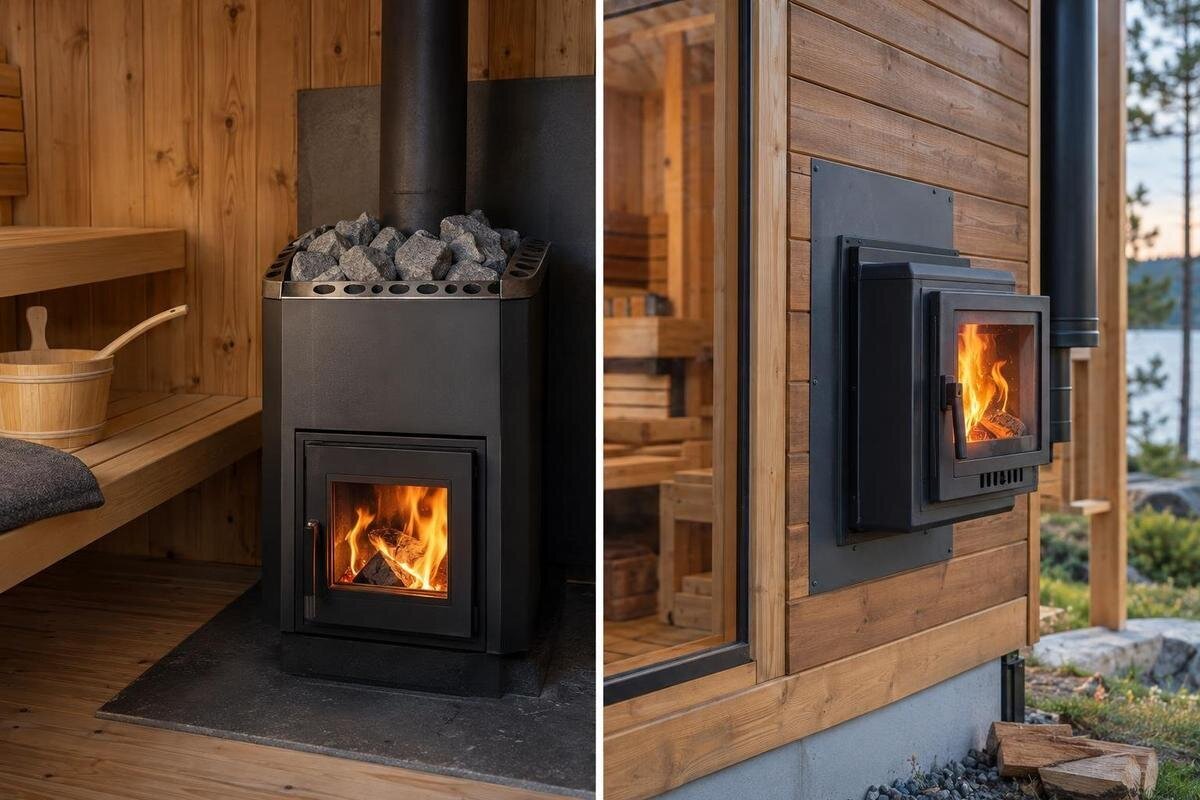
Wood-fired sauna layout guide
Choosing between internal and external wood loading is mainly a question of where the firebox door opens and how people carry fuel, tend the fire and reach the heater for maintenance. An internal-feed heater is loaded from inside the sauna; an external-feed arrangement takes the loading door through a wall into an adjoining space approved for that heater. Neither is automatically better. The cabin plan, the heater’s documented configuration, the route for bringing in logs and access for servicing determine which layout is workable.
What internal and external loading mean
“Internal” and “external” describe the side from which the firebox is loaded, not a general ranking of heater types. With internal loading, the firing door faces into the sauna and the person tending the fire enters that room. With external loading, a purpose-designed firebox extension or other manufacturer-approved arrangement takes the loading point through a wall; the heater body remains part of the sauna installation, even if the door opens elsewhere. That other side could be a changing room, utility area or outdoors, but the permissible arrangement depends on the exact heater and setting. Retail descriptions vary: “through-wall”, “external feed” and “outside loading” should be checked against a drawing, not assumed to mean the same configuration.
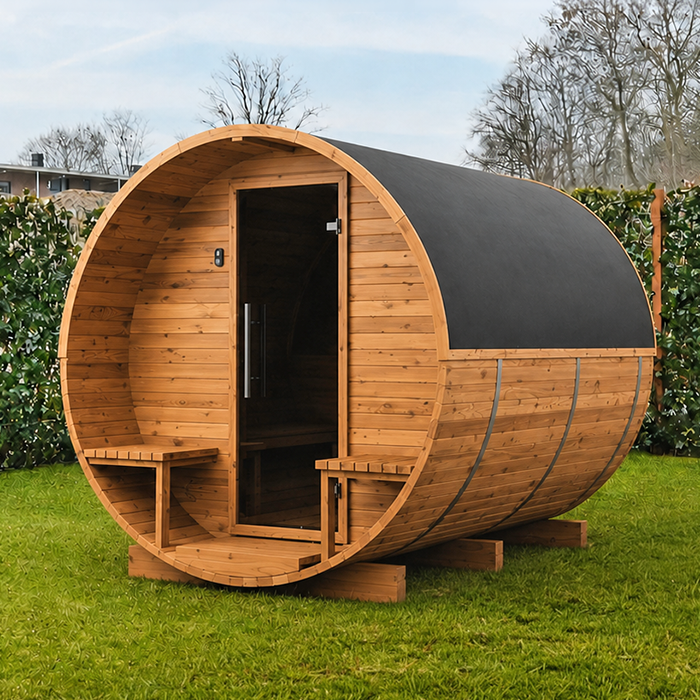
Look for a drawing that names the heater model, shows which way the firing door faces, and places the flue and manufacturer-required clearances. A photograph from one angle rarely shows the wall passage, how far a feed extension reaches, or how much access is available on the loading side. The cabin listings linked throughout this guide, including Thermowood Barrel Sauna HCF-300, identify sauna models; they do not establish heater compatibility or feed configuration. Treat cabin choice and heater feed as linked layout questions, then confirm each from its own manufacturer documents. Do this before deciding which wall should face an adjoining room or outdoors, because the door position can affect how that space is used.
Internal feed keeps loading in the sauna
An internal-feed layout puts the loading door where a person in the sauna can reach it without leaving the room. That can make the firing routine direct when the heater and its required working area fit without cutting across the entrance, benches or the main route between them. It also means someone tending the fire can remain on the sauna side. This is a convenience of access, not an automatic improvement in performance or safety: logs still have to be brought into the room, the door must be reachable as the manufacturer intends, and the stove cannot be positioned solely to suit a preferred bench arrangement. Consider what a person must move around while carrying fuel.
Consider the full task, not just a point on the floor plan: carrying logs past other occupants, setting aside the fuel you will use and leaving room to handle the firebox door. If the Sauna S-140, listed at 1.93 m², is on your shortlist, examine the proposed loading position in relation to its entrance and benches. The relevant question is whether someone can tend the fire while other people use the room, not simply whether the stove outline fits. A position beside a bench edge or across the doorway may make the routine awkward. Include the open firebox door and the person using it when assessing access, rather than judging the arrangement from an empty cabin plan.
External feed moves loading to another space
External loading changes the route rather than eliminating it: logs approach the firebox from an adjoining space, so they need not pass through the sauna room. This can suit a plan where the loading side is easy to reach and keeping fuel handling out of the bathing area matters to the household. Someone tending the fire must still reach the door and operate it as specified; they may also need to return to the sauna to check the room. The arrangement can reduce interruptions inside, but it does not make firing automatic or remove the need to decide who will tend the heater. Think about the repeated journey during a session, not only the initial delivery of logs.
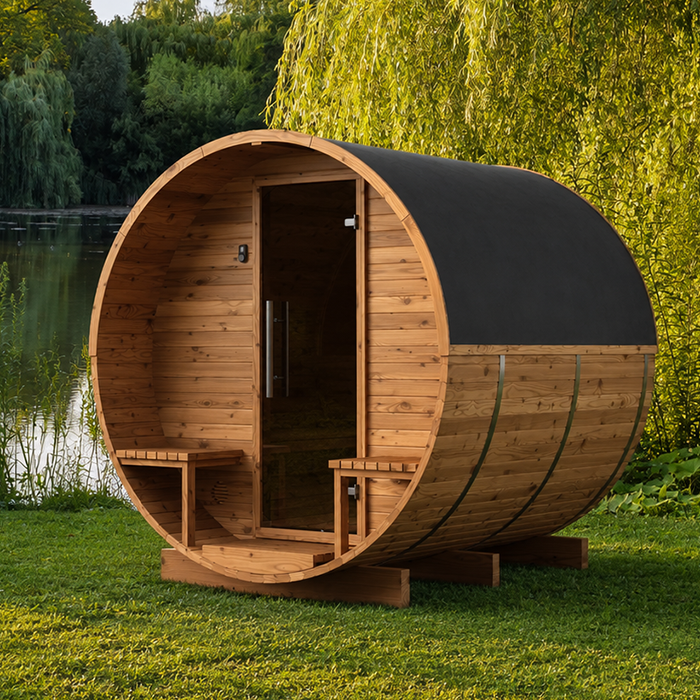
Check whether the space on the other side of the loading door will be accessible throughout the year. If it is a changing or utility room, account for its own doorway, storage and circulation. If the proposal is to load from outdoors, the manufacturer must confirm that the exact placement and exposure are suitable; do not assume every extended firebox can face the weather. When considering the Thermowood Barrel Sauna LCF-300 listing, include the proposed loading area in your comparison, rather than assessing the cabin alone. Think about how you will reach that area while the sauna is in use, where you will stand and whether the journey between the loading door and the sauna entrance is convenient.
Space for moving around the sauna
Draw normal movement before choosing the feed side. Mark the entrance, benches, heater, doors that open into the room and the route people take when entering, sitting down and leaving. With internal loading, include the standing space at the firebox and the movement needed to carry logs from the entrance. Avoid putting the loading task across the main route simply because the firing door is on the sauna side. Check how access works when someone is on a bench and another person needs to pass. The exact clearances and separation from benches or timber surfaces come from the heater and cabin instructions; a sketch helps identify questions but does not set those requirements.
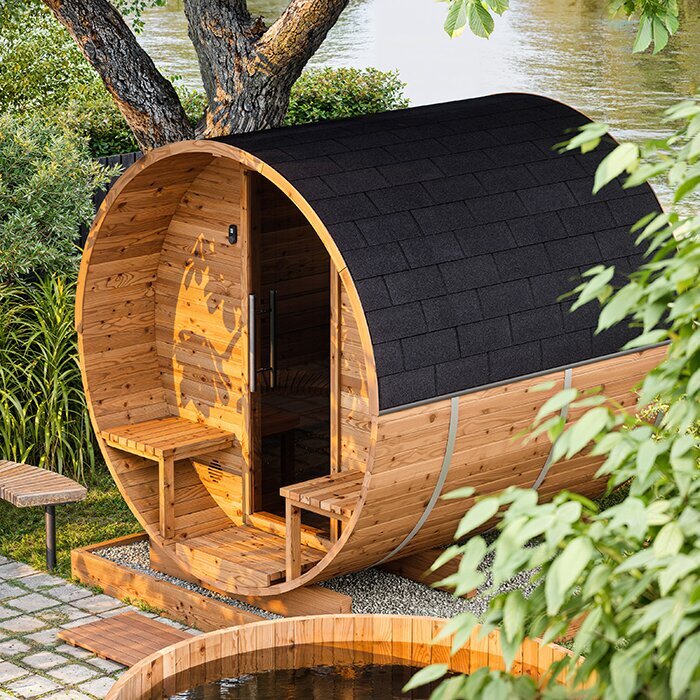
An external feed can move the log-carrying route and firing-door access out of the sauna, but the heater itself still occupies space there. Its body and manufacturer-required clearance zones remain part of the interior plan, even if the loading door faces elsewhere. When comparing the Thermowood Barrel Sauna HC-150, listed at 2.97 m², assess the space around the proposed heater rather than treating the stated area as entirely available for movement. Compare the routes from the entrance to the benches under both feed arrangements. Moving the loading task may remove an obstruction from one route, but it does not necessarily change every route through the room or free an equivalent amount of usable floor space.
Access on the external loading side
External loading only works if the other side of the wall is a sensible place to feed the heater. Think about the approach from where firewood is stored, whether a person can stand comfortably at the door, and whether opening it interferes with a doorway, a route through a changing room or stored items. Consider the adjoining space alongside its normal use, rather than treating it as an empty strip on a drawing. If the firewood store is elsewhere, include the extra walk and any turns. A convenient feed door matters each time the heater is tended, not only on the day the cabin is installed.
Ask the installer which side of the proposed cabin can accept the selected external-feed arrangement and what must remain clear on both sides of the partition. “External” does not mean an outer wall can be cut wherever convenient or that a firebox door can simply face an adjacent room. If the Sauna HC-225, listed at 4.4 m², is under consideration, include the adjoining room in the layout discussion. Show its doorways and stored items alongside the proposed loading position. Check whether that area remains usable when the firebox door is open and someone is standing in front of it. This distinguishes a genuinely accessible loading point from one that fits on paper but conflicts with the room’s everyday use.
Check the heater and cabin configuration together
Feed options are model-specific. Some wood-fired heaters are offered with different loading arrangements; others may have one approved orientation or require a particular extension. Do not assume a standard internal-feed heater can be turned around, extended or adapted by a carpenter. Ask for the exact heater reference and the drawing for the feed configuration being sold, including the partition it is designed to pass through. A cabin area or photograph cannot establish compatibility. For instance, the Thermowood Barrel Sauna N-210 listing, with a stated area of 4.43 m² identifies a cabin but not a compatible heater option. Get confirmation for the heater and cabin as a combination, not just for each item separately.
The installation plan needs to coordinate the heater position with the flue route, required clearances, combustion-air arrangements and the cabin’s construction details. These are manufacturer and installation questions, not dimensions to estimate from a web image. Have a qualified installer confirm that the chosen heater and proposed cabin layout work together, including the access arrangement. Raise the question before buying or modifying a wall: changing the feed side later may affect the layout and may not be permitted for that model. Keep the approved drawing and manual with the project so the installer and supplier are discussing the same configuration, rather than relying on separate product photographs or generic sketches.
Plan the fuel and ash-handling routine
Compare the fuel journey as well as the firebox door. With internal loading, logs travel through the sauna entrance and into a room where people may be using the benches; with external loading, they approach from the other space. In either case, decide where the permitted fuel will be kept before it is needed, without obstructing a route, an access door or the heater’s required clearances. Follow the heater manual for fuel type, log dimensions and any storage or handling instructions; do not infer fuel size from the door opening. When reviewing the Sauna N-250 listing (5.27 m²), consider the route from your intended fuel storage point to the proposed loading position, including any part of that journey outside the cabin.
Separate loading from ash handling and cleaning. The loading door does not necessarily show where ash or other service points are reached, and the loading side is not automatically the side used for every maintenance task. Find those details in the actual heater manual. Think through the routine after firing: carrying out ash, keeping any necessary tools to hand and leaving the work area accessible without crossing a crowded room. Do not plan to store tools or fuel against the stove or close to the firebox unless the manufacturer documents that arrangement. This is another reason to compare both sides of a through-wall unit.
Leave access for inspection and servicing
Service access deserves its own comparison. An external-feed door may make routine tending convenient from the adjoining side, yet a service technician may still need access to the heater from the sauna, the rear of the partition or the flue area. Internal loading likewise does not mean every part can be reached from the front. Ask which components need inspection or removal, from which side they are reached and whether adjacent fittings must remain accessible. These needs may differ from the space required just to put logs into the firebox, so ask for a drawing that shows maintenance access rather than relying on a general label.
Show the service approach on the plan, including the route in and out for tools or components and any panels or access points the manufacturer identifies. If the Thermowood Barrel Sauna LC-260, listed at 5.12 m², is on your shortlist, include servicing in the layout discussion as well as everyday access. Ask the installer whether the proposed benches or adjacent fittings would obstruct the identified maintenance points, whichever way the firing door faces. Distinguish access to the loading door from access to parts that may need inspection or removal. A clear approach to the front of the firebox alone does not answer every servicing question, so consider those separate tasks before settling the interior arrangement.
Compare the complete routes on a plan
Use a measured plan of the sauna and adjoining area to compare the two layouts. Mark the cabin entrance, bench edges, heater outline and doors that affect movement, then trace the firewood route. For internal loading, follow it from the storage point to the firing door; for external loading, include the route to the external loading door and any threshold or turn that affects handling. Mark where a person can stand while tending the fire and where others will walk. If the adjoining room has furniture or storage, show that too rather than leaving it blank. This is a planning aid, not a substitute for model-specific clearances or professional installation review.
Compare the plan at more than one point in the routine: bringing in fuel, opening the loading door, using the sauna with others present, cleaning and arranging a service visit. A layout that looks spacious when empty can become obstructed when someone is carrying logs or standing at a door. Consider tasks that may happen at the same time, such as one person tending the fire while another enters the sauna or uses the changing room. Note where either arrangement would require people to wait or move aside. Use the same cabin layout and household routine for both comparisons, so you can distinguish the effect of the feed position from unrelated changes to benches, storage or doorways.
When each layout is the better fit
Internal loading may be the more practical option when no suitable adjoining space is available and the sauna plan provides manufacturer-approved access from inside. It suits a fuel routine where bringing logs into the sauna is acceptable and does not disrupt movement. External loading is worth exploring when fuel can arrive at a convenient adjacent point and keeping loading activity out of the sauna matters, provided the heater is designed for that exact route. Neither choice guarantees less maintenance, heat loss or installation effort. Avoid relying on general assumptions about those outcomes; they depend on the selected model and its documented arrangement.
When weighing the two options, separate essential requirements from preferences. A configuration that is incompatible with the chosen heater or blocks required access is not a workable choice, however convenient its fuel route appears. Once those requirements are satisfied, compare the everyday trade-offs: whether someone must leave the sauna to tend the fire, whether logs pass through an occupied room and how the adjoining space is used. One household may prefer direct access from inside; another may value keeping loading activity outside the bathing area. Choose according to the routine you actually expect to follow, rather than treating external feed as an upgrade or internal feed as a compromise.
Frequently asked questions
Is an external-feed wood-fired sauna heater always the better option?
No. It can keep log handling and the firing door outside the sauna, but needs a manufacturer-approved arrangement and convenient access on the other side of the wall. Internal loading may suit a cabin where the heater can be reached without obstructing movement.
Does external feed mean the heater sits outside the sauna?
Not necessarily. The term describes where the loading door is reached. A purpose-designed extension may take that door through a wall while the heater remains part of the sauna installation. Check the exact arrangement in the manufacturer's drawing.
Can an internal-feed heater be converted to external loading?
Do not assume it can. Use an external-feed arrangement only if the manufacturer approves it for that exact heater. Ask for the model-specific drawing and have a qualified installer confirm the proposed layout.
Does external loading create more usable floor space inside the sauna?
It may move the log route and loading-door access out of the sauna, but the heater and its required clearances still affect the interior layout. Compare the actual cabin-and-heater plan rather than assuming the room gains a particular amount of space.
Does the loading side also determine where the heater is serviced?
Not necessarily. Loading access and maintenance access can be different. Check the heater manual for the inspection and service points, and make sure the plan leaves those areas accessible from the required side or sides.
The better feed position is the one that makes the full routine workable: bringing in fuel, tending the fire, keeping routes clear and leaving room for inspection. Internal loading keeps the firing door within reach from the sauna but brings fuel handling into that room. External loading shifts that activity to the other side of the wall while leaving the heater itself in the interior plan. Once compatibility and required access are established, the deciding question is which arrangement fits the way you will use both spaces.
