
Outdoor Sauna Warm-Up Times: Comparing Like with Like
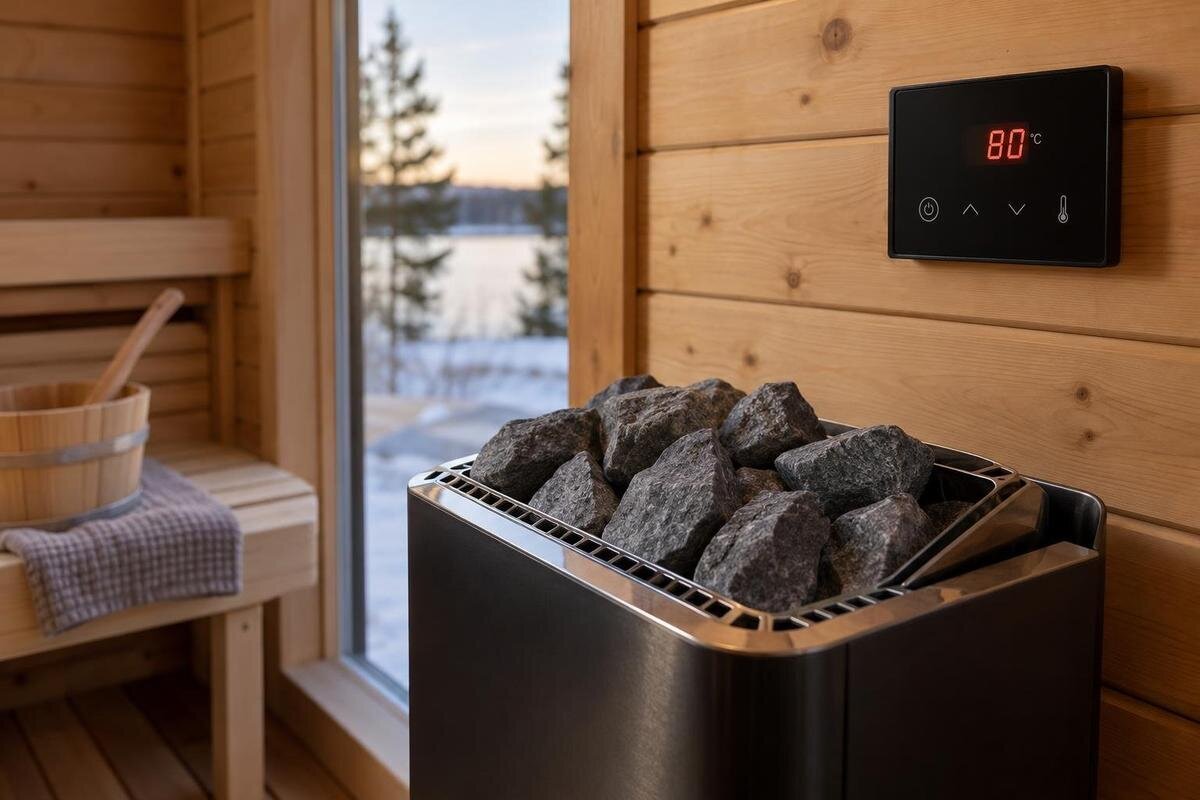
Outdoor sauna heating
A quoted outdoor sauna warm-up time describes a particular test, not a fixed duration that applies in every garden. The time can change with the cabin’s starting temperature, the weather, the heater and control arrangement, the target temperature, and where the reading is taken. Those details matter more than a headline figure on its own. If you are comparing tests or product claims, look for the conditions behind the minutes before deciding whether they are relevant to your intended setup. A clear test record makes two figures easier to assess; an unexplained claim does not.
What a warm-up time actually describes
A quoted time is an observation made under one set of conditions, rather than an inherent feature that stays constant across outdoor saunas. The same cabin can take a different length of time to reach a target after a cold start than it does when it still holds warmth from earlier use. Change the heater, the chosen endpoint or the temperature-reading method and the elapsed time can change again. Even the point at which someone starts the clock matters. A result may describe air reaching one reading, not every surface reaching the same temperature. Treat it as evidence for the stated test, not a universal promise.
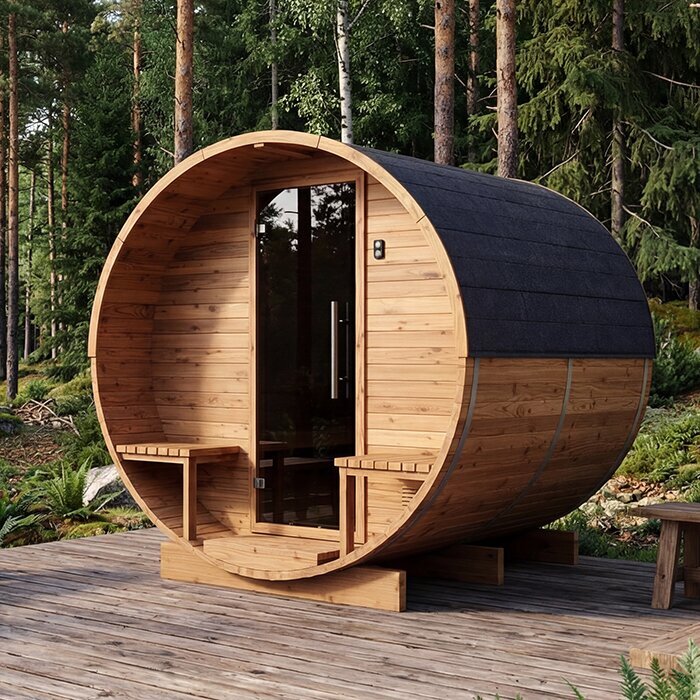
Keep product identity separate from performance evidence. The catalogue lists Sauna HC-150, with a stated area of 2.97 m² as a Thermowood Barrel Sauna; that identifies the product and its stated area, not a warm-up result or heater configuration. A useful time claim should say which cabin was tested and what equipment was used. It should also clarify whether the test describes the same configuration you are considering. If these details are absent, do not assume the result applies to every sauna in the category or to another model with a similar floor area.
Define when the test starts and stops
Establish exactly when the clock starts. A test might begin when the heater is switched on, when its control is set, when a fire is lit, or only after preparation that is not included in the reported time. Those choices measure different parts of the process. A figure timed from switching on the heater to a target may help compare heating tests, while a household may care about the full time from an unheated cabin to the chosen condition. Two accurate reports can therefore differ because one counts start-up and the other does not. For planning, use the timing definition that matches your routine, while keeping it clear when comparing results.
Define the endpoint just as carefully. A control set to a temperature is not the same as an independent thermometer showing that temperature at a stated position: a setpoint is an instruction to the control, not a reading of the air throughout the cabin. One test may stop at the first reading at target; another may wait until it remains there. When assessing a reported time for Sauna HC-225, shown at 4.4 m², look for the measured target and the precise stopping rule in the test description. If the report gives only a control setting, keep that distinction visible rather than treating it as a measured temperature.
Record the sauna’s starting temperature
Write down the temperature inside the cabin before heating begins. “Cold start” is too vague unless a report says what was measured and where: a sauna left outdoors may have air and surfaces at different temperatures, while a cabin used recently may retain warmth after its air has cooled. Note the initial air reading and sensor position, plus whether the cabin has been used since it last cooled. Do not use the outdoor reading as a substitute for the cabin reading. If you are comparing repeat runs, note the time since the previous use and whether the door was opened. That history provides context, but the measured starting temperature is the more useful comparison.
Two tests that finish at the same reading but start at different temperatures have not heated through the same range. Group results by their recorded starting conditions before comparing elapsed times, and keep recently used cabins separate from those that have fully cooled. Do not try to compensate for a missing starting reading by assuming that heating progresses at a constant rate. If you are collecting reports for Sauna N-210, listed at 4.43 m², record each run’s initial temperature alongside its duration. The product details identify the cabin, but cannot supply a missing temperature reading. Leave that entry as unknown rather than making the comparison appear more complete than it is.
Include outdoor weather in the test record
Outdoor conditions belong in the record because the sauna is not operating in a controlled indoor room. Note the air temperature near the cabin at the start and, if it changes, during the test. Wind exposure, direct sun, rain and shelter can also differ between sites and days, affecting how much heat the cabin gains or loses. A test on a calm, sheltered day is not automatically comparable with one made in exposed conditions. A distant weather reading or forecast may not represent the conditions beside the sauna. If the weather changes during a longer run, record the change rather than relying on one start-of-test reading.
Describe the actual position and exposure instead of writing only “outdoors”. Note whether the cabin was in sun or shade, behind a windbreak or open to the wind, and whether conditions remained steady. This is context, not a correction formula: you cannot convert a result for one site into an exact time for another from air temperature alone. When considering Sauna N-250, with a stated area of 5.27 m², compare the exposure described in any heating test with the position you have in mind. Where they differ, retain that qualification. Do not add or subtract a guessed number of minutes for wind; use recorded tests with similar exposure where available.
Cabin dimensions and construction
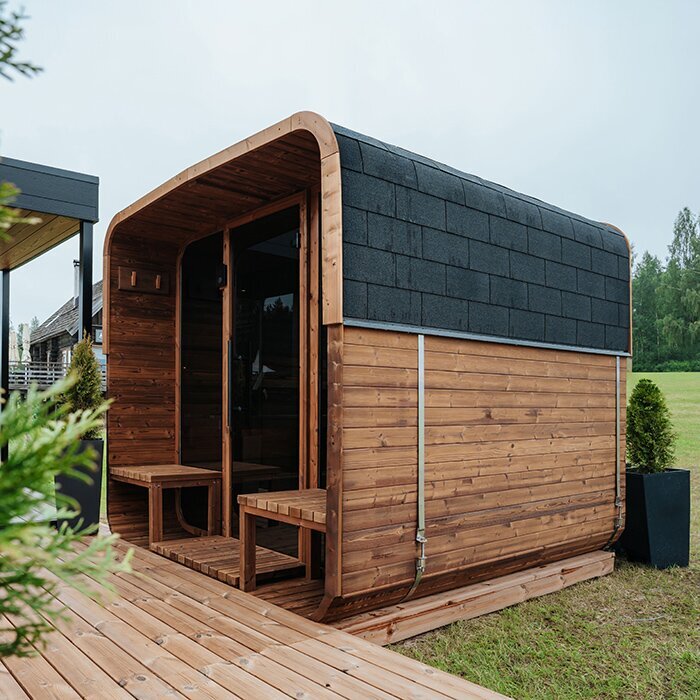
Cabin size affects the amount of space being warmed, but floor area is only one part of the description. Internal volume, ceiling height, surfaces and construction can influence how quickly the measured air reaches a target. Insulation, ventilation, gaps around openings and the proportion of glass affect heat loss; benches and other interior surfaces also absorb heat. The position and size of openings can differ between designs. A report should identify the sauna and its relevant configuration rather than treating all outdoor or barrel saunas as equivalent. There is no reliable minutes-per-square-metre conversion, because floor area does not account for these other variables.
The product listing for Sauna LC-260, shown at 5.12 m² gives a stated area, which can help distinguish the cabin in a shortlist. That figure does not, by itself, give internal volume, insulation, ventilation or the amount of glass in a particular test configuration. If reports involve different cabins, compare the actual details available rather than ranking them by area alone. If key construction information is missing, note that gap; it cannot be recovered from the model name or floor-area figure. Similar floor areas do not establish that two warm-up results should match.
Record the heater and its configuration
The heater is part of the test, not a detail to leave in the small print. Record its type and model, its stated output where the manufacturer gives one, the control used, and the settings or operating state described in the test. An electric heater and a wood-fired heater do not share an identical start-up process; with a wood-fired system, fuel and the fire-start method can affect what the reported clock includes. The way start-up is handled matters too. Even the same heater model may be tested with different control settings or preparation, so record what the report states rather than assuming it.
If a time omits the heater or does not say whether preparation was included, its relevance is limited even if the cabin is named. The catalogue identifies Sauna HCF-300, listed at 6.89 m² as a Thermowood Barrel Sauna with that stated area; neither its model name nor area identifies the heater used in a separate test. Check the complete cabin-and-heater combination in the relevant manufacturer documentation. A heater’s stated output alone does not tell you how quickly a particular cabin will reach a measured target. For electrical or combustion installation and configuration questions, follow the manuals and consult a qualified professional.
Measure temperature consistently
Temperature readings are only comparable if the measurement method is reasonably consistent. Air temperature can vary around a sauna, so a reading close to the heater, near a door or at another height may not match one taken elsewhere. A report should state the thermometer or sensor position and, ideally, the interval at which readings were taken. Follow the heater manufacturer’s instructions for its control sensor; do not move a fixed sensor to imitate a test. For a repeat observation, use the same documented position if the instructions permit it. An independent thermometer should be placed and used in line with its own instructions.
Distinguish the thermostat or controller display from a separate thermometer. The display may show a selected setting or a reading from its own sensor, while a test may use another instrument; neither number necessarily represents the temperature at every point in the cabin. When comparing reports for Sauna LCF-300, also stated at 6.89 m², check whether they use the same kind of reading before comparing the minutes. For repeat tests, keep the device, position, reading interval and stopping rule consistent. If these details change, record the change alongside the result. A single sensor reading describes one point, so it should not be presented as proof that the temperature is uniform throughout.
Compare the full test conditions
Build a comparison from the details that determine what the clock represents: exact cabin and configuration; heater type and relevant stated output; internal starting temperature; outdoor conditions; measured target; start and stop rules; and thermometer position. Add whether the sauna was fully cold or had been used recently, and whether preparation time is included. If a report leaves out an item, mark it as unknown instead of filling the gap with an assumption. A side-by-side note makes omissions visible. If one important condition differs, describe the comparison as partial rather than using it to rank products without qualification.
Imagine two reports ending at the same stated target, but one starts at 5°C and the other at 15°C, or uses a different heater or thermometer position. The headline minutes alone cannot tell you which cabin would heat faster under matching conditions. A stronger comparison holds the cabin, heater, start and finish readings and measurement method constant, or names the variable that changed. These starting temperatures are illustrative only, not a suggested sauna target or a performance promise. Avoid a simple minutes-per-degree adjustment: warm-up does not necessarily progress at a constant rate, and changing several factors at once makes the reason for a difference unclear.
Assess the source of a published time
Consider who produced the figure and how it was measured. A manufacturer’s timed test can be informative when the method and configuration are reported; a reviewer’s observation can help too if it includes enough detail to support the comparison. Phrases such as “quick to heat” or “ready in no time” do not provide a measurable result. Missing conditions do not prove a claim is wrong, but they prevent you from knowing whether it came from a cold start, mild weather, a particular heater or a specific endpoint. Check whether the source records one run or several; one result is an observation, not a usual range. A precise time without a method is less useful than a slower figure with conditions clearly stated.
Keep the product listing and the test report separate in your comparison notes. The listing can establish which item is being discussed; the report should explain how its heating time was measured. For Sauna S-140, listed with an area of 1.93 m², check that any attributed result names that exact model and describes the configuration used. A test of a similarly named cabin or another barrel design is not interchangeable simply because the products share a category. If the listing itself publishes a time, assess its accompanying method in the same way as any other report. An undocumented duration remains incomplete evidence, however prominently it is displayed.
Using a test result at your own site
Your own site is the final condition a published test cannot fully reproduce. Once the cabin and heater configuration are confirmed, keep a simple log over several ordinary starts: initial cabin reading, outdoor temperature and exposure, heater and control setup, target, sensor position and elapsed time. Use the same start and finish rules each time; if conditions differ, record them rather than averaging unlike runs. Do not alter a manufacturer’s fixed sensor or operate outside its instructions to collect observations. A short, consistent record can show the range you experience more honestly than one unusually mild or cold day. It need not be a laboratory trial; consistency makes the notes useful.
Use those observations to allow enough preparation time in your routine, rather than treating a product-page figure as a guaranteed duration. If a published test resembles your expected starting conditions and equipment, it can provide a useful initial reference. Your own records can then show whether that expectation matches comparable starts at your site. Keep results from different conditions separate: a recently used cabin should not define the allowance for a fully cold start, and an exposed day should remain identifiable in the log. A margin based on comparable runs is more grounded than an unexplained fixed allowance, but a few observations still cannot guarantee the time for every future start.
Frequently asked questions
How long should an outdoor sauna take to heat up?
There is no single duration that applies to every outdoor sauna. Starting temperature, weather, cabin and heater configuration, target temperature and measurement method all affect the result. Treat a published time as specific to its stated test, not as a guaranteed time for your own setup.
Does cold weather make an outdoor sauna take longer to heat?
It can: colder conditions and greater exposure may affect how much heat the cabin gains or loses. The effect depends on the full setup, so outdoor temperature alone cannot predict the extra time. Compare tests made under similar conditions rather than applying a fixed adjustment.
Is the heater’s set temperature the sauna’s temperature?
Not necessarily. A setpoint tells the control what to aim for; it is not a reading of the air throughout the cabin. The controller’s sensor and an independent thermometer may show different figures, particularly if they are in different positions. Check what a test actually measured.
Can I compare warm-up times for different sauna models?
Only when the test details are sufficiently alike, or clearly state what changed. Check the exact cabin and heater, starting and target temperatures, outdoor conditions, timing rules and thermometer position. A product’s listed floor area or a shared category name is not enough to make two results comparable.
How can I estimate warm-up time at my own site?
Follow the manufacturer’s instructions and keep consistent notes over several ordinary starts: cabin and outdoor temperatures, heater setup, target, sensor position and elapsed time. Compare runs with similar conditions and use the range as a planning guide, not a guarantee. Do not alter a fixed control sensor to conduct a test.
Outdoor sauna warm-up times are meaningful only alongside the conditions that produced them. Starting and target temperatures, weather, the exact cabin and heater, and the thermometer position can all change what a result tells you. Compare reports only when those details align, and treat missing information as uncertainty rather than filling it with a guess. A well-documented test can inform a buying decision; consistent readings at your own site show how that setup behaves in practice.
