
Replacing a Garden Sauna: Can You Reuse the Base and Connections?
Garden sauna replacement
Replacing a garden sauna can look like a straightforward swap: clear the old cabin and put a new one in the same spot. But the base and connections were chosen for a particular design and installation, and their condition may have changed. Reuse is possible only when the replacement’s own requirements suit the site and the relevant checks support it. Review the cabin, base, electrical supply, any other services and the access route separately before committing.
Identify the replacement model and specification
Treat the replacement as a new specification, not as a copy of the old sauna. Write down the exact model and configuration, including the selected heater and any optional equipment; confirm what is supplied and what is chosen separately. Obtain the current installation drawing and instructions for that exact cabin, plus the heater documentation where relevant. Record the document version or date, as an older brochure may describe another configuration. Similar appearance, a shared product name or the same location does not establish matching support points, clearances or service requirements. If a necessary drawing is missing, request it before relying on a sales image or altering the site.
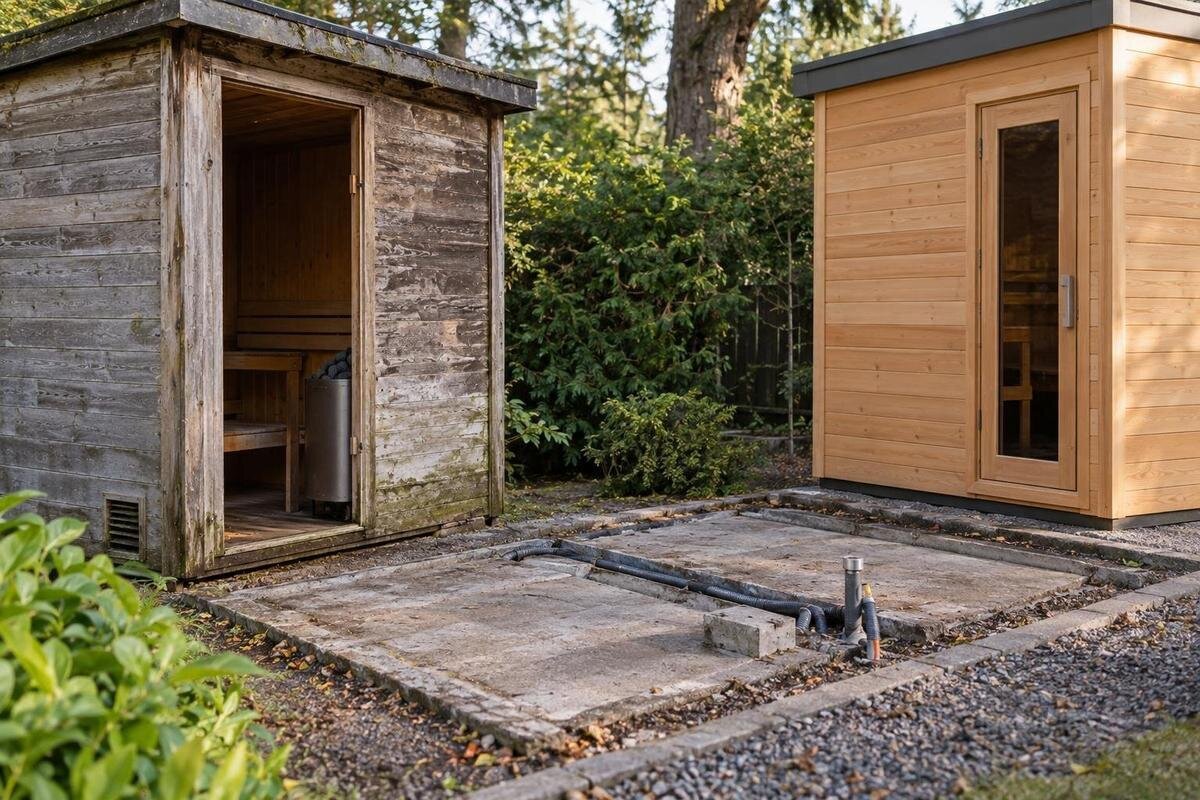
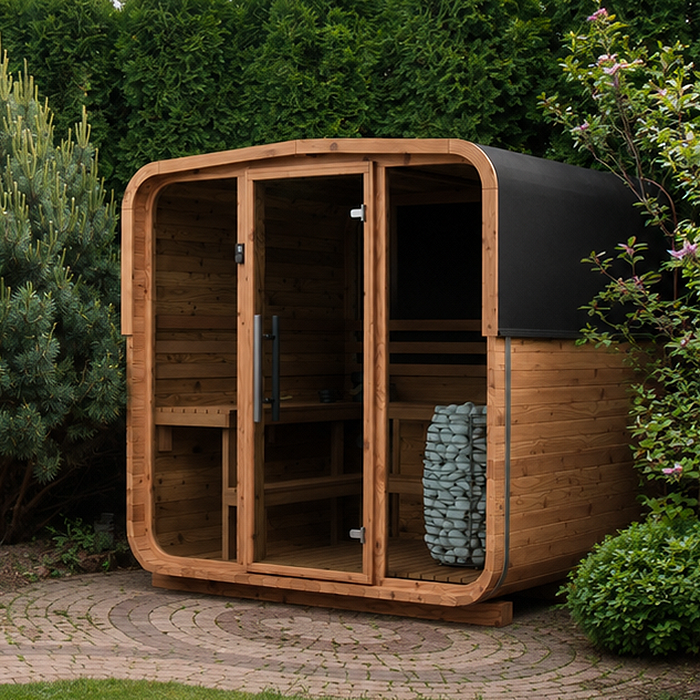
Make a simple site record without opening electrical equipment or disturbing pipes. Note the old cabin’s make and model if known, the base’s approximate outline and surface, visible service routes, the connection point, previous repairs and places where water tends to collect. Photograph accessible areas and visible labels only where safe; leave concealed equipment for a professional. If you are considering the Thermowood Barrel Sauna HC 225, use that model reference when requesting the installation documents. Keep your observations separate from the replacement’s stated requirements, so it is clear which details describe the existing site and which describe the new cabin. Record anything you cannot establish as unknown. This gives the supplier and installer a useful starting point without suggesting that the old installation is already suitable.
Compare the new drawings with the existing base
Use the replacement’s installation drawing and manual to understand the required base arrangement. Compare the overall footprint, the areas that need support, any stated fixing details and required clearances with the base that is actually there. A base can appear wide or long enough while its support areas do not line up with the new design. The outside dimensions of the old cabin do not necessarily show where its support was provided. Follow the requirements for the exact replacement configuration rather than treating a similar-looking cabin as an equivalent.
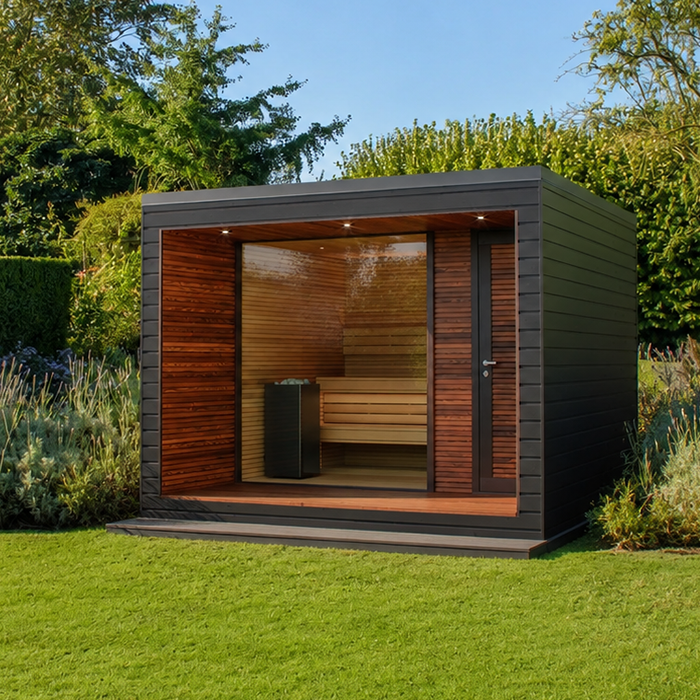
Sketch the base and mark its edges, steps, joints, projections, drains and any services crossing the proposed support area. Check the exact instructions for the required surface and any permitted variation; do not guess a tolerance from a quick measurement. When comparing Sauna N-210 with the site, make sure the drawing matches the version being considered. Mark the proposed cabin orientation on your sketch as well as its outline. This helps distinguish a footprint that fits within the base from an arrangement that also places the entrance and support areas where intended. Keep uncertain measurements clearly labelled rather than treating approximate dimensions as final. If support areas or specified fixings do not align, ask the supplier or installer whether an approved adaptation is possible. Do not drill, shift or add supports until the proposal has been reviewed.
Assess the base’s condition as well as its dimensions
Establish what the base is made from, if you can: it might be a slab, paving, compacted stone, a timber platform or another arrangement. Look over accessible surfaces for cracks, displaced joints, rocking paving, soft or decayed sections, damaged edges, unevenness or signs of erosion. These are observations, not a diagnosis of what lies beneath. A base that supported the old sauna is not automatically sound or suitable for the replacement; it may have moved, weakened or been altered since the original installation.
Some areas may only become visible after the old cabin is removed, so avoid covering up a concern or arranging repairs before the required checks are clear. A surface inspection cannot establish the condition of hidden supports or prove that an uncertain structure is adequate. If you find movement, significant damage or an unknown base construction, ask a suitably qualified building or ground professional to assess it against the new unit’s documents. When considering a model such as Thermowood Barrel Sauna N 250, give that professional the exact drawings rather than relying on the old cabin’s appearance.
Check levels, runoff and the area around the base
Check how the base sits and compare it with the requirements in the new sauna’s instructions. An uneven or damaged surface may complicate fitting or leave parts of the support arrangement unsuitable, but do not invent a level tolerance where the manufacturer has not provided one. Note changes across the base and where it meets surrounding paving or ground. If you are unsure how to interpret those observations, ask the installer or a suitable professional rather than trying to correct the surface by guesswork.
Review the surrounding ground for standing water, washout, downpipes discharging nearby, or changes made since the original sauna was installed. These conditions can affect the base and the work needed to prepare the site. Note whether water collects on the base itself, beside it or along the approach, rather than recording all three as one drainage problem. Describe what you have observed and when, without assuming the cause or proposing a repair before assessment. Also compare any clearances in the replacement documents with fences, walls, planting and routes needed to reach the cabin. For Sauna LC-260, request the exact installation information before deciding whether the existing position remains suitable. A product photograph or the space occupied by the old sauna cannot establish the required clearances.
Confirm what the replacement configuration includes
Before planning connections, confirm the actual replacement package and equipment. Ask what is included with the cabin, which heater and controls are specified, and whether any options are selected separately. Keep the answer tied to the exact model and configuration: a cabin name alone does not tell you what equipment is supplied or what services it needs. This also helps avoid arranging work around an assumed connection point or a heater that is not part of the chosen setup.
If you hope to retain the old heater or its controls, check compatibility with the manufacturer or supplier for the exact replacement configuration. A physical fit is not enough to establish that equipment can be used in the new setup; its installation requirements and condition need to be considered as well. When enquiring about Thermowood Barrel Sauna HCF 300, distinguish the cabin model from the equipment included in your proposed order. List each item as supplied new, retained from the old sauna or still to be selected. This makes it easier to spot an unresolved choice before tradespeople assess the connections. Do not describe the whole package simply as a replacement if some equipment will be reused: the people reviewing it need to know exactly which parts are new and which are existing.
Have a qualified electrician assess the existing supply
A connection that worked for the old sauna does not prove that the existing electrical installation suits the replacement. Give a qualified electrician the requirements for the exact heater being considered and ask them to assess the existing supply, circuit, cable route, connection point, protective arrangements, controls and condition. Previous changes, the location of equipment and its exposure to the elements may also be relevant. The electrician can determine whether any part can be retained, needs alteration or should be replaced; do not try to make that judgement from a switch or visible cable alone.
Distinguish between retaining a route and reusing the cable or other electrical equipment within it. Even if a route looks convenient, an electrician needs to assess what is actually installed and whether it suits the new configuration. Do not disconnect, open or alter equipment yourself. Ask what checks and records are appropriate for the proposed work under the applicable requirements. If Sauna LCF-300 is on your shortlist, give the electrician its exact model identity and the corresponding heater information rather than carrying over assumptions from the old sauna.
Plan access for removal and delivery
The replacement has to reach the site, and the old sauna has to be removed. Check the whole route, including gates, narrow turns, steps, overhead obstructions, changes in surface and space to set items down temporarily. Ask the supplier or installer how the chosen configuration is delivered and assembled; do not assume it arrives in a particular form. A route that worked for the old cabin may not work for a different delivery arrangement, and a tight access point can affect the plan even when the site itself is unchanged. Consider removal and delivery separately, since they may involve different handling arrangements. Identify where the old cabin or its components will go while the base is inspected, and where the replacement can wait if preparation is not complete. Agree those arrangements before booking the work, rather than relying on the base being immediately available.
Coordinate removal and installation with the people responsible for disconnecting services and handling the cabin. Identify visible cables, pipes, drains and other features that could be disturbed, and agree how the base and service routes will be protected during the work. Ask about access for the specific model, not just the old cabin. For example, use Sauna S-140 as a model identity when asking for delivery and assembly details; its listing alone does not establish the space or handling arrangements required at your property.
Review water and other services only where needed
An existing water pipe or drain is not automatically part of the replacement plan. First check whether the exact cabin configuration or any selected equipment actually requires those services. Confirm what is included and what the installation documents say before deciding that an old connection should remain. If the replacement does not call for a service, do not add it merely because it was present for the old sauna; if it does, check that its position and arrangement suit the new installation.
Have a suitably qualified plumber assess any existing pipework or drain that you intend to reuse, including its condition and how it connects to the planned equipment. Ask how a redundant line should be made safe; do not leave an uncertain or unused connection as an informal part of the installation. A model page such as Sauna HC-150 can help identify the cabin under consideration, but do not infer from its name or image that it includes or requires water services. Confirm those details for the chosen configuration.

Gather records and agree what needs inspecting
Collect the old sauna’s model details, manuals, heater information, invoices and records of repairs or alterations, if available. Notes about previous movement, leaks or recurring water around the base may help explain what a professional sees. Photos of accessible surfaces can be useful, but do not remove covers or enter equipment to find information. If the old model or service layout is unknown, say so rather than filling gaps with guesses; an electrician or other professional can decide how to inspect concealed parts safely.
For the replacement, keep the exact cabin drawing and manual, the heater requirements and a clear list of the equipment selected. Ask each professional what their inspection will cover and what remains outside it. For example, a visual visit may not answer questions about concealed wiring or hidden parts of a base; ask whether further access or assessment is needed. Distinguish observations from conclusions in your notes: a visible crack is an observation, while advice about retaining or repairing the base is an assessment. Where advice depends on seeing the site after removal, record that condition rather than treating the initial visit as a final decision. Also note who will address any question that falls between the supplier’s information and a trade’s inspection. Keep the observations, advice and agreed work together so that the installer and the people assessing the base and services are working from the same information.
Decide separately what can be reused
Make a separate decision for the base, electrical supply, cable route, heater, controls and any other service. For each, record whether it can be retained as checked, needs an agreed modification, should be replaced, is not required, or remains unresolved. One part may be suitable while another is not, so a site-wide yes or no can hide important differences. Reuse should follow from the replacement’s requirements, the condition of the existing item and the relevant professional assessment, not from the fact that it served the old sauna.
Resolve mismatches before they become installation-day surprises. If the drawings, site measurements and professional findings do not agree, ask the supplier or relevant trade to clarify the options and record the proposed work. It may be appropriate to alter the site or reconsider the chosen configuration, but that decision should follow from the actual requirements. When comparing quotations, check whether each allows for the same retained items, alterations, removal work and outstanding inspections. A plan that assumes the base can stay is not directly comparable with one that includes its replacement. Agree which decisions can be made now and which must wait until the old cabin is removed, then allow for that distinction in the work schedule. The useful outcome is a clear record of what remains, what changes and who has assessed it. Keep any unresolved point open rather than assuming the old installation has already answered it.
Common questions
Can I reuse the base if the new sauna is the same size?
Not on size alone. Compare the new model’s drawings and installation instructions with the existing base, including the support arrangement and any specified fixing details. The base also needs to be in suitable condition. If its construction, stability or capacity is uncertain, have an appropriate building or ground professional assess it before deciding.
Does the old sauna’s electrical connection prove it will suit the replacement?
No. The old connection served a different setup, and its condition may have changed. Give a qualified electrician the replacement heater’s requirements and ask them to assess the existing supply and installation. Do not disconnect, alter or test electrical equipment yourself.
Can I keep the old heater as well as the electrical supply?
Possibly, but check both separately. Ask the heater’s manufacturer or supplier whether that exact heater is suitable for the replacement configuration, then have a qualified electrician assess its condition and installation. A physical fit or a connection that worked before does not establish compatibility.
Can existing water pipes or a drain be reused?
Only if the replacement configuration actually requires those services and an appropriate tradesperson confirms the existing pipework or drain is suitable. Check the documents for the exact cabin and any selected options. Arrange for any redundant connection to be made safe by the relevant trade rather than leaving it as an assumption.
What should I have ready before an installer visits?
Have the replacement model and configuration, current cabin and heater documents, and any information about the existing base or services to hand. Photos of accessible areas and records of repairs can help. Keep notes of visible issues and previous alterations, but leave concealed electrical equipment and pipework for qualified professionals to inspect.
Replacing a garden sauna does not necessarily mean replacing everything beneath and around it. The base, supply, heater and other connections each need a separate decision, based on the new configuration and the condition of what is already there. Establish what can stay and what needs changing before the changeover, while allowing for checks that can only be completed once the old cabin is removed. That leaves a practical replacement plan rather than a series of assumptions carried over from the old sauna.
