
Getting a Sauna into a Garden with Narrow Access
SAUNA DELIVERY PLANNING
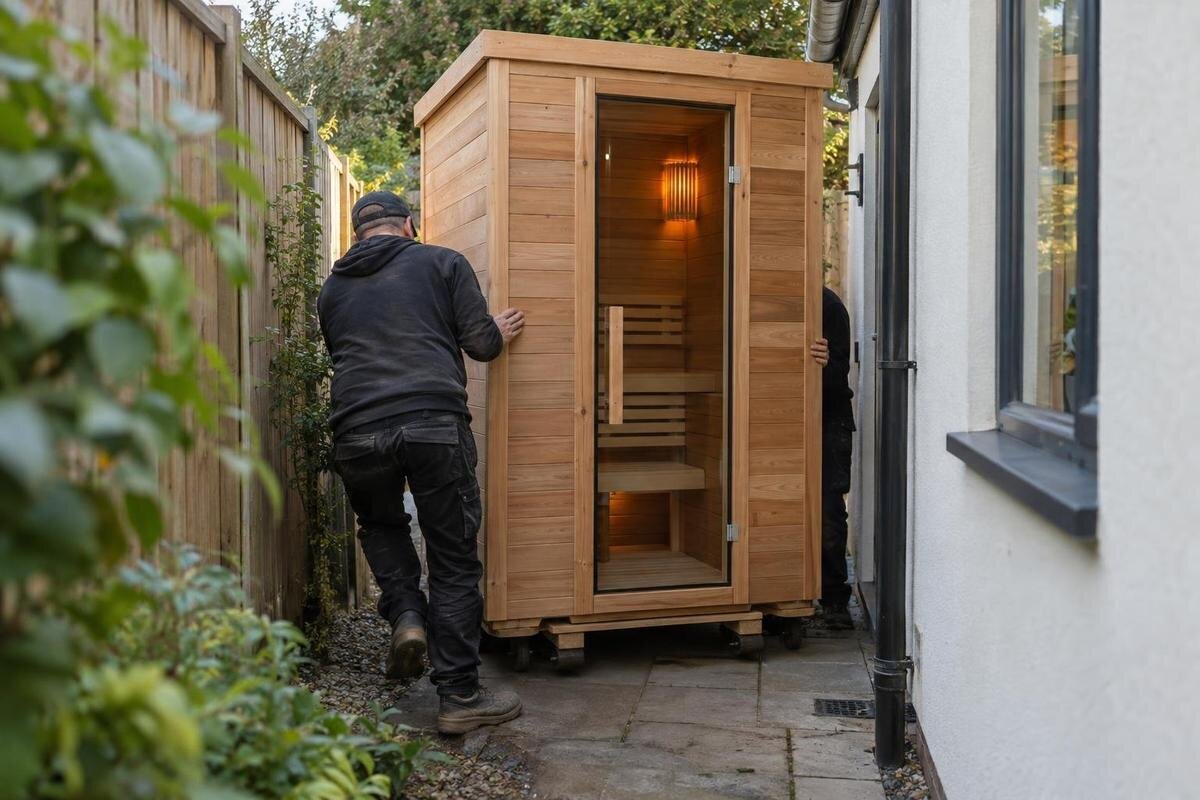
Getting a sauna into a garden with narrow access is a delivery question before it is a siting question. The assembled outline or advertised area cannot tell you whether the packaging, largest rigid section, handling equipment and delivery crew can get from the vehicle to the final position. Establish how the exact model will arrive, obtain its delivery dimensions, and walk the full route: vehicle approach, unloading point, gate, turns, overhead obstructions and the last stretch across the garden. Where a measurement or handling method is uncertain, ask the supplier and delivery provider to confirm it from their drawings and procedures rather than relying on a photograph or estimate.
Delivery route checks 1
Delivery access is separate from the sauna’s final footprint
A garden may have ample room for a sauna once it is in place and still present a difficult delivery route. A narrow side passage, a tight turn beside a shed, steps or a low arch may make delivery difficult even when the final space is generous. Conversely, a restricted path does not automatically rule out a product: the outcome depends on how it is supplied, whether components can be moved separately and what handling equipment the delivery provider can use. Treat access as a separate check, not an estimate based on the size of the garden.
Map the journey from the point where the delivery vehicle can actually stop, not just from the garden gate. Include the unloading position, a driveway or shared passage, every threshold and turn, and the final stretch to the agreed position. The permanent footprint shows how much space the assembled sauna occupies; it does not show the room needed for packaging, a carried section, moving equipment or the people controlling it. Establish a feasible route first, then check the installation space and clearances around the final position against the selected model’s instructions. Identify a place to set packages down without blocking a narrow passage.
Confirm how the sauna will arrive
Delivery format changes the access problem more than a product photograph suggests. Depending on the exact model, configuration and delivery arrangement, a sauna may arrive as one assembled unit, as large sections or as multiple packed components. Treat these as possibilities to verify, not assumptions based on a category name. Ask the seller for the format of the model you intend to order, the number of packages, whether a pallet or protective wrapping remains in place during movement, and which pieces cannot be separated or repositioned. If the order or specification changes later, check whether the delivery details change too.
Establish where the carrier’s responsibility ends. The service may unload at an agreed point rather than carry the sauna through a side passage or place it in the garden, so ask what is included in writing: vehicle access, unloading, movement beyond the vehicle and on-site assembly are separate tasks. Ask whether packaging can be opened at the unloading point and who will remove it. If you are considering the Sauna N-250, use that exact model name in your enquiry; the product name alone does not say whether your delivery will be assembled or packed. Confirm that the answer applies to your chosen configuration and delivery address.
Delivery route checks 2
Request dimensions for the actual delivery
Ask for the current manufacturer drawing and delivery information for the exact version, not just an assembled outline or category image. The useful set includes the outside length, width and height of every package, the dimensions of the largest rigid component, and any projections or handles that affect clearance. Check whether stated measurements include the pallet, wrapping and protective corners; packaging can change the space a piece needs to pass through. Request package weights and any manufacturer instructions about orientation or handling as well, then pass that information to the delivery provider rather than trying to devise a lifting plan yourself.
A single overall length and width may not describe all the pieces. Get the package count and identify the largest rigid item, while also checking that another package is not taller or wider. Match the documents to the exact model and configuration. The catalogue shows 5.12 m² for the Sauna LC-260, but that area figure does not state the packed length, width, height or turning clearance. If a listing and drawing differ, or the only dimensions available are for the assembled sauna, ask the supplier to resolve the gap before booking.
Measure the narrowest clear openings
Walk the route with a tape measure rather than relying on a gate’s nominal width. Measure with the gate fully open to its normal stop, allowing for hinges, posts, a latch, handles, wall returns and any raised threshold. If the opening is uneven, check at more than one height and note the narrowest usable point. Where a piece must stay upright, do not assume there is room to tilt it through. If a gate leaf could be opened further or temporarily removed, confirm that this is permitted and safe, and agree who will do it.
Repeat the check at every pinch point beyond the gate: a gap between a wall and shed, a downpipe, meter box, raised bed, outdoor tap or stored bin can be the limiting point. Record the smallest clear opening and take photographs with a tape visible, then have the delivery provider compare those measurements with the shipment and its handling space. If the Sauna HCF-300 is the model under review, use its confirmed delivery dimensions for that comparison, not a product image or a generic barrel-sauna outline. Note any obstacle that cannot be moved before the route is agreed.
Delivery route checks 3
Check every turn and change of direction
A load that fits through a straight gate may still be unable to negotiate the path immediately beyond it. At each bend, check the usable width on both legs and the open space around the inside and outside corners. A long rigid package needs room to swing; its clearance depends on its shape, orientation and how it is controlled, not just on the width of either straight section. A simple plan can show where a wall or post narrows the turn, but a single diagonal measurement cannot prove that the real load can be moved safely.
Sketch the route and mark gates, corners, walls, posts, steps and any space that opens beside a turn. Add measured lengths and widths, and note whether a gate must be held open or a door swings into the path. Ask the delivery team to review the plan or clear photographs against the actual package dimensions and permitted carrying position. When your enquiry is about the Sauna LCF-300, request the delivery dimensions and permitted orientation of its largest rigid piece; those are needed to assess a turn. Do not dismantle a boundary or fixed fitting without the owner’s permission and appropriate advice.
Include overhead clearance in the route check
Check vertical clearance as well as width along the route. Look above the vehicle approach, unloading point, gates and garden path for eaves, gutters, low branches, archways, pergolas, wall lights and overhead lines. Measure the lowest fixed point, not the most open part of the route, and check whether the shipment and any moving equipment can pass beneath it in the actual orientation. A piece carried upright may need more height than one moved differently, but do not assume that tilting or rotating is allowed; the manufacturer and handling team should confirm permitted positions.
Include the height of the handling equipment in the discussion, not just the top of the package. Send clear photographs and measurements to the delivery provider if a roof, branch or service line is close to the route. Keep clear of overhead services, and do not ask the delivery crew to move or alter them; ask a relevant qualified professional to assess any uncertain clearance. The listed 1.93 m² for the Sauna S-140 is an area figure, not the height of its tallest package or the clearance required while it is being handled.
Delivery route checks 4
Agree the unloading point and vehicle approach
The garden route starts at the delivery vehicle, so check where it can approach and stop before discussing the final carry. Ask the carrier what vehicle is planned, what space it needs to turn or reverse, where it can unload, and whether there are restrictions or permissions to resolve for a road, driveway or shared lane. Do not assume a large delivery vehicle can reach the house because a car can. If it must stop short, record the actual unloading point and measure the distance from there to the sauna position, including any gates or turns on that part of the route.
Clarify who provides the equipment and crew to unload, and whether the order includes moving packages beyond the vehicle, across the property or to the prepared location. Confirm that the equipment can reach the unloading point and that there is room to manoeuvre there. If the Sauna HC-150 is the model selected, include its exact name and confirmed package information in the enquiry. A product listing does not establish which vehicle, crew or unloading service is included in a particular delivery, so get those details from the provider.
Check the ground and clear temporary obstacles
A clear route on a drawing may not suit the planned handling equipment. Walk it and note gravel, soft or wet ground, uneven paving, changes in level, steps, narrow drains and fragile landscaping. Ask the delivery provider what surfaces its proposed equipment can cross and what protection it requires; do not assume that wheels, a pallet truck or manual carrying will suit every path. If a drain cover or other surface is uncertain, have the appropriate professional assess it rather than testing it with the delivery load. Mention any likely changes in ground conditions before the delivery is arranged.
Move temporary obstacles such as bins, bicycles, pots, outdoor furniture, hoses and washing lines before the agreed delivery time, and leave room for people to work around the load. Identify items that cannot simply be shifted, including fixed lights, pipes, boundary posts and service covers, and flag them early. If the Sauna HC-225 is under consideration, give the delivery team the confirmed package information and describe the route surface; the listed product area cannot establish whether a particular surface or transport aid is suitable. Check any shared path or land with the person responsible before relying on access through it.
Delivery route checks 5
Plan the final movement and any assembly
Some deliveries may be moved forward package by package and assembled on site; others may need a clear route for a much larger section or completed unit. Confirm which applies rather than assuming that a narrow entrance can be dealt with by unpacking at the kerb. Ask how the packages are protected, which pieces must stay together, where they can be set down temporarily, and whether assembly is included or arranged separately. If assembly is required, check the instructions for working space around the sauna so the route ends at a practical assembly area, not merely at a patch of garden.
Check the last few metres as carefully as the gate: a step, soft strip of ground, tight gap beside the planned position or lack of space to turn can prevent handlers reaching the agreed spot. Allow for the people, tools and components involved in the delivery and assembly, without assuming they can use space outside your property. If considering the Sauna N-210, ask the supplier whether your exact configuration arrives assembled or in parts and how much space is needed to set its packages down. Keep that delivery decision separate from the sauna’s permanent footprint.
Put the route agreement in writing
Make a short record before confirming a delivery date: exact model and configuration; package dimensions, count and weights; vehicle stopping point; narrowest opening; each turn; overhead clearance; steps and surface conditions; and the unloading and handover points. Add a simple plan and clear photographs. Mark which obstacles will be moved, who will move them, and whether any part of the route is shared. This gives the supplier and carrier specific details to review instead of a description such as ‘the garden is a bit tight’.
Ask the supplier or delivery provider to confirm in writing whether the route and proposed handling method are suitable for the exact shipment, and what must be ready beforehand. If they cannot confirm it, pause and ask what alternatives, such as a different delivery configuration, route or professionally arranged handling, are actually available; do not assume one can be provided. Recheck after any change to the product, packaging, gate, garden works or vehicle. On delivery day, keep the agreed path clear. If conditions differ from the plan, stop and get the provider’s advice before moving the sauna.
Frequently asked questions
Can I use the sauna’s advertised area to check whether it will fit through a gate?
No. An area figure or assembled outline does not tell you the size of the packages, their height while being carried, or the room needed to turn them. Ask for dimensions for the exact delivery configuration, then compare them with the whole route and the handling method.
Which dimensions should I request from the supplier?
Ask for the outside length, width and height of every package, including any pallet and protective wrapping, and identify the largest rigid piece. Request package weights, the number of pieces and any instructions about orientation or handling. If the information only describes the assembled sauna, ask for the delivery details separately.
Is measuring the narrowest gate enough?
No. Check every opening, turn and overhead obstruction, as well as the vehicle approach, unloading point and surface under the route. A package can fit through a straight opening but still be difficult to turn or move over a step. Have the delivery provider review the measurements against the actual shipment.
Can the sauna be unpacked before it goes through the narrow access?
That depends on the product, how it is delivered and what the supplier and carrier permit. Unpacking may not make the largest rigid pieces smaller, and packaging can be needed for protection. Confirm who may unpack it, where that can happen and who will deal with the packaging before arranging the delivery.
Who should confirm that the delivery route is workable?
Give the supplier and delivery provider the exact model, confirmed package details, measurements and clear photographs, then ask them to confirm the proposed handling method. A qualified professional should assess uncertain fixed obstacles or overhead services. Do not rely on a guess or improvise a lift if the route differs from the agreed plan.
A reliable access plan is based on the exact shipment and the route as it exists, not the sauna’s area or a best-case guess. Once the supplier and delivery provider have reviewed the packages, turns, overhead clearance, ground and unloading arrangements together, you can make the separate decision about the final garden position. If they cannot confirm a workable handling method, resolve that before delivery is booked.
