
Traditional or Infrared Sauna: Which Experience Suits You?
Sauna buying guide
Traditional and infrared saunas can both provide a warm, enclosed place to unwind, but they do not create warmth in the same way. The difference changes the session’s feel, the equipment to compare and the routine that may suit your household. This guide focuses on those practical choices rather than health promises. It also separates heating method from shape or timber: a sauna described as a barrel or thermowood model is not, on that description alone, identified as traditional, infrared or hybrid.
How traditional and infrared saunas produce warmth
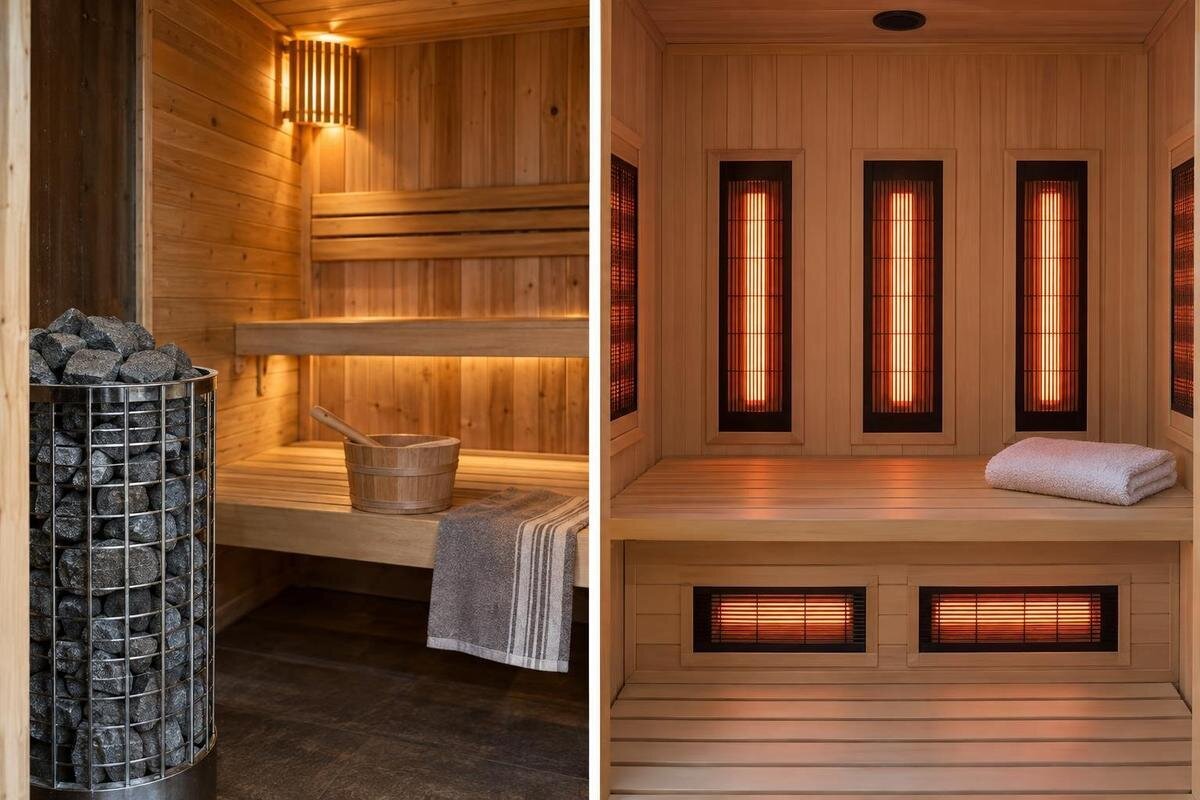
Here, a traditional sauna means a cabin heated mainly by a sauna heater and stones. The heater warms the stones, the air and nearby surfaces, so the experience includes a strong hot-air component. Some traditional heaters permit water to be poured over the stones, briefly increasing humidity; use water only as the product instructions allow. The label does not guarantee one fuel, controller or cabin design, and those details affect operation. A steam room is a different arrangement, not simply a traditional sauna with more water. Treat the category as a first clue, then identify the heat source and permitted operation.
An infrared sauna uses emitters to send radiant energy into the cabin; the body and surrounding surfaces absorb some of it, while the air also warms. In a typical infrared setup, emitters rather than a stone heater provide the main heat source, but confirm the precise design for each model. Keep the enclosure and the heating equipment separate in your comparison: the cabin description tells you what structure is offered, while the equipment specification explains how it produces warmth. The Thermowood Barrel Sauna N-210 listing states 4.43 m², but that area figure does not identify its heating system or establish an infrared configuration. When reading a product page, look for an explicit description of the heat source rather than drawing conclusions from the cabin’s shape, timber or size.
What the session feels like
With a traditional heater, you usually notice warmth as hot air around the body, together with heat from the warmed room and benches. How intense that feels depends on the cabin, heater, air movement, bench position and how the session is run. If the heater permits water on the stones, the temporary increase in humidity changes the sensation again; it does not make every session alike. Someone who likes a full-room, hot-air environment may prefer this style, while another person may find it less comfortable. Personal comfort matters more than a label or a number on a control.
Infrared warmth comes more directly from emitters, so a session can feel different even when a display shows a similar temperature. Some people prefer the radiant sensation and a cabin that does not feel as dominated by hot air; others want the enveloping warmth of a stone-heated room. Emitter layout, controls and cabin conditions all affect the experience. A displayed temperature is meaningful only in the context of how and where it is measured. If possible, experience both approaches before deciding, while remembering that a demonstration setup may not match your home.
The equipment behind each type
With a traditional sauna, the core equipment is the heater and its stones, together with the control and sensing arrangement specified for that cabin. Product documents should identify the heater type, its stated compatibility with the enclosure, how the controls operate, any permitted water use and the required clearances. If a wood-fired heater is offered, confirm its flue requirements and who handles that work; for an electric model, have a qualified electrician verify the supply and installation requirements. Do not assume the heater is included just because a page describes a sauna: check the selected package and written inclusions.
Infrared cabins use radiant emitters and a controller, with panel locations and access differing by model. Compare which parts are supplied, whether a separate control or sensor is needed, and what the manual says about operation and cleaning. The N-250 Thermowood Barrel Sauna listing reports 5.27 m², a useful area figure but not an equipment list. Its name and area cannot confirm whether a heater, stones, emitters or controller are included. Record what is supplied, what is optional and how any serviceable parts are accessed. Keep those entries separate when comparing packages: a cabin price and a price covering the cabin plus heating equipment are not equivalent starting points. If you plan to select equipment separately, ask who will confirm that the proposed components are compatible. Do not leave that responsibility unclear between the cabin supplier, equipment supplier and installer.
Warm-up and everyday routine
Neither type has a reliable warm-up time that can be inferred from its name. The result depends on the heater or emitters, cabin size and construction, starting conditions, available power and the maker’s operating instructions. Ask whether any quoted time refers to a particular starting temperature, an empty cabin or a specified target. Also establish what the supplier means by ready for use: a control display reaching a setting and the whole setup reaching its recommended operating condition should not be treated as interchangeable descriptions. The LC-260 barrel sauna listing states 5.12 m²; that figure alone says nothing about heater output or warm-up time. Compare guidance for the exact configurations under consideration, noting the conditions attached to each estimate rather than comparing two headline times without their context.
Think about the routine as well as the wait. A traditional setup may involve allowing the heater and stones to reach the maker’s recommended operating condition, then using the controls and, where allowed, water on the stones. An infrared setup has its own preheat instructions, timer and control sequence; do not assume it switches on instantly or uses the same displayed setting. Consider when you would use the sauna, how much preparation you accept and how the maker says to turn it off and air the cabin afterwards. The manual, not a general category rule, should guide that routine.
Space, seating and emitter position
Check the usable layout, not only the external shape. In a traditional cabin, internal height, bench levels, bench depth and the position of the heater all affect how people sit and where warmth is felt. Door access and space around the entrance matter too; a drawing can show whether the benches suit sitting upright or stretching out. The Thermowood Barrel Sauna HCF-300 listing gives 6.89 m², but a stated area does not reveal usable bench length, headroom or the room needed around the unit. Compare dimensioned drawings and distinguish internal measurements from the overall size.
For infrared, study the maker’s diagram of the emitter locations relative to the seats. Panel position and orientation can change which parts of the body receive radiant warmth, so a photograph alone is not enough to judge the layout. Check how a seated user relates to the emitters, whether benches or accessories affect the arrangement, and what the manual requires around the panels. Allow for the door opening, cleaning, ventilation and access to controls as well. A cabin that fits the available space on paper may still be awkward if its interior or access route does not suit your intended use.
Match the sauna to the people using it
For a shared sauna, compare seating positions and dimensions with the number and posture of the people who will use it, rather than treating area as capacity. The LCF-300 model page gives 6.89 m², but that figure cannot tell you how many people can sit comfortably or whether the benches suit them. Use interior drawings and ask how usable space is measured. Consider who needs to enter and move around, how close users will sit to a heater or emitters, and whether a trial is possible. Do not infer a seating count from a model name or photograph alone.
Frequency and preferred routine matter too. If use will be occasional, straightforward controls and manageable preparation may matter most. If several people will use the cabin, discuss whether each prefers stone-heated air, water on stones where permitted, or radiant warmth. Be specific about those preferences: does everyone want the same heating experience, or would they simply use the sauna at different times? Separate a preference for the heat itself from a preference for the routine, since these may lead to different priorities. One person may value preparing the cabin in advance, while another wants fewer tasks before use. A sauna that suits one person may not suit the whole household. Agree which compromises are acceptable before comparing appearance or extra features. Where preferences differ, trying each type is more informative than assuming there is one standard session everyone will enjoy.
How to read infrared sauna research
When looking up infrared sauna research, identify the exact system studied, the participants, the session protocol, the comparison group and the outcome measured. An experiment using one emitter design and particular conditions cannot automatically be applied to every cabin sold under the infrared label, or compared directly with a traditional sauna study using different conditions. Check whether you are reading a full study or a summary, when it was published and what limitations the authors report. A headline about one measured outcome does not establish a lasting health effect or prove that one sauna type is better. The same care applies to claims about traditional sauna use.
Do not buy either type on the promise that it detoxifies the body, produces a specific weight change or treats an illness; this comparison cannot substantiate those claims. Research about sauna use is not a substitute for advice about your own health, and evidence for one heat system should not be presented as proof about the other. If you have a health concern or have been told to limit heat exposure, ask a healthcare professional whether sauna use is suitable for you. Follow the safety information supplied with the exact product.
Compare energy use and ongoing care
Do not assume infrared uses less electricity, or that traditional heating costs more, simply because of the type. Compare the stated input power and the maker’s operating information for the actual models, then consider your likely frequency of use, warm-up routine, session length and local electricity tariff. A size figure alone is not an energy estimate: the S-140 Thermowood Barrel Sauna listing states 1.93 m², but it does not establish power consumption or running cost. Keep the assumptions consistent when comparing estimates. For example, do not compare one model’s warm-up period with another model’s complete session, or occasional use with a daily routine. Write down which stages of use each estimate covers and which figures remain uncertain. If you estimate cost, use product-specific power information and your own tariff, and label the result as an estimate rather than a guaranteed bill.
Ask about upkeep before buying. Traditional heater stones and other heater components may need the inspection or replacement described in the manual; timber surfaces and ventilation also need care according to the cabin’s instructions. For infrared, find out how to clean around the panels and whether the maker specifies checks or service access for components. Neither system has a universal maintenance advantage: details depend on the unit and its materials. Include the documented cleaning routine, any specified replacement tasks and access for service in your comparison.
Comparing your shortlist
Write down your non-negotiables before looking at designs: the session sensation, whether you want a stone heater, whether water on stones matters, how many people need to sit and how much preparation you accept. Rank those preferences so you know which differences are decisive and which are optional. If the amount of space a cabin occupies matters too, the HC-150 sauna listing states 2.97 m²; use that figure alongside a measured site plan, not as evidence of usable seating or heater type. Space and heating method are separate parts of the choice.
Compare the remaining options on the same sheet: stated heating method, exact heater or emitter configuration, included controls, internal dimensions, stated capacity, warm-up guidance, electrical requirements, cleaning and manufacturer support. Give each entry a clear status: confirmed, optional or still unclear. This makes a missing detail visible without treating it as a feature the product definitely lacks. Keep your essential requirements separate from features that would merely be welcome; otherwise, a long list of extras can obscure the heating experience you actually want. If information is missing, ask one specific question about the precise model and configuration rather than requesting a general recommendation. Where possible, try each type, but record which cabin and conditions you experienced. Base the decision on comparable details and your preference, not a slogan such as more powerful or more efficient without an explanation of what is being compared.
Confirming the model and selected options
Before ordering, confirm that the title, selected options and technical documents all describe the same sauna. Check the heating method explicitly, whether the heater and stones or infrared emitters are included, what controls come with it, the cabin’s internal and external dimensions, and any stated power or clearance requirements. For example, the Thermowood Barrel Sauna HC-225 listing states 4.4 m²; area alone cannot answer any of those equipment questions. Ask for the manufacturer’s drawings and the applicable operating manual if the details are unclear.
Then check practical supply and site questions: access to the intended position, the room or surface requirements stated by the maker, ventilation, installation responsibility and any work that needs a qualified professional. Clarify who supplies each part and who is responsible for installing it, particularly where the cabin and heating equipment are ordered separately. Keep the agreed configuration with your order details so that later discussions refer to the same package rather than just the model name. The linked products here are Thermowood Barrel Sauna listings, included to illustrate stated area figures; they are not evidence that an infrared or hybrid version is available. Confirm local availability for the selected configuration, not merely the presence of a product page. Any remaining uncertainty about the heating system should be resolved before ordering.
Frequently asked questions
Is a traditional sauna always hotter than an infrared sauna?
There is no universal comparison. Traditional saunas heat stones and cabin air, while infrared saunas rely on radiant emitters and may have different air conditions. Heater design, cabin, controls and measurement points all vary. Compare the operating information for the specific models rather than treating display temperatures as equivalent.
Can you pour water on an infrared sauna heater?
Only if the manufacturer explicitly allows it for that equipment. Infrared emitters are not sauna stones, so do not assume they can be splashed. The same rule applies to a traditional heater: use water on stones only as its instructions permit.
Does an infrared sauna use less electricity?
Not automatically. Energy use depends on the specific equipment, cabin and operating routine. Compare the stated power and manufacturer’s operating information, then consider how often you expect to use the sauna and your electricity tariff. A general claim about one heating type is not enough to estimate your cost.
Does a barrel shape identify the sauna’s heating system?
No. Barrel describes the cabin’s shape, not its heating system. Check the exact product specification for the heater or emitters, controls and included equipment. Neither a barrel shape nor a timber description identifies a sauna as traditional, infrared or hybrid.
Are infrared saunas better for your health?
This comparison cannot establish that either type is medically better. Research relates to particular equipment, participants and session conditions, and should not be treated as proof about every sauna. If you have a health concern or have been advised to limit heat exposure, ask a healthcare professional whether sauna use is suitable for you.
The key distinction is the source of warmth: traditional saunas centre on a heater and stones, while infrared saunas use radiant emitters. That difference shapes the session, equipment and routine, but does not make one universally better. Decide which experience appeals to you, then compare the actual specifications, layout and instructions of each candidate. The heating label is useful only when it matches the details of the product and the way you want to use it.
