
Buying an Aluminium Greenhouse: What to Check in the Frame
Greenhouse buying guide
When buying an aluminium greenhouse, the material is only the beginning of the comparison. The words aluminium frame do not tell you the profile dimensions, how members meet, which fixings are supplied or how the frame connects to its base. Those details help you understand what you are actually comparing and what information to request before ordering. Use this guide to read frame descriptions and drawings critically, separate confirmed details from assumptions, and focus on the construction of the greenhouse rather than its position or glazing.
What an aluminium frame specification should identify
Treat the material name as one line of a specification, not a quality grade. Aluminium identifies the frame material, but it does not tell you the shape or dimensions of each profile, the number and position of members, or how those members are joined. It also does not establish what the base, brackets, clips or opening hardware are made from. Those details may be described separately, so read the component list as well as the headline description. The useful comparison is the assembly of rails, uprights, roof members and connectors, rather than the word aluminium on its own.
A product title, the finish shown in a photograph or a broad adjective such as robust cannot fill gaps in the technical information. For each model, note which details are stated, which appear only in an illustration and which are absent. Keep dimensions and performance statements within the supplier’s published specification; a picture alone is not a basis for judging structural capacity. Also check whether the specification describes frame sections only or a complete frame kit. If a detail matters to your purchase and is not documented, record it as a question instead of guessing. It can help to date your notes and save the relevant document version, since a general brochure, product page and assembly guide may not describe the same configuration.
Frame profiles and member layout
Look for profile dimensions or a cross-section drawing, not just a perspective image of the assembled greenhouse. Check whether the document identifies the rails, uprights, eaves, ridge and roof members, and whether it gives dimensions for the same parts. A side view may show the overall outline while hiding how a corner, ridge or door opening is formed. If profile wall thickness is provided, note it as a stated specification; do not turn one measurement into a conclusion about the whole frame’s performance. Ask for a parts diagram or schedule if the list uses codes without identifying where pieces belong.
Use a consistent record for each product: profile type, dimensions where supplied, location of the main members, and any stated reinforcement or special connector. For example, the classic aluminium greenhouse listing is one product page to read with that record in hand; its name alone cannot tell you those details. Check whether listed measurements refer to individual profiles or the assembled greenhouse, as these are not the same thing. Do not judge apparent thickness from an angled photograph. If the page gives only an outer outline, ask whether a frame drawing is available before treating two models as comparable. Where drawings use a scale, use it only to understand the layout unless the supplier explicitly gives the dimensions of the relevant profile.
Joints and connectors
Joints are where individual frame members meet, so examine them at corners, along the roof, around openings and where the frame reaches the base. A product diagram may identify a bracket, connector, sleeve, channel or another method; these are possibilities to look for, not assumptions about a particular greenhouse. See whether diagrams label each component and distinguish a joint from a decorative cover. Check that any part references in the drawing match the parts list. A connection that is not shown clearly cannot be compared reliably with one that is documented.
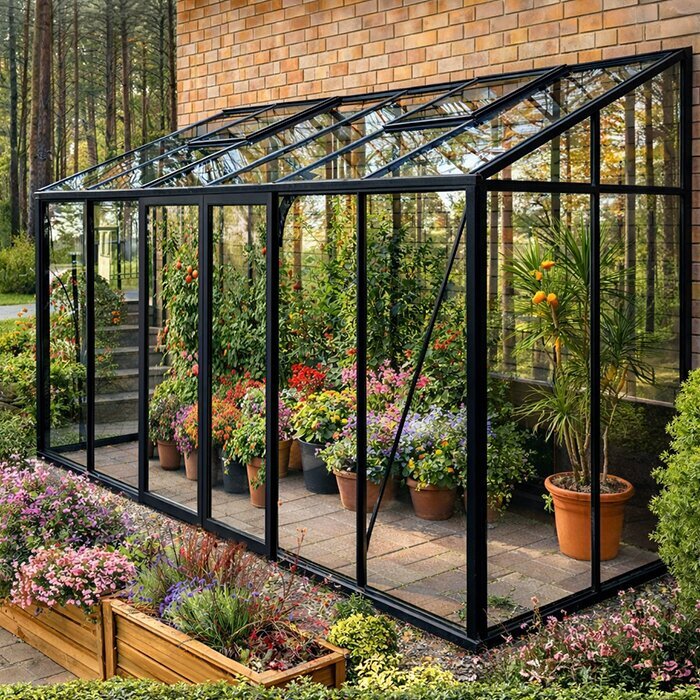
For a lean-to aluminium greenhouse listing, find the drawing that shows the frame along the wall-side edge rather than inferring its construction from the lean-to name. Check how members meet at changes of direction and whether the document shows different connectors at the roof, base or openings. Confirm that the drawing belongs to the exact model and version you are considering; a generic illustration may describe a range rather than a specific package. If a joint is partly hidden in a photograph, use a technical drawing or ask for written clarification before comparing it with another frame. When reviewing an answer, ask which joint it refers to, because a description of one corner does not necessarily explain every connection in the structure.
Fixings: what is in the package?
Fixings are a separate part of the comparison from the profiles themselves. Look for a list showing whether screws, bolts, clips, brackets or other connectors are included, and whether quantities or part references are identified. A photograph of an assembled frame may show fixings without establishing what arrives in the box; a drawing may show pieces that are optional or supplied separately. The description should make the package boundary clear, including whether the listing includes hardware for its frame joints and any fittings that attach doors, vents or base components.
Ask what material and finish are specified for the fixings if that information matters to your maintenance expectations, and whether replacement items can be identified by part number. Do not assume every screw in an illustration is part of the order or that a general hardware-shop alternative is approved. A limited-edition aluminium greenhouse listing still needs the same itemised checks: an edition label does not describe the fixings. Separate included parts, optional extras and items the supplier says must be sourced separately. This makes it easier to ask a precise question about what the kit contains. Also note whether quantities are stated for each fixing type, as an unnamed bag of hardware is harder to compare or query later.
The base rail and its connection
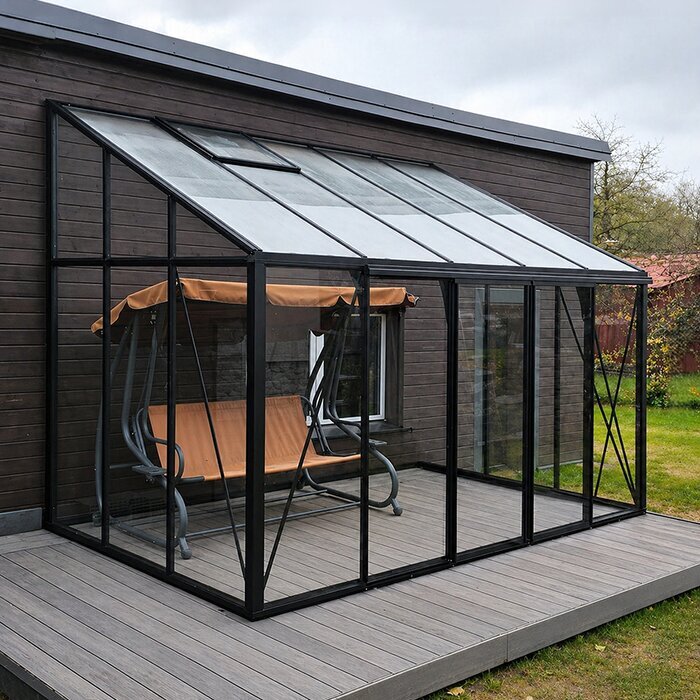
At the bottom of the structure, identify the part described as the base rail, base frame or base kit; terms can vary, so match the wording to a drawing. Check whether it forms part of the greenhouse package, is a separate option or is not described. Find out how the uprights and corner members meet the base and what parts connect them. Do not infer that a metallic-looking strip in a photograph is a particular material or that an illustrated base is included: confirm both in the written specification and contents list.
If Garden Orangery T appears in a wider shortlist, confirm its listed frame material and base details before treating it as an aluminium comparison; the product name alone does not establish either. Ask whether the instructions identify the base connection and intended support surface, and whether any anchors or fittings are included. For a site-specific fixing question, use the supplied guidance and seek advice from a qualified professional rather than selecting hardware by appearance or improvising an engineering solution. Keep this check focused on the frame-to-base connection, not on choosing the greenhouse’s position in the garden. Make a note of any separate base kit or support requirements, so they are not inadvertently treated as part of the main frame package.
Roof members and bracing
Roof members deserve their own check because an outside outline does not reveal how bars meet at the ridge, eaves, corners or roof slopes. Look for a drawing that labels the main roof profiles and any cross-members or braces, and shows where they connect to the rest of the frame. Compare the member layout, not just the apparent shape: photographs can hide information about spacing, joints or part references. Where the documentation uses a parts code, trace it to the diagram so you know which piece is being described. Do not read structural capacity into how substantial a bar looks in a render.
The pyramid greenhouse name suggests a shape, but it does not establish the frame material or explain how its roof members are joined. Check the product specification before including it in an aluminium shortlist, then look for the same roof details you would request for any other model. Ask whether the illustration represents the exact configuration and whether the listed members, connectors and braces are included. If no structural drawing is available, do not assume that a similar-looking design has the same layout; compare only details the supplier documents. Keep the roof diagram alongside the parts list, since an unlabelled line in a drawing may otherwise be mistaken for a separate member or brace.
Door and vent openings
Doors and vents meet the frame at openings, so include those areas rather than assessing only long rails and corner posts. Check whether a drawing shows the opening perimeter, the members above and beside it, and where hinges, tracks or other hardware attach. If the greenhouse has more than one opening arrangement, confirm which one applies to the model or configuration on the page. Dimensions are useful only when you know whether they describe the opening, an individual component or the complete frame. That distinction helps you understand what can be assembled from the parts listed.
The aluminium greenhouse with built-in storage title highlights a feature, but it does not answer questions about door or vent framing; look for those details separately. Check the parts list to see whether opening hardware is part of the greenhouse package or listed as another component, and ask for clarification if text and diagram differ. A clear drawing also helps show where the frame ends and an opening accessory begins. Do not assume a particular door type, number of vents or layout from the model name; those particulars should come from the selected configuration’s specification. If measurements are supplied, record the label used beside each one, so an overall dimension is not confused with a clear opening size.
Surface finish and care
Aluminium describes the frame material, not necessarily the treatment or colour of its surface. Look for an explicit description of any finish and check which components it covers: the main profiles, connectors, base, or only selected parts. A colour shown in a product image is not enough to identify a coating, its extent or the care it needs. If the listing uses a term for a surface treatment, make sure it refers to the greenhouse frame you are comparing rather than a separate base or accessory. This matters especially when several components are described using different material terms.
The Prestige greenhouse with a metallic base title mentions a metallic base, but it does not establish that the greenhouse frame is aluminium or say how either part is finished. Confirm the frame and base descriptions separately, then read the care instructions for the specified surfaces and fixings. Ask whether cleaning guidance differs among components and how to identify a part if it needs attention later. Avoid assuming that every visible metal part has the same treatment or maintenance requirements; use product-specific documentation rather than a generic rule about aluminium. Retain any stated care guidance with your comparison notes, as it may distinguish advice for profiles, hardware and a separately described base.
Parts lists and replacement components
The frame description is more useful when it connects to a parts list and an assembly document for the exact model. Check that profile names or part numbers in the list correspond with the drawings, and that the list distinguishes the frame from glazing, doors, vents, base and optional accessories. This helps establish the package boundary before payment and gives you a reference if you need to query an omitted component. If instructions are not available on the product page, ask whether you can review them before ordering, particularly where joint or base details remain unclear. Check that the documents refer to the model and configuration you are considering.
If Bloomcabin Orangery is in your broader search, check its written frame-material description before counting it as an aluminium option; the name alone is not proof. For any model, ask whether replacement frame parts are identifiable and how a missing or damaged component is handled. Read the supplier’s stated warranty terms, if provided, rather than assuming they cover every frame, fixing or finish issue in the same way. The point is to know what documents and support information exist, not to infer that a particular model includes a guarantee or replacement service. Keep copies of the documents used for comparison, including their model references, so a later question can be linked to the correct frame version.
Comparing shortlisted frames before ordering
Before ordering, make a compact comparison record for each shortlisted greenhouse. Note the stated profile dimensions, member layout, joint type, fixings included, base arrangement, opening details, finish and the exact documents consulted; mark each item as stated, unclear or confirmed in writing. This is more useful than a general score for the frame, because a missing detail may matter more to your purchase than another model’s extra feature. Record the model name and configuration as well, so you do not compare a drawing for one version with the package details for another.
Then compare like with like: use the same categories for every product and separate stated facts from your impressions of the photographs. If one greenhouse lists profile and joint information while another gives only a headline material, regard the latter as less documented, not necessarily inferior; ask for the missing information before deciding. If an answer remains unavailable, decide whether that uncertainty is acceptable for your purchase or leave the model off the shortlist. Avoid turning a product name, an image or a single dimension into a claim about the complete frame. A completed record also makes it easier to spot when two answers use different terms for the same component and need clarification before they can be compared.
Frequently asked questions
Is an aluminium frame automatically durable?
The material name alone does not establish how a particular frame will perform. Compare the specified profiles, joints, fixings, base connection, finish and care guidance. Avoid treating a photograph or a single measurement as proof of the complete frame's suitability.
Which drawings should I ask for?
Ask for a model-specific frame drawing showing the profiles and main members, how they meet at joints, the base connection, roof layout and door or vent openings. A parts list that matches the drawing can help clarify which components are included.
Are all fixings included with an aluminium greenhouse?
Do not assume so from a photograph or an assembly illustration. Check the written package contents for fixings and connectors, and ask whether any parts are optional or need to be sourced separately. This gives you a clearer picture of what the order includes.
Does a metallic base mean the frame is aluminium?
No. A base and the greenhouse frame are separate components, and a product title that mentions a metallic base does not establish the material of the frame. Check the specification for each component individually.
What should I do if joint or anchoring details are missing?
Ask for the relevant model-specific documentation before ordering rather than inferring details from the image. For a site-specific anchoring question, follow the supplied guidance and seek advice from a qualified professional; do not guess at a fixing method.
A useful aluminium greenhouse comparison is grounded in frame details: profiles and member layout, joints, fixings, the base connection, openings, finish and package contents. Check what the product documents actually state, and leave gaps as unknown until they are clarified. That way, your decision reflects the particular frame and package being offered, rather than a material label or an impression from a photograph.
