
Growing Okra in a Greenhouse
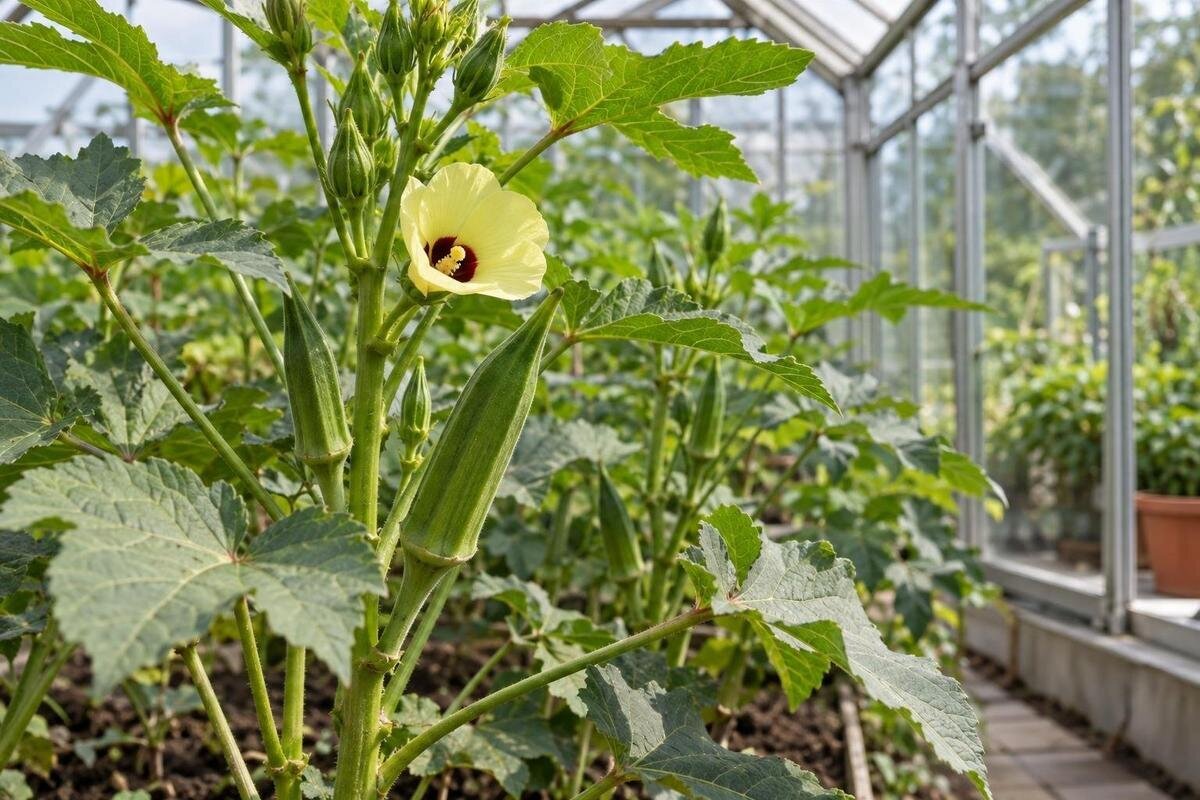
Greenhouse growing guide
Okra can produce pods in a UK greenhouse, but it demands more warmth and time than many familiar protected crops. It needs warm compost to germinate, sustained heat for steady growth and enough bright weeks to flower before autumn. Glass captures daytime warmth and provides shelter, but an unheated greenhouse cannot promise mild nights. That makes okra possible rather than dependable: the result depends on variety, sunlight, the site and the weather. The practical decision is whether to treat it as a small trial, share heat already used for other crops, or pay to extend its growing window.

Before choosing a greenhouse 1
Is okra a realistic crop for a UK greenhouse?
Okra is a tropical, frost-sensitive annual. In Britain, the challenge is not simply getting a seed to sprout; the plant must keep growing in warm, bright conditions for long enough to flower and fill pods. A greenhouse can provide warmer days and shelter leaves from wind and rain, but its temperature still follows the weather and available light. A plant may remain alive in conditions that are too cool for steady growth, so healthy foliage at midsummer does not guarantee a useful harvest. Choose an early-maturing variety and check its stated height and days to maturity before sowing.
Treat okra under glass as a warm-summer project rather than a dependable crop every year. In a bright, favourable summer, one or two plants may give a modest harvest; cool nights or a dull spell can push flowering and pod development late, leaving little time before autumn. If you want many pods, this uncertainty matters as much as the floor area the plants occupy. Keep notes on sowing, planting, flowering, first pod and overnight lows. Those records help separate a timing problem from a temperature or light problem, and make a second attempt more informed. Plan for a seasonal crop, not year-round picking.
How warm and how long does okra need?
Okra needs warmth from germination onwards, not just a hot spell when the plants are mature. The Royal Horticultural Society recommends keeping newly sown seeds above 16°C, then moving seedlings into good light and keeping them warm. Follow the seed packet if it gives more specific germination instructions for your variety. That sowing guidance is not a recommended night-time temperature for a whole greenhouse, nor a threshold at which cropping is guaranteed. Once seedlings emerge, assess their growing conditions as well as the thermometer reading: warmth without enough light can leave you with weak plants rather than a useful head start.
Allow a long warm period from sowing through pod development. RHS guidance places the UK harvest from mid-summer into autumn, with cropping ending as temperatures fall. Use the packet's maturity information to compare varieties, but do not treat it as a fixed countdown in a greenhouse with variable temperatures. A plant that only begins flowering late in summer has less time to provide repeated pickings. The Classic greenhouse range lists floor areas from 40.6 to 302.3 ft², but floor area alone says nothing about how warm a structure stays overnight. Compare the footprint with the growing plan, and assess temperature performance separately.
Before choosing a greenhouse 2
When to sow and plant okra under glass
RHS guidance recommends sowing okra indoors in March or April. Choose a date within that window when you can keep the seeds warm and provide good light after emergence, rather than sowing early simply to lengthen the calendar. Sow seeds individually into small pots or modules of moist, peat-free compost; the RHS also advises soaking them in warm water for two hours beforehand. Check the packet for any variety-specific instructions. A propagator can provide a controlled starting environment, but seedlings will need somewhere suitable to grow afterwards. Label each pot with the variety and sowing date so you can assess how the crop develops.
Move seedlings into larger pots as they grow, handling the rootball carefully rather than pulling on the stem. The RHS recommends transferring plants to their final position when they are 10–15cm tall, usually in late May or June. That is a useful planning window, not a reason to put young plants into a cold greenhouse. Check conditions at your site and keep plants warm while they establish. When moving them into a brighter greenhouse position, introduce the change gradually and maintain steady moisture. Have the final bed or container ready beforehand, so plants are not left waiting in small pots while you rearrange the growing space.
What an unheated greenhouse can provide
Sun can warm an unheated greenhouse quickly by day, and the structure shelters plants from wind and rain. It is not a night-time heating system: once sunlight fades, temperatures can fall towards those outdoors, especially during a cold spell. Check the minimum as well as the maximum with a min–max thermometer at plant height. A midday reading or a quick sense of the air by the door tells you little about conditions before dawn. A log of several consecutive nights gives a better basis for deciding whether young plants are ready to move in.
If minimum readings are still low, keep young plants in their warm growing place rather than putting them under cover too soon. Temporary insulation may soften a brief dip, but it cannot provide sustained warmth through a cold spell, and a sunny greenhouse still needs ventilation. The Lean-To Greenhouse range lists floor areas from 40 to 154 ft²; use that figure to compare footprints, not overnight temperatures. The product name and stated area do not prove that nights will be warmer, so base the planting decision on measured conditions and the structure's actual location.

Before choosing a greenhouse 3
How much room do okra plants need?
Check the seed packet's eventual plant height and spread before planning a bed. RHS guidance gives a typical height of 90–120cm, depending on variety, and border spacing of 30–90cm; use the variety's own spacing recommendation within that broad range. Okra grows upright but can branch, so include room for foliage as well as the main stem. Provide canes for support and tie stems in as they grow. Avoid packing plants together simply because seedlings are small: mature leaves need access to light, and close spacing makes it harder to inspect the crop and reach pods without brushing neighbouring plants.
Decide how many plants you can reach from the path before buying several packets. One well-sited plant is a better trial than a crowded row that shades other crops or blocks access. Allow headroom for the variety's likely height, and include enough clearance to reach lower pods and tend the plant. The limited-edition aluminium greenhouse range lists floor areas from 40.6 to 302 ft², which helps compare overall scale; it does not state usable bed width or clearance above a plant. Check a dimensioned layout before translating the listed area into planting capacity.
Should you grow okra in a bed or a pot?
An in-ground bed gives roots room to develop, while a container keeps the crop separate from other beds; neither choice removes the need for warmth and sun. For container growing, the RHS recommends one plant in a pot at least 30cm wide and deep, filled with peat-free multi-purpose compost. Plant it at the same level as in its previous pot and water it in well. Choose its position before the plant becomes large and awkward to move. Containers can dry faster than bed soil on bright days, so check them more often. Ensure drainage is clear while keeping the compost consistently moist rather than repeatedly soaking a dry rootball.
Sketch the bed, containers, shelves and walking route together rather than treating all remaining floor area as usable growing space. Okra needs to be reachable for watering and picking, and the path should remain clear as foliage broadens. The T-Shaped Orangery Greenhouse is one catalogue layout to compare, but its name alone does not establish bed width, doorway clearance or headroom. Use a dimensioned plan to test where a plant and route could sit. Do not assume that a particular shape suits the crop without checking those measurements against your intended layout.
Before choosing a greenhouse 4
Space for tools and daily access
Daily jobs are easier when tools and water are close without taking up the brightest growing space. Include access for a watering can or hose, a place for secateurs and ties, and a route that lets you inspect the undersides of leaves. If storage is part of the greenhouse plan, distinguish storage area from the footprint available for plants: the greenhouse with built-in storage range lists total floor areas from 59.4 to 302 ft², but that figure does not tell you the remaining bed dimensions. Check the actual plan before deciding how many plants will fit.
Keep boxes, staging and stored materials from shading okra or blocking openings used to ventilate the greenhouse. A clear route matters for more than convenience: it helps you notice flowers, small pods, pests and dry pots before a problem has been there for days. Think about access when plants are full-sized, not only when a seedling sits alone on a bench. If the crop is in a container, leave room to water around it and move it if necessary without dragging foliage through neighbouring plants.
Sunlight, ventilation and steady watering
Give okra the brightest available position, with as little shading from benches, roof bars or taller crops as practical. Warmth alone cannot compensate for low light, particularly late in the season as days shorten. On sunny days a greenhouse can become excessively hot, so use the available openings to ventilate and monitor conditions around the leaves. Do not leave plants in a sealed house simply to hold warmth. Air movement helps the growing space stay less congested, while access to vents should remain clear as plants grow.
Use fertile, free-draining soil and aim for even moisture while plants are growing, flowering and filling pods. Check containers twice a day in hot weather, as the RHS advises, rather than assuming yesterday's watering will last. Plants in enriched border soil should not need additional feeding; for containers, RHS guidance recommends a weekly organic high-potassium liquid feed once flowering begins. Follow the fertiliser's dilution instructions and check moisture before feeding. The Pyramid-type greenhouse range lists floor areas from 60 to 203 sq ft, but those figures do not describe vent positions or shade. Check the actual layout for light and airflow around the crop.

Before choosing a greenhouse 5
Flowering, pod set and picking
Flowers are followed by pods, but the first flowers do not tell you how long or productive the harvest will be. RHS guidance describes cropping from mid-summer until temperatures fall in autumn. Record the first flower and first harvest separately, then note whether pods continue to develop as the weather changes. If progress is disappointing, review the plant's access to sunshine, warmth and steady moisture rather than assuming there is a single cause. Inspect leaves too: red spider mite and whitefly are pests to watch for under glass. Identify a suspected pest before choosing a treatment, and seek crop-specific guidance if you are unsure what you have found.
Pick pods while they are young and tender, using the variety's recommended size as your guide; RHS guidance gives about 5–10cm, before they become tough and stringy. Check regularly during warm weather so pods do not outgrow the picking stage between visits. Use secateurs or a sharp knife to cut the thin stalk rather than pulling on the plant, and handle pods gently to avoid marking their skin. Wear gloves and long sleeves because the plant's short hairs can irritate bare skin. Regular harvesting encourages further pods to form. The Prestige Greenhouse with Metallic Base range lists floor areas from 40.6 to 302 ft²; check paths as well as total area for easy, repeated picking.
When is heating worth the cost?
Heating makes most sense when the greenhouse is already kept warm for another purpose, or when you are growing okra as a hobby and value the extra season. A warm propagator can help seeds germinate, but it only solves the beginning of the crop; okra still needs warmth after planting and through flowering and pod growth. Heating the whole structure for one or two plants may be hard to justify if the aim is inexpensive food. Choose equipment intended for the greenhouse environment and follow its maker's instructions; have a suitably qualified professional assess any permanent installation.
Heating also has diminishing returns as autumn approaches. Shorter days and weaker light can slow flowering and pod growth even when the air is warm, so adding heat late does not guarantee a proportionate increase in harvest. Compare actual energy use and measured night temperatures with the quantity and timing of pods you want; there is no universal break-even figure without those details. The Spacious Greenhouse range lists floor areas from 506 to 753 ft², but area is not a measure of heating demand or heat retention. Decide whether okra can share heat and space with other crops before building a plan around it.
Frequently asked questions
Can I grow okra in an unheated greenhouse?
Yes, but results depend on a warm, bright summer and a sheltered site. An unheated greenhouse can give okra warmer days, but it does not guarantee mild nights, so growth and cropping may be slow or limited.
When should I sow okra in the UK?
RHS guidance recommends sowing indoors in March or April, keeping seeds above 16°C and providing good light once seedlings emerge. Transfer plants to their final position at about 10–15cm tall, usually in late May or June, while taking account of actual greenhouse conditions.
Does okra need a heated greenhouse all summer?
Not necessarily. A warm start helps seeds germinate, and extra heat may extend the season, but heating the whole greenhouse for a few plants can be hard to justify. If you rely on an unheated house, expect the harvest to vary with the weather.
Why has my okra not started cropping?
Slow cropping can reflect a short or cool growing season, insufficient sunshine or inconsistent moisture. Check the sowing date and growing conditions, and inspect leaves for pests. These checks can help narrow down the problem, but a lack of pods alone does not establish the cause.
How often should I pick okra pods?
Check regularly during warm weather and pick pods while they are young and tender. RHS guidance suggests about 5–10cm, but follow your variety's recommended size. Regular picking encourages further pods; those left to mature become tough and stringy.
Okra is most promising under glass when it gets an early, warm start, full light and enough of the season to flower and crop. An unheated greenhouse can work in a favourable summer, but it is a gamble rather than a guarantee; protection from frost alone is not enough. Begin with an early variety and a small number of well-spaced plants, then use overnight readings and the first-pod date to judge whether extra heat would improve a future crop. That record will tell you more than simply extending the calendar.
