
Growing Peaches or Nectarines Under Glass
Greenhouse growing guide
Peaches and nectarines can produce fruit under glass in the UK, but a greenhouse is not a promise of warmth, pollination or compact growth. Both need a suitable winter rest, good light and room for a trained canopy that will occupy space for years. Glass can shelter buds and fruit from rain, yet an unheated structure can still freeze in winter and become very hot on a sunny day. Choose the cultivar, rootstock, training system and greenhouse layout as one plan. Nectarines are smooth-skinned peaches and have broadly the same cultivation needs, so the variety and the fruit you want are more important than choosing a different growing system.

01
Can peaches and nectarines fruit under glass in the UK?
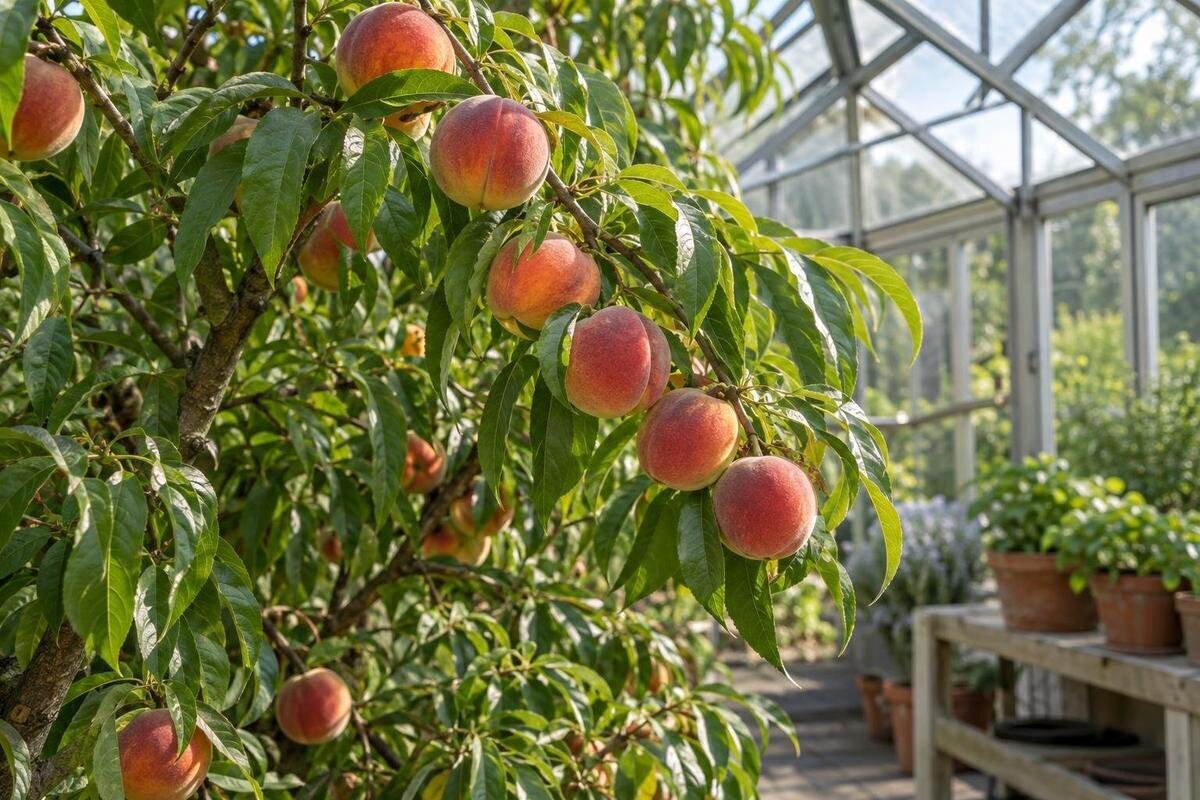
Peaches and nectarines can crop under glass, often trained as fans rather than left to form broad orchard-style crowns. A nectarine is a smooth-skinned form of peach, so the main cultivation decisions—winter conditions, pollination, rootstock, training and pruning—are broadly shared. Nectarines usually need warmer conditions to ripen in the UK, making the available summer warmth an important part of the choice. A greenhouse can keep rain off the canopy and make blossom easier to reach, but it does not provide a controlled climate by default. An unheated house can freeze in winter, while spring or summer sunshine can raise the temperature quickly. Fruit set and ripening still depend on the cultivar, light, temperatures and care.
Consider what the cover is meant to achieve: sheltering buds from rain, making a trained tree easier to manage, or protecting a crop in a site where outdoor growing is difficult. Compare that benefit with the permanent floor space the tree will occupy. If weighing up greenhouse sizes, the Bloomcabin Prestige Greenhouse is listed in sizes from 40.6 to 302 sq ft; those figures are a scale reference, not proof that a particular version suits a fruit tree. Check its chosen configuration’s internal dimensions, headroom and usable growing area, then allow room for the canopy and access.
Match the cultivar to winter conditions
Peaches and nectarines are deciduous trees, so plan for winter dormancy rather than trying to keep them growing continuously. The RHS describes unheated greenhouse growing as an option for compact trees in containers and recommends protected growing for nectarines in cooler UK regions. That does not make every greenhouse position suitable for every cultivar. Ask the nursery about the tree’s winter chilling requirements and whether it is suitable for your proposed conditions. A greenhouse can warm on sunny winter days yet become very cold at night, so assess temperatures where the tree will stand rather than relying only on outdoor weather records.
Before buying, ask for the exact cultivar and rootstock, stated winter requirements, mature size under the planned training system, pollination details and usual ripening period. Rootstock influences vigour, but it does not guarantee a permanently small tree. If you plan to heat the greenhouse, bear in mind that warmth can alter the winter conditions the tree experiences; it is not a substitute for choosing a suitable cultivar. Keep a record of temperatures through winter before settling on a tree for a borderline site. A minimum–maximum thermometer shows extremes, but it does not measure how long the tree spends at different temperatures. If winter chill is a concern, ask the nursery how the cultivar’s requirements should be assessed against your records. Also consider neighbouring plants: a greenhouse kept warm for tender overwintering crops may not provide the winter conditions intended for a dormant fruit tree.
02
Allow room for the mature canopy
A young tree can look deceptively small beside the space it will need later. Ask the supplier for its expected height and spread on the specified rootstock, and consider how those dimensions change when the branches are trained flat. Reserve room for the whole canopy, not just the trunk: branches need space to grow and be pruned, and you need access to inspect blossom, thin fruit and harvest. Also account for the greenhouse door, vents and paths, so a growing tree does not gradually block circulation or routine access.
Measure usable internal space at the height where branches will spread, as well as the floor area. A large footprint does not necessarily mean generous headroom at the planting point. The Spacious Greenhouse is listed in sizes from 506 to 753 sq ft, but area alone cannot show whether a particular layout gives a tree suitable clearance or leaves room for other crops. Draw the tree at its anticipated mature dimensions on the plan for the exact model and version; include a working route around it rather than filling every spare corner with planting.
Choose a training shape before planting
A fan-trained tree is a common way to keep peach or nectarine branches in a flatter plane. It can make the canopy easier to inspect and help you reach flowers and fruit, but it still needs enough width and height for its branches to develop. A more rounded, free-standing crown uses space in several directions and may be harder to accommodate in a narrow layout. Choose the training form alongside the cultivar and rootstock, then position the tree so that its eventual shape does not crowd other plants or shade a large part of the greenhouse. Ask whether the nursery supplies a tree already trained as a fan or a young tree suitable for training. These are different starting points, with different amounts of work needed to establish the branch framework. Plan where you will stand to tie in new shoots; a flat canopy is not necessarily accessible if a bench occupies the space immediately in front of it.
Put the support plan in place before the branches need training. Use a suitable support system and keep ties adjustable so they do not constrict growing stems. Do not assume that a greenhouse frame is designed to carry the force of trained branches or wires; check the manufacturer’s information before attaching anything to it. If comparing a Lean-To Greenhouse, use the exact drawings to assess tree position, light, clearance and support options rather than relying on the format name to answer those questions.

03
Pollinating blossom under glass
Peaches and nectarines are self-fertile, so you do not need a second tree as a pollination partner. This is useful when planning a greenhouse: one tree can provide a crop without reserving another permanent planting position. Self-fertile does not mean that pollen transfer can be ignored, however. The RHS recommends hand pollination for trees grown in a greenhouse. Choose an additional tree for a different flavour or ripening period only if there is room for both mature canopies and their care, rather than buying it simply to secure pollination.
A protected greenhouse may receive fewer visits from pollinating insects than an open garden. Use a small, soft brush to dab gently into the centre of each open flower in turn, transferring pollen without damaging the blooms. Work over several dry, sunny days as fresh flowers open rather than treating pollination as a single annual job. If you grow several cultivars, label them and record their flowering periods so you can organise the work. Make sure the whole canopy is reachable, especially if the tree is trained against a wall or support. When reviewing the T-Shaped Orangery Greenhouse layout, mark a working position beside the tree and check that you can reach its upper and outer branches without leaning across other plants. Fruit set will still depend on conditions and flower health, not just the act of brushing the blossom.
Manage spring frost and summer heat
A greenhouse may warm in bright weather and encourage buds to develop earlier than they would outside. That can bring blossom into flower while cold nights are still possible. Glass does not make an unheated structure frost-proof, and peach and nectarine blossom is vulnerable to frost. Place a minimum–maximum thermometer near the tree’s canopy and note conditions during bud development and flowering. If frost is forecast, protect the blossom overnight with horticultural fleece supported clear of the flowers, then remove it during the day to admit light and allow access for pollination. A container-grown tree may instead be moved to a known frost-free position if its size and training arrangement allow. Do not assume another unheated enclosure will be frost-free without checking it.
The same sunny spell can make a greenhouse very hot, so ventilation matters through spring and summer. Use the available openings in response to conditions and check how their position relates to the tree; a dense canopy near an opening can restrict air movement. For a model such as the aluminium Classic greenhouse, consult the specifications for the selected version rather than inferring temperature control, opening arrangements or frost protection from its name or photographs. Avoid assuming that one fixed temperature routine will suit every cultivar and site.
04
Choose a suitable root space and watering routine
A tree can be planted in a greenhouse border or grown in a container, depending on the available space, soil and chosen rootstock. A border gives roots room to extend, but the soil should drain well rather than remain waterlogged. A container can make a tree easier to reposition, yet the restricted root volume means its moisture and nutrient needs require closer attention. Container growing does not automatically control the final size: cultivar, rootstock, pot volume and pruning all influence the result. Nor does a pot guarantee easy movement once the tree is established. Consider the combined size of the container and canopy, the doorway and any steps along the route. If seasonal movement is part of your plan, avoid a training arrangement that permanently ties the branches to the greenhouse.
Check the soil or growing medium regularly and aim for consistent moisture rather than cycles of severe drying and saturation. Water the root area, and avoid repeatedly wetting foliage where practical. Feeding should support steady growth, not force excess soft growth that is difficult to train. Choose a feeding programme appropriate to a fruit tree in a border or container, rather than automatically using the same routine as for neighbouring vegetables. If comparing a greenhouse with built-in storage, mark the storage area and equipment on the layout alongside the tree’s root space. Keep watering equipment accessible and leave room to inspect drainage or collect runoff where needed. A hose route that crosses the doorway or tangles with low branches can make a frequent task unnecessarily awkward.
Prune, thin and harvest at the right stages
Peaches and nectarines bear fruit on shoots produced during the previous growing season. A pruning plan therefore needs to retain suitable young shoots while removing dead, damaged or unproductive wood. Fan-trained trees also need their branches kept in the intended plane, with replacement growth selected as older fruiting shoots are removed. Pruning is normally undertaken in spring and summer while the tree is in leaf, rather than during winter dormancy, to reduce the risk of silver-leaf disease. The timing and cuts depend on whether you are establishing the framework or maintaining a cropping tree. Obtain guidance for that training stage before cutting: shortening every branch by the same amount can remove useful fruiting growth without creating a workable replacement pattern. Plan access for pruning as carefully as access for harvest.
A tree may set more fruit than its branches can mature well. Once fruitlets have formed and any natural drop has taken place, remove crowded or excess fruit so the remaining crop has room to develop. The right amount depends on the tree’s size and condition, so avoid using a fixed number as a rule for every plant. Inspect individual branches rather than judging the crop only by its overall appearance; fruit may be concentrated on a few shoots. Learn the expected ripening signs for the cultivar: colour alone can mislead, and fruit should be handled gently. Check the crop regularly as it approaches maturity because not every fruit will be ready at once. Keep notes on flowering, thinning and harvest, including any heavily laden branches, to help refine care in later seasons.

05
Use rain shelter to reduce disease pressure
Peach leaf curl is a concern for both crops, and shelter from rain is one reason to grow them under cover. The RHS identifies moving container-grown trees under shelter as a way to help protect them against the disease. A greenhouse roof is useful only if rain is actually kept off the tree; wind-driven rain may still reach branches through open doors or vents. Ask the nursery for crop-specific guidance on when rain protection is needed, rather than assuming summer cover alone is sufficient. Preserve ventilation while arranging that shelter, as keeping rain out and managing damp air are separate tasks.
Inspect leaves and shoots regularly so you can notice changes early, and keep fallen leaves and spoiled fruit from accumulating around the tree. Good spacing makes it easier to check the whole canopy and reduces congestion around branches. Also look for common greenhouse pests such as aphids and spider mites; warm, enclosed conditions do not make a fruit tree immune to them. Check leaf undersides as well as the surfaces visible from the path, and identify the cause of damage before choosing a response. If considering a Pyramid-type greenhouse, compare the roof profile with the planned canopy so that outer shoots remain within reach for inspection. Leave enough clearance to examine and remove affected growth without pressing neighbouring branches against the glazing.
Check light and layout before choosing a greenhouse
Peaches and nectarines need a bright position to grow and ripen well. A greenhouse cannot make up for a site shaded by buildings, trees or other structures, and the tree’s own canopy can shade nearby crops as it matures. Before planting, consider where the sun reaches the greenhouse and whether the proposed tree position receives useful light through the growing season. Also check that the location leaves enough room to reach the plant for watering, hand pollination, pruning and harvest.
When comparing greenhouse options, use the dimensions and drawings for the exact model and configuration, not a gallery image or a broad product name. For the aluminium Limited Edition greenhouse, put the tree and the other intended crops on the same plan. Separate permanent commitments, such as a border-planted fruit tree, from benches or seasonal containers that can be rearranged. A peach canopy may occupy space needed for spring seedlings before those seedlings move outdoors, so check the busiest overlap in your growing calendar rather than only the summer layout. Decide which crops you are willing to reduce or relocate as the tree develops. This makes the comparison more useful than choosing the largest tree that can physically fit inside the structure.
Frequently asked questions
Can I grow a peach tree in an unheated greenhouse?
Yes, an unheated greenhouse can be suitable, particularly for a compact tree in a container, provided there is enough light and room for its growth. Confirm the cultivar’s suitability and winter requirements with the nursery. The structure can still freeze, so it does not guarantee protection for blossom during a cold spell. Monitor conditions near the tree rather than assuming the greenhouse remains warmer than outdoors.
Do I need two trees for pollination?
No. Peaches and nectarines are self-fertile, so one tree can produce a crop without a pollination partner. Hand pollination is still recommended under glass because insect visits may be limited. Gently dab a small, soft brush into the centre of each open flower in turn, repeating the task over several dry, sunny days as more flowers open.
Is it better to plant in the ground or in a pot?
Neither is best for every greenhouse. A border gives roots more room, while a container can make the tree easier to move but needs closer attention to watering and feeding. In either case, check the cultivar’s vigour and rootstock, and do not treat a pot as a guaranteed way to keep a tree small.
When should I prune a greenhouse peach or nectarine?
Peaches and nectarines fruit on shoots made during the previous growing season, so avoid removing all the recent growth. Pruning is normally carried out in spring and summer while the tree is in leaf, rather than during winter dormancy, to reduce the risk of silver-leaf disease. The precise timing and cuts depend on the training system and the tree’s stage of development. Retain suitable replacement fruiting shoots and follow guidance for establishing or maintaining that form.
Does growing under glass prevent peach leaf curl?
Sheltering a tree from rain can help protect it against peach leaf curl, but a greenhouse is not an automatic guarantee. Check whether wind-driven rain reaches the branches through openings, and seek crop-specific guidance on when rain protection is needed. Keep ventilation available rather than sealing the greenhouse to exclude rain, and identify any symptoms before choosing a treatment.
Growing peaches or nectarines under glass is most promising when the cover solves a real problem, such as keeping developing buds dry, and the chosen site still provides suitable winter conditions and light. Select the cultivar and rootstock before fixing the training plan, then compare the mature canopy with the greenhouse’s actual internal dimensions. If there is room to reach the flowers, prune the tree, ventilate the space and harvest without crowding, you are planning for a long-lived fruit tree rather than just the young plant you first bring home.
