
Greenhouse Glass Keeps Cracking: What Should an Installer Check?
Greenhouse repairs
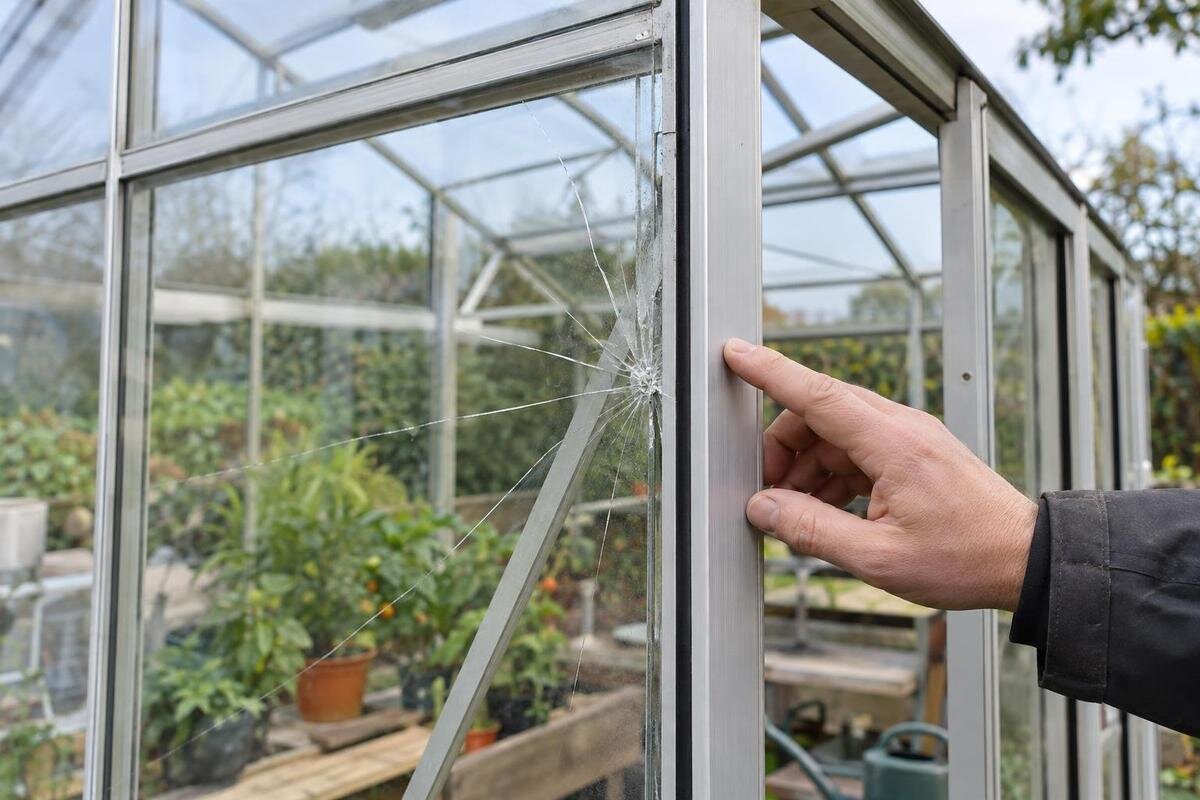
One cracked pane may be an isolated accident; repeated breaks deserve a broader inspection. Replacing the glass again without checking how it is supported, how the frame is sitting and whether the pane matches the greenhouse system can leave the cause untouched. A qualified installer should look for local contact, movement in the structure, a damaged retainer or an external impact, then separate observable evidence from possibilities. The pattern helps focus the visit, but it is not a diagnosis by itself.

Why repeated cracking warrants a broader check
A single broken pane can follow an accidental impact, but recurring damage changes the question the installer needs to answer. Note whether breaks affect the same opening, nearby panes or unrelated parts of the greenhouse, and whether each replacement failed in the same way. One repeatedly affected bay may focus attention on its seating, edge clearance or local frame; failures in several places may warrant a wider look at frame movement, installation history or outside exposure. Repeated damage to a recently replaced pane is particularly useful to flag, but none of these patterns proves a cause. Even a recognisable-looking crack cannot, by itself, distinguish a faulty pane from strain imposed by its surroundings.
The inspection should treat the glass, retaining parts, frame and supporting base as one assembly, while checking the exact manufacturer’s instructions for the model. The installer can establish whether the pane is the specified type and size, whether its edges are bearing correctly and whether surrounding parts have moved or deteriorated. Ask which observations support the proposed explanation, which conditions were checked and which remain possibilities. The aim is not to rule out replacement glass; it is to avoid fitting another pane before checking whether the conditions that affected the last one are still present. That broader check is what makes a repair plan useful.
Make the area safe and document each failure
If glass has already broken, keep people and pets out of the immediate area and do not handle fragments, remove clips or reach over the frame to inspect a roof pane. Keep clear of the area below and around any damaged overhead glass, and do not use a ladder or greenhouse frame as an improvised way to reach it. Arrange for a competent installer or glazing professional to make the area safe. If another pane looks loose, or the frame appears to have moved, tell the professional before the visit and stay away; do not try to hold, wedge or brace the glazing yourself.
Record only what can be seen safely. Take overview and close photographs from outside the affected area, and mark the pane’s position on a simple sketch so the installer can identify its bay and neighbouring supports. Note when the crack appeared, when the pane was fitted and whether you noticed wind, direct impact, sudden temperature changes, nearby building or garden work, or a change in how a door or vent operated. Record whether the damage happened before or after any earlier repair. Separate something witnessed from something suspected; do not recreate an event to test a theory. Keep invoices, the manual, labels and earlier repair notes.
Map crack locations and identify the greenhouse
Map the failures over time, distinguishing roof and wall positions and noting whether each affected pane was original or a replacement. Give each opening a simple reference so photographs, invoices and inspection notes can be matched to the same location. Mark neighbouring panes that have remained intact: this helps distinguish a recurring problem in one bay from damage spreading across the structure. Where records allow, include how long each replacement lasted and whether the same retaining components were reused. An unknown date should remain unknown rather than be estimated as fact. This record gives the installer a clearer basis for comparing failures than a collection of photographs without dates or locations.
Model identification matters because glazing and retainers are not automatically interchangeable between greenhouses that look alike. Find the original order confirmation, assembly instructions, serial or model label and any glazing description; note the approximate installation date if exact paperwork is unavailable. A broad description such as aluminium greenhouse is not enough to specify parts. For an enquiry about a Limited Edition aluminium greenhouse, include the original order details and any recorded size or configuration so the supplier can identify the relevant documentation. A current catalogue page can help name the product being discussed, but the installer still needs to establish which version is on site.
Confirm the glazing specification and fit
The installer should identify the exact glazing system and compare it with the manufacturer’s documentation for that model. Depending on the design, relevant details may include glass type, thickness, dimensions, edge preparation and which face or orientation is specified; appearance alone may not establish them. The professional should check that any replacement pane is approved for the frame and retaining arrangement, rather than assume that a standard-looking sheet will fit. If the original specification is unclear, the installer may need to check with the manufacturer or supplier before ordering. Mention whether a previous replacement came from a different source or had a different description. Do not assume an intact pane in another opening is an exact template.
Fit is as important as nominal size. Have the installer examine whether the pane sits in its intended channel, whether its edges touch a hard point, and whether clips, glazing bars, gaskets or caps retain it as shown in the instructions. They should look for debris, displaced seals, an uneven seat or signs that the pane has been forced into place, including in adjacent bays. Leave any adjustment or packing to the professional. If you are comparing repair with buying a T-shaped orangery greenhouse, request the proposed unit’s glazing specification and maintenance information too. That allows you to compare documented systems rather than assume the new structure uses the same glass or fittings.

Have the installer assess frame alignment
Frame alignment can affect where support or pressure is applied to a pane, so the installer should inspect the greenhouse frame rather than judge the glass in isolation. They can check the positions of uprights, horizontal members, corners and glazing bars, and assess whether joints or base supports show movement, damage or looseness. The frame should be compared with the manufacturer’s drawings or assembly instructions, not merely judged by whether it looks straight from one viewpoint. Ask whether the base and frame meet as intended, and whether movement is evident at more than one joint. A recent move, impact, repair or change to the support beneath the frame may be relevant history.
Tell the installer if doors or vents have recently become harder to close, gaps seem to have changed, or the structure has been moved, repaired or struck. Ask whether any misalignment is local to the damaged bay or appears elsewhere, and what evidence supports that conclusion. Do not force a door, pull the frame square, alter fixings or add a brace as a test. For a greenhouse identified in your records as a Pyramid-type greenhouse, request the corresponding assembly drawings for the inspection. The relevant reference is the documented arrangement of members and joints, not a visual comparison with a differently shaped greenhouse or a catalogue photograph.
Check pane supports and retaining components
Look at each part that holds the pane, not only the glass. An installer should inspect glazing bars, clips, capping pieces, gaskets, seals and any supports specified by the manufacturer for missing, displaced, damaged or mismatched items. They should check whether a hard point, trapped grit or an uneven support could press against the pane edge, and whether the neighbouring panes use the same components. If wear, rubbing or a mark appears at the edge, note its location rather than trying to remove the fitting. The correct check depends on the greenhouse’s own assembly instructions and may require inspection around the full perimeter.
Ask whether retainers or seals were changed when the last pane was fitted, and whether the installer can identify the correct part number rather than substitute a generic clip or sealant. Avoid adding clips, tightening fittings or filling a gap yourself: a modification can alter how the pane is held and hide the original fault. For an enquiry concerning a Limited Edition greenhouse with built-in storage, identify the affected opening on the model’s drawing, including its position relative to the storage area. This helps the supplier locate the component being discussed. If the required parts cannot be confirmed, settle their identity before authorising an order or substitution.
Consider temperature-related movement carefully
Temperature-related movement is another possibility for an installer to assess, especially if the timing is consistent, but a crack appearing after a warm afternoon or a cold spell does not prove thermal stress. Glass and its supporting frame can respond differently as conditions change; poor clearance, tight retention or localised heating may matter if they conflict with the system’s design. Record the conditions around each break, including any nearby heat source, a marked change from shade to sun, or another unusual event you actually observed. Note whether similar conditions were present when earlier panes cracked. Do not expose the pane to hot or cold water, or alter heating, shading or fixings to try to reproduce a crack.
Ask the installer to review the manufacturer’s provisions for movement and clearance, then examine whether the pane is constrained at an edge or fittings have been changed from the specified arrangement. The professional should relate those findings to the failure history rather than attribute the damage to temperature alone. There is no universal gap or adjustment to prescribe across greenhouse systems. If replacement is being considered, ask for the equivalent installation information for the proposed model. For example, an enquiry about the Prestige greenhouse with metallic base should establish the specified relationship between its base, frame and glazing. Do not carry an adjustment intended for the old greenhouse into the new installation without checking its instructions.
Look for impact and changes outside the greenhouse
External impact and pressure deserve a separate check. The installer can look for visible impact marks, damage to nearby frame members, fallen branches or debris, and recent work with tools or machinery around the greenhouse. Ask whether landscaping, building work or maintenance changed since the pane last remained intact, and mention objects routinely moved close to it. A recurring break after windy weather may justify checking retention and frame condition, but timing alone does not prove wind caused it, and a surface mark does not always reveal what struck the glass. Provide a clear account of any event rather than trying to interpret the fracture yourself.
Check the surroundings from a safe position and tell the installer about overhanging growth, objects stored close to the structure or repeated knocks during routine work. Describe where equipment is moved and whether those routes have changed since the damage began. If investigation leads to a full replacement enquiry, the Spacious Greenhouse listing gives a stated area range of 506–753 sq ft. That is a size reference for planning, not an exposure rating. Have the proposed position assessed, including its relationship to nearby trees, working areas and access routes. A different footprint may change those relationships, so the replacement proposal should consider the actual site rather than simply reuse the existing position.

Ask for findings before authorising another pane
Before authorising another pane, ask for the findings in writing: which areas were inspected, what was observed, the most likely cause and how certain the installer is. Request the model and pane specification used for the proposed replacement, the part number for retainers or seals if relevant, and the manufacturer instruction or drawing that supports the repair approach. A useful report should say whether nearby panes or frame members need attention and distinguish immediate make-safe work from the longer-term repair. If access prevented a full check, ask what could not be assessed and whether a follow-up inspection is needed.
Make sure the proposed work addresses the reason for recurrence, not just the visible break. A plan might include replacing a damaged retaining component or correcting a verified fit issue as well as replacing the pane; the installer should explain any frame work and arrange appropriate professional assessment before proceeding. For a Classic aluminium greenhouse repair enquiry, attach the inspection findings to the model and order records rather than send only a request for another pane. Ask the supplier to distinguish confirmed replacement items from anything awaiting identification. Keep the report, photographs and parts correspondence together, with a record of the completed work, so any later failure can be assessed against what actually changed.
Compare repair with full replacement only if needed
Repair may remain reasonable when the installer identifies a local, correctable issue and the frame and glazing system remain suitable for the specified repair. A wider replacement discussion may be appropriate if the inspection finds extensive frame damage, several affected bays, unavailable matching components or recurring failure after a documented correction. Those are reasons to ask for a comparison, not a rule that one cracked pane makes a greenhouse uneconomic. Ask the professional to explain what evidence supports repair or replacement, what work each option includes, and whether any uncertainty remains.
If a new structure is considered, treat it as a separate design and installation decision: verify its footprint, position, intended use, support requirements, glazing system and manufacturer documentation for your site. Include the cost and scope of removing the damaged structure and preparing the site in the comparison, without assuming the existing base can be reused. If the Lean-To Greenhouse is among the options, ask a qualified installer to assess the proposed supporting wall and the model’s connection and support requirements. Its suitability must be established for that location. Compare complete repair and replacement proposals, including work needed to address the identified cause, rather than comparing the price of a pane with the price of a new greenhouse alone.
Frequently asked questions
Can the crack pattern show why the glass broke?
Not reliably. A crack’s starting point or direction can be one clue, and a pattern that recurs in the same bay may help focus the inspection. But appearance alone cannot distinguish impact, edge contact, movement or a pane fault with confidence. The installer should compare it with the frame, retainers and history.
Should I fit another pane before the installer inspects the greenhouse?
If a pane has broken, make the area safe first. Before fitting another replacement, ask the installer to check the glazing fit, retaining parts and surrounding frame so the repair addresses the likely cause. The exact repair scope depends on the inspection; another pane should not be treated as proof that the underlying issue is resolved.
Should I remove or measure the broken glass myself?
Do not remove or handle broken greenhouse glass, or climb onto the frame to measure a roof pane. Record the opening and its location from a safe position, then give the model details and documentation to the installer. They can confirm the required dimensions and specification against the correct manufacturer information.
Can temperature changes make greenhouse glass crack?
Temperature changes can be one factor for an installer to consider, particularly if failures repeatedly follow similar conditions, but timing alone is not proof. The inspection should include the specified movement allowance, how the pane is retained and any local heating or exposure noted around the failure. Do not test the theory by heating or cooling the glass.
What information should I give the installer?
Share the make and model if known, purchase or installation records, pane location, earlier replacement details, safe photographs, and dates or conditions around each break. Say which events you witnessed and which are guesses. If available, include the assembly manual or part labels; do not estimate the glass type or thickness from its appearance.
Repeated breakage is a reason to look beyond the pane, not a reason to guess at a single cause. Give the installer a clear history and safe photographs, then expect the check to cover the glazing specification, its supports, frame alignment, base and surrounding conditions. A written explanation of what was found—and what remains uncertain—helps ensure that any replacement is part of a considered repair rather than another attempt that leaves the original condition in place.
