
Scratched Greenhouse Powder Coating: Repair Options
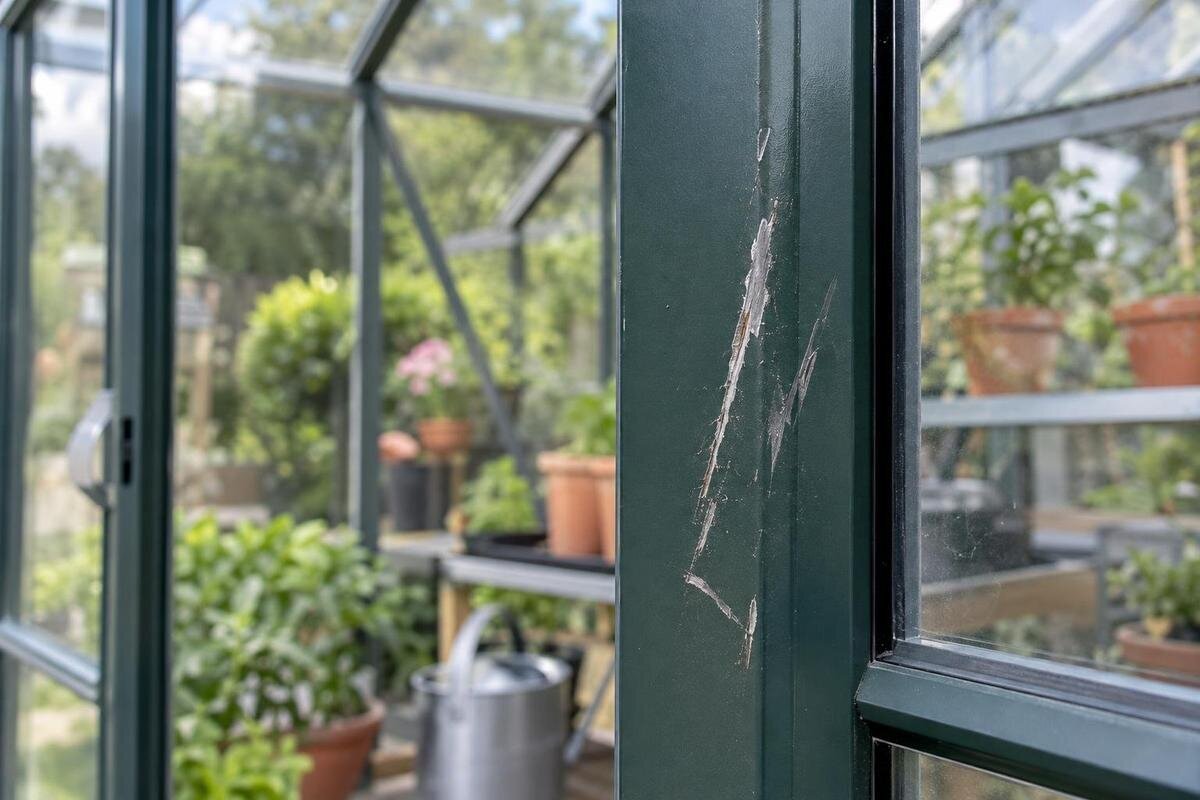
Greenhouse care and repair
A scratch on powder-coated greenhouse aluminium may be a surface scuff, transferred dirt or a break in the finish, and each calls for a different response. Cleaning can remove a superficial mark; it cannot restore coating that has lifted or been cut away. Before applying anything, identify the greenhouse, record the damage and check the manufacturer’s care and repair guidance. A small, confirmed chip may be suitable for approved touch-up, while an uncertain match, extensive damage or a mark near a moving or supporting part needs a more careful assessment.

Scuff or scratch? Look for a change in the finish
Powder coating is the finish on the frame, but a line on it is not automatically a break in that finish. Soil, plant residue or material rubbed off a tool can sit on top; friction can also polish or dull a patch without cutting through the coating. A true scratch interrupts or removes some of the finish, yet a bright or dark line alone does not prove that metal is exposed. Reflections, dirt and surrounding colours can make an intact surface look different. One clue is whether the mark changes after wiping, though colour on the cloth alone is not proof because it may pick up residue from another area. Treat the first inspection as a comparison, not as a reason to paint.
Look at the mark before and after gentle cleaning, once the frame is dry. If residue disappears and the finish beneath looks continuous, touch-up is unlikely to be needed. A definite groove, chipped or lifted edge, flaking, blistering or a patch that appears to show the underlying material is stronger evidence of coating damage. A rub can change gloss without removing coating, so do not test its depth with a fingernail, coin or blade. Do not peel a lifted edge to see how far it extends. If the result remains uncertain, take clear photographs and ask the manufacturer or an installer rather than probing the surface.
Record the damage and identify the greenhouse
Inspect in good natural light, first from straight on and then from an angle; reflections can hide the edge of a small chip. Compare the mark with an undamaged area of the same frame, not with a different greenhouse or a photograph on a screen. Note whether damage is on the inside or outside face, how long and wide it appears, and whether it lies beside a joint, fixing, door, vent or glazed section. If several marks are present, record each one rather than relying on memory. Their location can help a supplier decide whether the issue is a finish mark or part of a wider problem. Do not remove glazing or loosen frame parts to get a better view.
Take one wider image showing where the mark sits and a close-up in focus; holding a ruler beside it gives scale without rubbing it. Avoid flash glare where possible, and include a little surrounding frame so the location is clear. Record the date and, if known, how the mark may have occurred. Find the original order confirmation, manual or model information before asking about colour or repair. If you believe you own a Bloomcabin Prestige Greenhouse, include the relevant model name in your enquiry, along with the order reference and any variant details. Ask the supplier to confirm the identification before requesting a finish reference or spare part.
Clean gently before assessing a mark
Use the cleaning method in the greenhouse manual first. If it permits, wash the small area with clean water and a soft cloth; a little mild, non-abrasive washing-up liquid can help with ordinary greasy residue. Use a damp cloth rather than one dripping with water, work gently, rinse away any cleaner and dry with a soft cloth so streaks do not obscure the finish. Once dry, inspect the mark again and compare it with the surrounding frame. A clean surface makes it easier to distinguish a transferred mark from a change in the coating, and reduces the chance of mistaking dried residue for a chip.
Do not use a scourer, wire brush, abrasive pad, blade, metal polish or strong solvent to make the line disappear unless the manufacturer expressly recommends that method for this finish. These tools or products may dull, scratch or otherwise alter the coating, leaving more to assess than before. Avoid bleach, strong degreasers and a concentrated jet of water unless the manual permits them. Do not mix cleaning products or let cleaner dry on the frame. Keep cleaners away from glazing, seals and nearby materials unless they are labelled suitable for those surfaces; a product appropriate for one greenhouse part may not suit another.
Find the source of repeated rubbing
A mark that returns after cleaning or touch-up may mean something is rubbing the same place. Look for a clear contact point, such as a garden tool leaned against the frame, a plant support, pot, stored item, branch or accessory. Check whether there is a matching mark on the object, or whether the line follows a moving part or appears only where two components meet. Do not force a door, vent or frame to reproduce the contact. If alignment or movement appears involved, make a note and ask the supplier or an installer to check it. Touching up before the source is dealt with leaves the repair exposed to the same abrasion again.
Move a loose object only if that can be done safely and without disturbing the structure. Do not file, bend, grind or drill a frame member to stop contact, and do not alter a glazed or moving part by guesswork. A photograph showing both the mark and the object causing it can help an installer assess the problem. If cramped working space is also prompting you to consider a different greenhouse, you could include the Bloomcabin Orangery in that separate comparison. Assess the proposed layout and room for tools and plant supports from its documentation; replacing the greenhouse without addressing the source of contact may leave the same problem unresolved.

When touch-up is suitable, and when it is not
For a small, isolated chip or scratch, ask whether the manufacturer offers a compatible touch-up product and a written process for the exact model and finish. Use it only if those instructions cover the location and condition you have found. If the coating remains intact and the mark is only a change in sheen, adding paint may create a more noticeable patch. A repair product is not automatically suitable because it is described as metal paint, matches the broad colour or is intended for outdoor use. Ask what appearance to expect from an approved local repair; do not assume it will be indistinguishable from the original finish.
More extensive flaking, several damaged members, a mark that crosses a joint, or finish loss that keeps returning needs advice rather than a larger quantity of touch-up. A specialist may recommend an approved local repair, a correctly identified replacement component or further assessment before coating work. Ask which defects the proposed work would address and what appearance to expect afterwards. If whole-greenhouse replacement is also being considered, request a separate quotation for a model such as the Classic greenhouse. Keep that quotation distinct from the repair proposal, so the cost of resolving coating damage is not confused with the cost of changing the entire structure.
Confirm the finish before buying touch-up paint
Matching paint by eye is unreliable. A name such as green, black or metallic does not specify the coating, its shade, sheen or texture, and the visible finish may have changed with age and exposure. Even a repair described as the same colour can stand out against an older frame. An online image or a sample viewed on a screen is not a dependable match. Ask the manufacturer to confirm the correct product or finish reference for the precise model and variant. If the greenhouse identity or finish cannot be confirmed, do not choose an approximate touch-up simply because the container looks close in a shop.
When making an enquiry, include the model details from your paperwork, photos, the mark’s position and approximate size, and whether the underlying material appears visible. Ask which touch-up product is approved, what preparation it needs, whether it is intended for that part of the frame, and what application and curing conditions apply. For an enquiry about a Lean-To Greenhouse, also identify the affected face and whether the area is readily accessible. Those details help explain the work required, but the finish reference must still come from the supplier. If it cannot be confirmed, ask about other repair options rather than substituting a similar-looking paint.
Follow the approved touch-up method
The manufacturer’s instructions should determine whether the surface needs cleaning, masking, a particular primer or any other preparation. Do not assume that sanding, scraping, rust treatment or a general-purpose primer is required; an unsuitable step can remove more coating or leave a surface that the recommended product will not bond to. Check that the instructions cover the damage you have found, not just routine cleaning. If the manual does not address the mark or gives only broad care advice, ask for a repair method rather than improvising. Keep the instructions and product details together so anyone assessing the frame later can see what was used.
If touch-up is approved, follow the stated application method, coverage, number of coats and curing interval exactly. Do not add layers to make a chip level or extend the repair beyond the prescribed area. Protect adjacent glazing and seals only in the way the instructions specify, and stop if the product spreads beyond the marked spot or the existing coating begins to lift. Avoid contact with the repair until the instructions say it is ready. When considering a Limited Edition greenhouse as a replacement, request its care documentation before purchase. Check how finish damage should be reported and whether there is a documented route for obtaining repair advice.
When an installer should assess the frame
Ask a qualified greenhouse installer or the manufacturer to assess damage that is extensive, difficult to identify or close to an assembly point. The same applies if a member is bent, a joint appears loose, a door or vent no longer moves as it did, or the mark is near a glass support or glazing. A finish repair cannot establish that the frame is sound. Do not remove panes, loosen structural fixings or reshape a member to reach or repair a scratch. If the frame or glazing area may be affected, leave the structural work to someone competent to assess the assembly.
An installer can distinguish a surface defect from possible damage to a profile or connection, advise whether a local finish repair is appropriate and identify a component by its exact part reference. Ask whether the assessment is based on documentation for your model and whether reaching the damaged area requires work around the glazing. That access work belongs in the repair quotation, not in an improvised do-it-yourself touch-up. If you also request a quotation for a T-Shaped Orangery Greenhouse, have the installer separate assessment, removal of the existing structure and installation of the proposed replacement. This makes the extent of each option easier to understand.

Check the guarantee and replacement-part details
Before any do-it-yourself touch-up, read the guarantee and maintenance documents for the greenhouse. Terms differ, so do not assume that every repair is covered or that a touch-up automatically cancels cover. Ask the manufacturer or seller how an approved repair should be recorded and whether permission is needed first. Keep dated photographs, the reply, product details, receipts and a note of the method used. This record can help if the same area changes later or a future service enquiry needs to distinguish the original mark from the repair.
If the damage is on a part that can be replaced, ask for the exact spare-part identifier and confirmation of compatibility rather than ordering by colour or appearance. Ask whether the proposed part is supplied finished, which finish reference applies and what fitting work is required. Do not adapt a component unless the manufacturer confirms it is suitable. If replacement enquiries extend to a different model, such as the Bloomcabin Oasis pyramid greenhouse, request its own guarantee and parts information. Compare how finish defects are reported, what documentation is required and any stated exclusions; do not assume the terms for your existing greenhouse carry over.
Compare repair with replacement on scope and cost
Compare replacement with repair only after you know the extent of the damage, whether its cause can be stopped, which approved repair materials or parts may be available, and what an installer expects the work to involve. A single superficial scuff does not by itself justify a new greenhouse. Wider coating loss, repeat repair costs, a damaged frame member or unavailable matched components may make a broader quotation worth exploring, but the scratch alone does not decide the issue. Ask for costs and scope in writing, including any associated removal or installation work, so you are comparing equivalent options rather than a touch-up price with a complete replacement.
If you consider a replacement, compare its stated dimensions, layout, glazing, site requirements, assembly support and parts information against your needs; verify these directly in the relevant documentation. Do not assume a new model shares your old greenhouse’s footprint, finish or fittings. If storage is also part of your buying brief, include the Limited Edition greenhouse with built-in storage in the comparison and check the documented arrangement against what you intend to store. Keep that additional requirement separate from the coating repair decision. There is no universal scratch-length threshold for replacement: frame condition, the cause of damage and the available repair route all matter.
Frequently asked questions
Is every bright line on a greenhouse frame a scratch?
No. It may be residue, a reflection or a change in sheen rather than a break in the coating. Clean the area using the method allowed by the manual, let it dry and inspect it again before considering a repair.
Can I use ordinary metal paint or an automotive touch-up pen?
Only if the greenhouse manufacturer confirms that the product and method are suitable for your exact frame and finish. A similar colour does not establish compatibility, and a repair may remain visible even when the shade looks close.
What should I do if the scratch seems to expose metal?
Photograph the mark, note its size and position, and ask the manufacturer for the approved procedure for your model. Do not cover it with paint whose suitability has not been confirmed. Seek an installer’s assessment if the damage is extensive or close to a joint or glazing.
Should I sand the damaged area before touching it up?
Do not sand, scrape or polish it unless the manufacturer’s instructions for that specific finish say to. Abrasive preparation can remove more coating or make the repair harder to assess. If the instructions are unclear, ask before starting.
Could a touch-up affect the greenhouse guarantee?
Guarantee terms vary, so check the documents and ask the manufacturer or seller before applying a repair product. Keep their reply, dated photographs and details of any approved product and work.
A superficial mark may need only approved cleaning; a chip or loss of coating needs a repair decision based on the exact finish and the condition of the frame. An approved touch-up may remain visible, so agree on the expected result before starting. Where rubbing caused the damage, addressing that contact is part of the repair. Keep a dated record of the finished area so any later change can be compared with its condition after the work.
