



MATERIALS
Powder-Coated Aluminium: Durability, Corrosion Protection and RAL Colours
Powder-coated aluminium is durable, corrosion-resistant and available in many RAL colours. Choosing the right product, careful installation, suitable fixings and material-appropriate care all matter.

Powder-coated aluminium is used for greenhouses, pergolas and other outdoor structures because it combines low weight, dimensional stability, corrosion resistance and a lasting coloured finish. The coating is not indestructible, however. Location, pretreatment, installation, fixings, cleaning and mechanical loads all influence its long-term appearance.
This guide explains the technical basics and what to consider before ordering, when receiving goods, during installation and in later use. Product-specific information always takes precedence. Explore the Useful information section for more topics.
What is powder-coated aluminium?
Powder coating applies a dry coating material to prepared aluminium components, which is then cured under controlled conditions. This creates a continuous layer firmly bonded to the substrate. Unlike liquid paint, the applied powder contains no liquid carrier before curing.
The visible powder is not the only factor governing system quality. The aluminium alloy, cleaning and pretreatment of the substrate, coating conditions and structural design also matter. These processes are difficult to assess after installation. Check the confirmed colour and finish against product documents and the order confirmation rather than inferring every technical property from a product photograph.
The coating has several roles: it finishes the surface, makes regular cleaning easier and adds a barrier against moisture and contaminants. It does not replace sound construction, correct drainage or proper installation.
Durability in everyday outdoor use
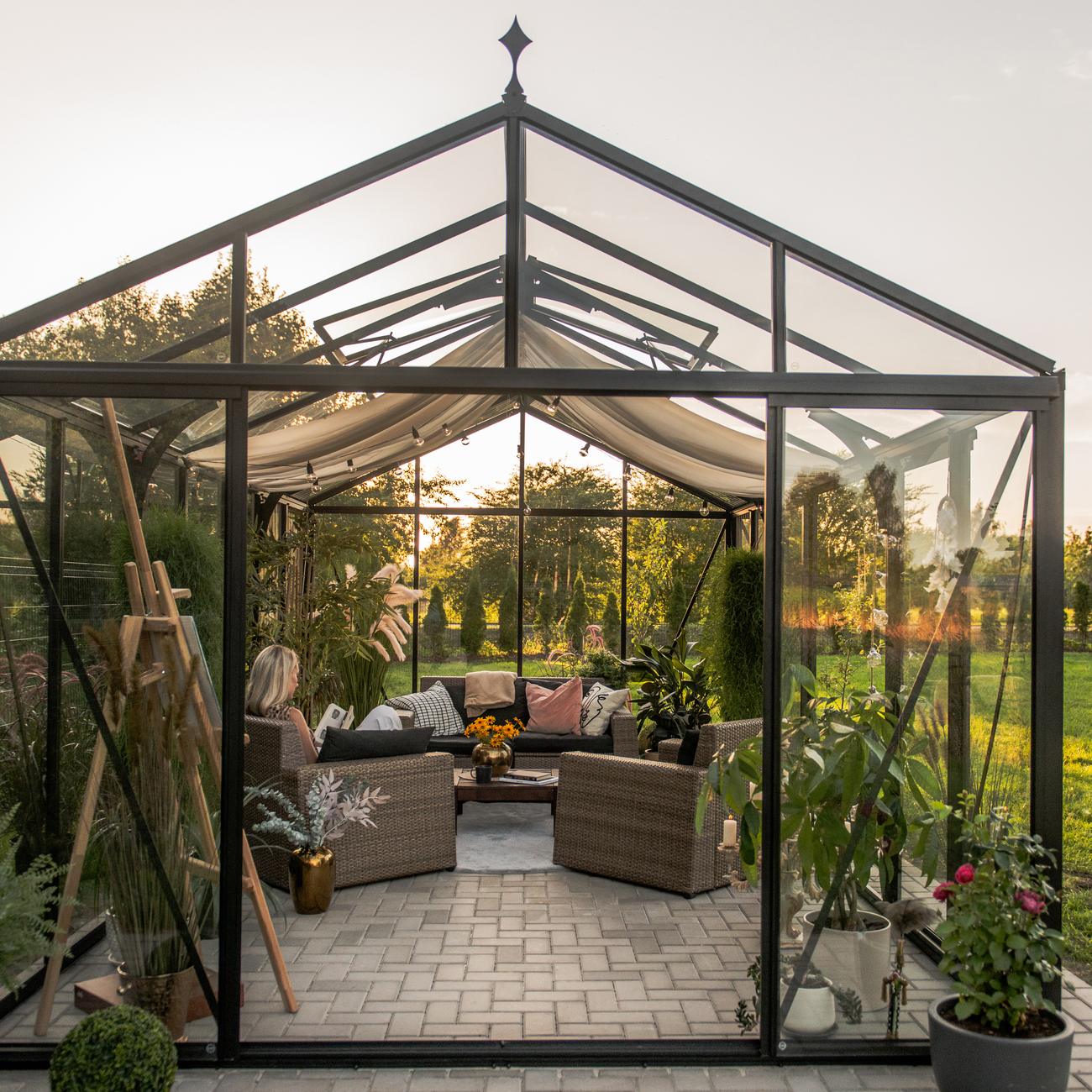
In a normal garden setting, a coated structure must withstand rain, UV exposure, temperature changes, pollen, bird droppings, plant sap and occasional impacts. Powder-coated aluminium is well suited to this use when the surface and components are handled as intended.
Normal ageing should not be mistaken for structural damage. Depending on location and period of use, gloss and colour appearance may gradually diminish. Light dust, mineral marks and pollen are often more visible on dark surfaces, while dark deposits show more clearly on pale finishes. Neither necessarily says much about frame performance.
Mechanical contact is often more critical than normal weathering. Leaning tools, rubbing branches, garden furniture, metal ladders or grit between a component and installation tool can scratch the finish. Decorations fixed permanently must not rub against profiles in wind. See Caring for your aluminium greenhouse for regular frame-care guidance.
How aluminium resists corrosion
Aluminium behaves differently from unprotected steel. When exposed to oxygen, its surface forms a very thin natural oxide layer that impedes further attack on the base material. It therefore does not develop the familiar reddish-brown rust of iron. Powder coating adds another separating protective layer.
Corrosion-resistant does not mean immune to corrosion. Standing moisture, salt, unsuitable cleaning chemicals or contact with incompatible metals can encourage local attack. Narrow gaps where water and dirt remain are particularly unfavourable. Drainage openings and channels must therefore not be blocked by soil, leaves, sealant or installation material.
Galvanic corrosion is another possible cause. It can occur when different metals are electrically connected and moisture is present as an electrolyte. Use only the specified or expressly approved screws, washers and connecting parts.
Conditions requiring particular attention
- Coastal or salty environments: Remove salt deposits regularly with clean water and shorten cleaning intervals.
- Road salt and traffic areas: Do not allow spray from paths or roads to remain on the frame for extended periods.
- Industrial and urban air: Deposits can retain moisture and should be washed away promptly.
- Pool and spa areas: Do not assume chemicals, splashes and vapours are harmless. Check suitability for the specific setting.
- Fresh mortar, concrete or plaster: Do not let alkaline building materials dry on the surface. Protect components during nearby work.
- Permanent planting against profiles: Plan supports so plants, wires and fixings neither obstruct drainage nor abrade the coating.
Understanding RAL colours
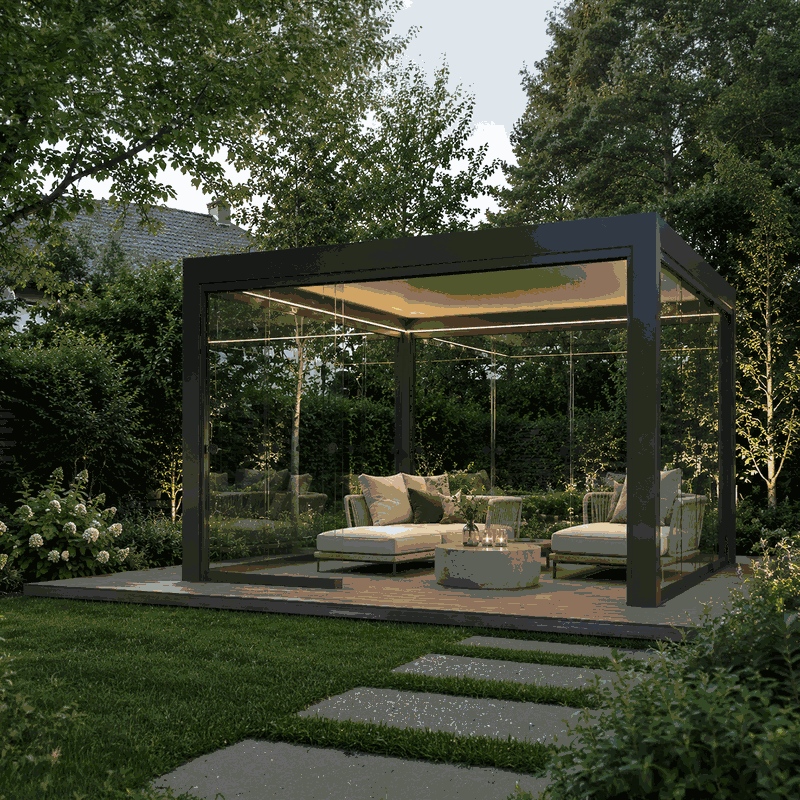
RAL colour names provide a standardised way to communicate shades. A RAL code is far more meaningful than terms such as anthracite, dark green or black grey. Yet the code does not automatically define every visible property of a finished surface.
Gloss level and texture affect the result as well as colour. A smooth, glossy surface reflects light differently from a matt or finely textured finish. Buyers should therefore ask not only for a RAL reference, but also confirm the finish specified for the particular product.
Screens and printed material are useful only as guides. Displays vary in brightness and colour reproduction; browsers, ambient light and image processing alter the impression too. For colour-sensitive projects, a physical sample matching the intended finish is more useful. Confirm before ordering whether such a sample is available or binding.
Why the same colour can look different
A frame may look cool and dark in the morning, yet lighter or warmer in direct afternoon sun. Glass, polycarbonate, timber façades, paving and plants also affect colour contrast. Read about the impact of classic structures in our guides to Victorian greenhouses and the orangery greenhouse guide.
Slight visual differences can also result from varying material geometry, viewing angles, production batches or surface textures. A narrow profile reflects differently from broad sheet metal. Where an exact visual match with windows, doors or other components is required, coordinate it before placing the order.
Choosing the product and finish before ordering
Choose colour only after clarifying the design, dimensions, site and intended use. For pergolas, wall connections, drainage and roof design influence planning more than colour. Useful decision guides include bioclimatic or classic pergolas, wall-mounted or freestanding pergolas and the pergola size guide.
For greenhouses, consider glazing, ventilation, internal climate and intended use together. The greenhouses and conservatories overview provides orientation. Our guides to greenhouse polycarbonate and temperature and humidity explain other key selection factors.
The product page is decisive for outdoor products combining several materials too. For an Elma S outdoor sauna or a HC150 barrel sauna , do not transfer information about frames, timber, hardware or finishes from another model. The general sauna category helps compare construction types.
Finish-selection checklist before purchase
- Record the exact product name, variant and dimensions.
- Check the available RAL code and named surface finish.
- Do not choose colour solely from a phone or monitor image.
- Consider connections to façades, foundations, gutters and adjacent components.
- State site conditions such as coastal exposure, road salt or heavy soiling.
- Confirm whether visible accessories and connecting elements should have the same colour appearance.
- Check colour, quantity and specification on the order confirmation before approval.
- Clarify outstanding points through contact and document them in writing.
For ordering, see How to order and our guidance on shopping and delivery .
Receiving and checking coated components
Inspect the delivery, where possible, before installation begins. Check packaging for impact marks, punctures and moisture. Compare packages and identifiable components with the delivery documents. Open packages carefully with tools that cannot accidentally cut into the profiles.
Distinguish loose packaging residue and dirt from actual damage. First clean a dirty area gently with water and a soft cloth. Do not rub hard to “test” whether a mark disappears. Photograph scratches, dents, chips or missing parts from several angles before installation and report them through the applicable process. See Warranty for information about claims and conditions.
Store components dry, stable and protected from site traffic until installation. Do not leave film unnecessarily long on the surface in sun and moisture unless product-specific instructions say otherwise.
Protecting the surface during installation
Many avoidable surface defects occur during unpacking and assembly. Do not place profiles directly on paving, gravel or concrete. Clean, soft supports prevent grains of sand beneath a component from acting like abrasive material. Keep screws and tools in containers, not on coated profiles.
The structure must be aligned and anchored on its intended base. Forced installation can stress profiles and damage connections. Consider the pergola foundation guide at the planning stage. In South Africa, whether approval or consent is required depends on the municipality, planning scheme and the actual project classification, including use, enclosure, roof, size, services and siting. For Cape Town projects, consult the official building-plan route and District Planning Office; elsewhere, check the relevant municipal authority. Approval for greenhouses or pergolas should always be confirmed against local requirements before installation.
- Use only specified holes, screws, seals and fittings.
- Remove swarf immediately and completely after drilling or adjustment work.
- Do not grip profiles with unprotected clamps or metal tools.
- Remove protective films according to the installation instructions.
- Keep drainage channels and openings clear.
- Do not make cuts or drill holes unless expressly approved.
Cleaning and regular care
Regular, gentle cleaning is more effective than occasional intensive scrubbing. First rinse loose dirt away with clean water. Then clean the surface with a soft cloth or sponge and a mild cleaner suitable for the coating. Rinse thoroughly with clean water afterwards.
Avoid scouring powders, steel wool, hard brushes, blades and aggressive solvents. Strongly acidic or alkaline products, and unidentified site cleaners, must not be used without confirmed material compatibility. Do not allow cleaner to dry on a heated surface. Test a new product first on an inconspicuous area and follow product-specific care guidance.
The useful frequency depends on location. A freestanding structure in a clean rural setting may need less cleaning than one under trees, beside a busy road or in salty air. The key is not a fixed calendar, but preventing aggressive or moisture-retaining deposits from remaining permanently.
Practical care routine
| When | Check or action |
|---|---|
| After installation | Remove swarf, adhesive residue, packaging and site dirt; check drainage. |
| When visibly dirty | Clean with water and soft material; remove bird droppings and plant sap promptly. |
| After winter or heavy pollen | Inspect and clean frames, connections, gutters and drainage routes. |
| After storms or building work | Check for rubbing marks, loose foreign objects, mortar splashes and mechanical damage. |
| For minor damage | Photograph it, remove the cause and ask about the appropriate repair method first. |
Scratches, chips and cosmetic repairs
First assess a superficial scratch: does it affect only dirt, the coating or the profile geometry too? A dent, distortion or damaged connection must not be treated as merely cosmetic. If uncertain, do not continue loading or alter the component without authorisation.
Small damaged areas may sometimes be improved visually and covered against direct environmental exposure with a suitable repair product. An on-site repair is not identical to the original industrial powder coating, however. Shade, gloss and texture can visibly differ. Do not use arbitrary automotive paint or a hardware-store shade merely because its colour name sounds similar.
Before touching up, the area must be clean, dry and free of loose material. Match the method and product to the product or care instructions. Extensive sanding can needlessly damage an intact coating system.
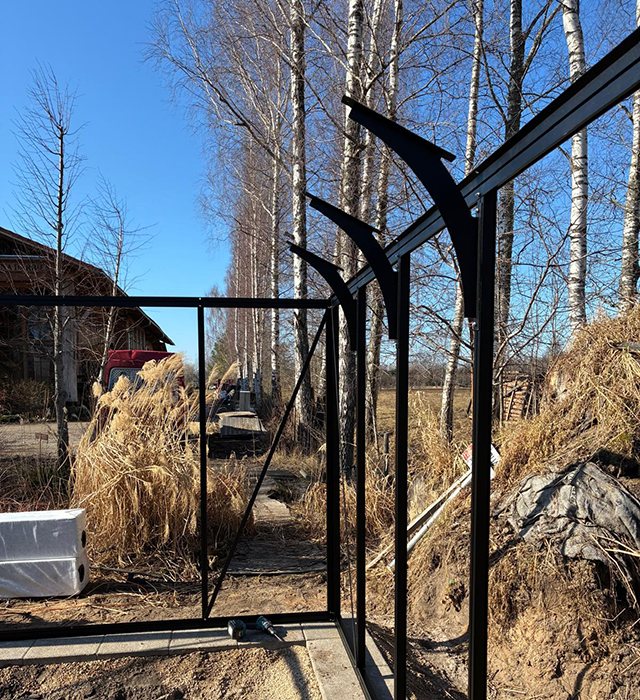
Particular considerations for greenhouses and pergolas
Inside a greenhouse, condensation, high humidity, fertiliser, crop-protection or cleaning products, and organic residues meet in a confined space. Splashes should not remain on profiles. Gutters and drainage channels must also stay clear of soil and plant debris. For intensive growing, see practical guidance on growing lettuce in a greenhouse. Growing advice does not replace frame-care instructions.
For pergolas, water management, wall connections and foundations are decisive. Coating cannot compensate for poorly planned drainage. Movable louvres and other mechanical components must not be painted over, blocked or treated with unsuitable lubricants. Our article Is a bioclimatic pergola worthwhile? helps with basic system selection.
Dark and light coatings can heat differently in sun, but no single colour is universally “best”. For plants, glazing, shading, ventilation, humidity management and location are generally more important than the colour of narrow frame profiles. For people beneath a pergola, roof type, orientation and air movement matter alongside colour.
Frequently asked questions
Does powder-coated aluminium rust?
Aluminium does not form reddish-brown iron rust. It can still corrode under unfavourable conditions, especially with salt exposure, standing moisture, unsuitable chemicals or contact with incompatible metals. Powder coating improves protection but does not remove the need for correct construction and care.
Will the coating eventually need repainting?
Not on a fixed timetable. Condition, location and mechanical wear are what matter. An intact coating should be cleaned, not preventively painted over. With widespread wear or numerous defects, first assess whether professional refurbishment is technically sensible.
Is a RAL code an exact digital colour?
No. A RAL code is a standardised colour reference, not a universal screen value. Display calibration, brightness, photography and ambient light all change its appearance. The code alone also does not automatically specify gloss level and surface texture.
Can two components with the same RAL reference look slightly different?
Yes. Geometry, light direction, texture, gloss, substrate and production batches can create visible differences. A slight difference in appearance does not automatically mean the wrong colour code was used. Where design expectations are high, coordinate physical samples.
Can I clean the frame with a pressure washer?
Water, a soft sponge and a suitable mild cleaner are the gentler choice. A pressure jet can stress seals, joints, damaged areas or sensitive connection zones and force dirt into gaps. Use one only where product-specific instructions expressly allow it.
What should I do with a scratched delivered component?
Do not install or repair the part yourself immediately. Record the packaging, component, damaged area and marking with clear photographs. Compare the delivery with the documents and report the finding through the intended process. Keep packaging until the matter is resolved.
Is powder-coated aluminium maintenance-free?
No. It is low-maintenance, not maintenance-free. Dirt, salt, leaves and aggressive residues need removing. Drainage routes, connections and mechanically stressed areas also need regular checks. Care requirements and intervals depend on location and use.
Can I use any stainless-steel screws or hardware-store fixings?
Not without checking. Dimensions, strength, head shape, sealing, coating and metal compatibility must suit the construction. A metal perceived as high-quality is not automatically suitable for every connection. Use the specified or expressly approved fixings.
Does a scratch automatically mean the frame will fail?
No. A small superficial scratch is usually a local surface issue. A deep notch, distortion, cracked connection or damage at a load-bearing joint requires technical assessment. Position and depth matter more than visibility alone.
Which colour is best for warmth or plant growth?
There is no universally best frame colour. Dark surfaces generally absorb more solar energy, but a greenhouse’s overall climate is shaped much more by glazing, ventilation, shading, size and location. Do not use colour as a substitute for functional climate planning.
Where can I find my product’s confirmed colour and care requirements?
The product description, quotation, order confirmation, installation instructions and supplied care documents are decisive. General photographs or details of a similar model are insufficient. If information conflicts, obtain written clarification before ordering or treating the surface.
Final checklist for purchase and use
- Match the product, variant, RAL reference and finish in writing.
- Assess colour in realistic light and use screen images only as guides.
- Clarify the site, foundation, drainage and local requirements before ordering.
- Check delivery before installation and document anything unusual.
- Install profiles on clean, soft supports and remove metal swarf immediately.
- Use only specified fixings, seals and accessories.
- Clean with mild products; avoid aggressive chemicals and abrasive tools.
- Remove salt, bird droppings, plant sap and building-material residue promptly.
- Assess scratches by depth and location rather than painting them over unchecked.
- Always apply product-specific documents before general recommendations.
Considering colour, construction and care together delivers an attractive surface and reduces avoidable damage in delivery, installation and use. Find further guidance in greenhouse reviews and on the central Bloomcabin page for South Africa.
