



PREPARATION
Store products safely before installation
Correct temporary storage protects glass, aluminium, timber, seals and fittings from moisture, distortion and loss. This guide covers preparing the storage area, receiving goods and an orderly handover to the installation team.
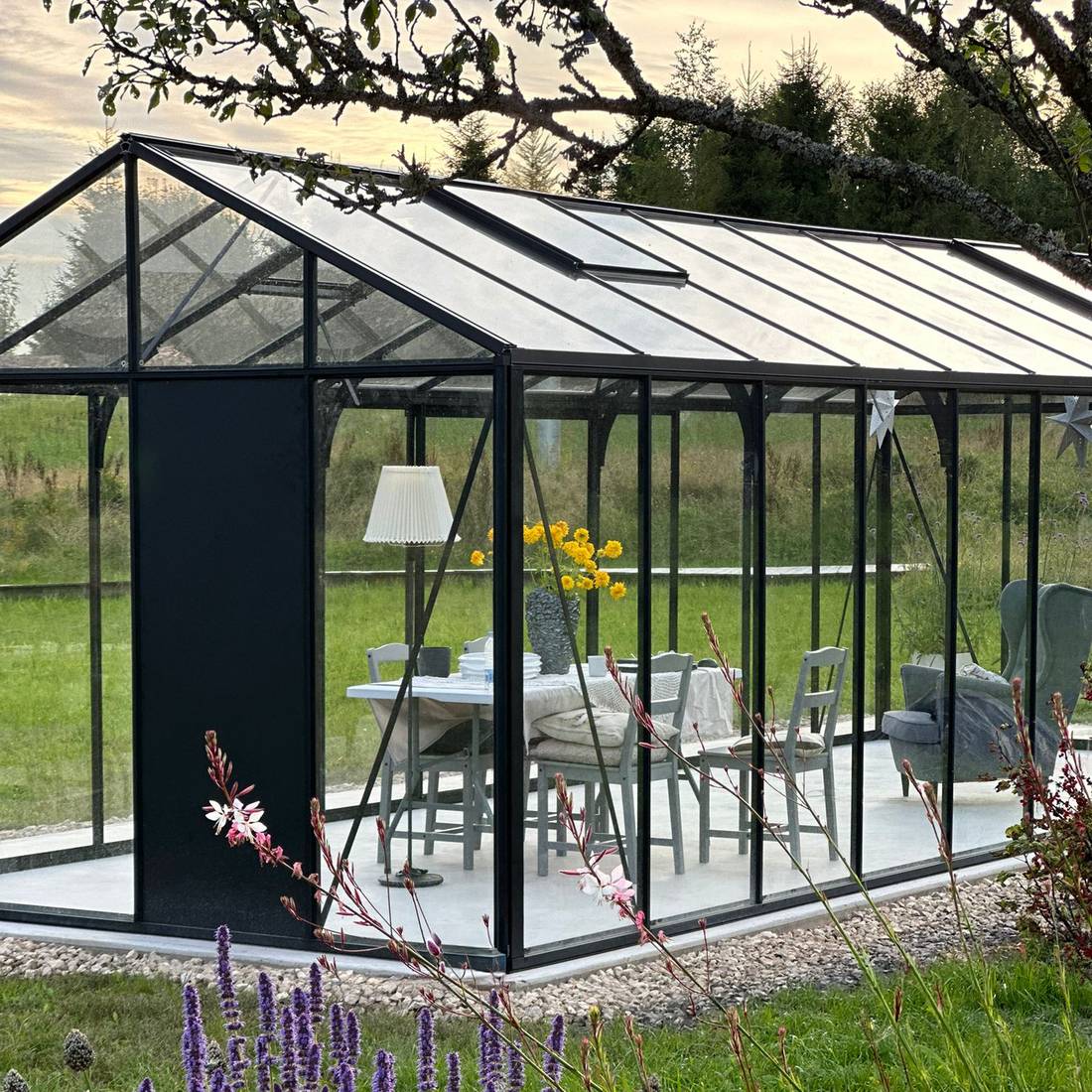
Days, or a longer project-dependent period, may pass between delivery and installation. During this time, greenhouse, pergola or outdoor sauna components are not yet protected by their completed structure. Packaging must therefore not be treated as ordinary stored goods or spread around the site without control.
Safe temporary storage starts before delivery. A level, load-bearing storage area, protection from rain and ground moisture, a traceable package layout and prompt delivery checks are essential. Instructions on packaging, delivery documents and installation manuals always take priority over general advice. For order or delivery queries, see Shopping & delivery, How to order and contact Bloomcabin .
Pre-installation storage checklist
- Keep the installation manual and delivery information ready before unloading.
- Choose a level, clean and sufficiently large storage area.
- Keep components clear of soil, standing water and splashback.
- Keep access, unloading routes and manoeuvring space clear.
- Do not load delicate packages without confirmed stacking approval.
- Check delivered contents, package numbers and visible condition on arrival.
- Photograph and record damage or irregularities in writing.
- Do not remove labels, protective films or orientation markings.
- Store glass, timber, aluminium and small parts appropriately.
- Allow ventilation without exposing the delivery to weather.
- Keep foundation materials separate from product packages.
- Restrict access to informed people and document the handover.
1. Prepare the storage area before delivery
Do not decide where to store packages only when the delivery vehicle arrives. Check in advance how packages will travel from the unloading point to storage. Narrow passages, steps, soft ground, low clearances or parked vehicles can force unnecessary handling. Every extra move increases the risk of impacts, scratches and mixed-up components.
The storage area should be large enough to support long packages along their full length and to position glass or glazing units as their markings specify. Allow for a safe working aisle as well. Packages must not be packed so closely that labels can only be read by moving heavy items.
Storage-area requirements
| Criterion | Practical approach |
|---|---|
| Ground | Level, load-bearing, clean and free from sharp building debris |
| Clearance from ground | Use suitable, stable supports and prevent sagging |
| Weather protection | Protect from rain, snow, prolonged damp and strong wind |
| Ventilation | Allow airflow; do not seal packages in wet plastic sheeting |
| Access | Authorised people only; do not use as a general site thoroughfare |
| Order | Keep package numbers visible and mark areas by installation stage |
A locked indoor space is often helpful, but not automatically suitable. Unventilated basements, damp shell buildings or rooms with plastering and screeding in progress may have high humidity. Equally, an open area beneath a loosely placed tarpaulin is not automatically safe. Wind can lift covers, rain can drive in from the side and coatings can be damaged by rubbing.
2. Receive and inspect the delivery promptly
Arrange goods receipt so that a responsible person can inspect the consignment immediately. Match the packages received against the delivery documents without prematurely taking every package apart. Visible transport damage, crushed corners, torn wrapping, soaked cartons, shifted glass units or missing packages should be recorded straight away.
A signature does not replace condition records. First photograph the entire consignment at the unloading point, then each irregularity from several angles. Ensure package numbers and labels can be seen in at least one photograph. Follow the stated process for reporting transport damage and also check the information on warranty and claims handling.
Information to document
- Date and approximate time of delivery
- Name of the person who accepted delivery
- Number and identification of packages received
- Overall view of the consignment before moving it
- Condition of cartons, wrapping, crates, pallets and edge protection
- Location and type of visible damage
- Noticeable moisture or signs of shifting
- Differences between delivery documents and packages present
- Immediate action taken, such as moving items to dry storage
Do not dispose of damaged packaging before it is clear whether it is needed for assessment. Alter identified damage only as far as necessary to prevent further damage or an immediate hazard.
3. Preserve labels, orientation and packaging condition
Arrows, package numbers, centre-of-gravity marks and instructions such as this way up, fragile or do not stack form part of the storage plan. Do not turn packages merely to save space. Removed labels or cut-open bundles make later identification harder and may result in components being opened in the wrong order.
Open only as much as required for the specified incoming inspection. If a package must be opened, photograph its condition beforehand and retain every marking. Then reseal it so that protection and ventilation remain as close as possible to the original purpose. Do not apply tape directly to painted, powder-coated, glazed or visible timber surfaces.
4. Protect glass, aluminium, timber, seals and fittings
Materials in a delivery respond differently to moisture, point loads, temperature changes and unsuitable supports. One storage method for every package is therefore unsuitable.
Glass and glazing packages
Glass is especially vulnerable to point impacts on its edges. Store and move glass units only as package markings and installation documents require. Where upright storage is specified, secure the package against tipping and support it on a suitable base. Do not lean unwrapped panes loosely against walls or other components.
Do not lay glass packages flat simply to save space. Profiles, toolboxes and building materials must not be placed on them either. Keep the area clear of grinding, sparks, mortar, metal filings and heavily used walkways. For glazing options, material properties are also important; the article on polycarbonate and multiwall sheets for greenhouses explains different glazing considerations.
Aluminium profiles and finished surfaces
Long aluminium profiles need even support. Isolated supports placed far apart can encourage unwanted sagging. Do not place heavy objects on profile packages or drag components over rough ground. Sand, drill swarf and small stones act like abrasives.
Protective films should generally remain in place until the installation stage specified in the manual. At the same time, films must not be stored under intense sunlight for an unspecified period on your own initiative. Product-specific instructions govern. For later use, the guide to caring for an aluminium greenhouse is also useful.
Timber components
Timber should be stored dry, ventilated and protected from direct weather. Avoid direct contact with soil, damp concrete or wet walls. Support longer components so they cannot sag on one side. An airtight cover can retain trapped moisture, while completely open storage can cause repeated wetting and drying.
For outdoor saunas, clear package organisation is especially important because structural, roofing, interior fit-out and accessory parts may be needed at different installation stages. Always check the documents for the specific model, for example the Elma S outdoor sauna, Elma L outdoor sauna, HC150 barrel sauna or HC 180 barrel sauna.
Seals, connectors and small parts
Keep screws, connectors, cover caps, seals and installation aids in their labelled bags or cartons wherever possible. Store small parts dry and protected from unauthorised access. Do not combine different screws in one container: similar diameters or heads do not mean that parts are interchangeable.
Seals must not be crushed beneath heavy packages or stretched unnecessarily. Keep them away from sharp objects, contamination and unsuitable chemicals. If small parts are removed for inventory checks, count them on a clean surface and immediately repack them with their position identification.
5. Control moisture without trapping condensation
Moisture reaches deliveries through more than direct rain. Condensation can form when cold components enter warmer, humid air or temperatures change sharply inside temporarily covered packages. A seemingly watertight tarpaulin may keep water out while trapping existing moisture inside a package.
Regularly inspect the storage area for dripping water, damp ground, damaged covers and condensation. Provide airflow without opening packages to wind and driving rain. Do not place heaters directly beside components or try to dry damp timber, seal or glazing packages with intense local heat. If a package is wet: document it, move it into a protected area, have its condition assessed appropriately and obtain product-specific instructions.
Managing moisture later in an assembled greenhouse is a different subject. See the guide to temperature and humidity in the greenhouse.
6. Adapt the storage plan to product and project
A compact greenhouse, large orangery, wall-mounted pergola and timber sauna do not have the same needs for access, package sequence and temporary storage. First clarify the product type, planned position, installation date and installation team. Information about greenhouses and conservatories, saunas and further useful information can support project preparation.
For pergolas, design and positioning affect which packages must be accessible first. Compare the guidance on bioclimatic or classic pergolas, wall-mounted or freestanding pergolas and the pergola size guide. The article on bioclimatic pergolas also helps define the concept early.
For larger greenhouse projects, the storage plan should provide enough manoeuvring space for long profiles and glazing. Background and inspiration are available in articles about Victorian greenhouses and orangeries and their planning. These pages do not replace delivery documents or the installation manual for the ordered product.
7. Separate foundation work from stored components
Foundation work creates dust, splashback, cement slurry, metal filings and site traffic. Do not therefore store product packages directly beside mixing areas, excavations, formwork or cutting work. Fresh concrete surfaces are not general storage areas either. Keep routes clear so wheelbarrows, machinery or building materials do not have to be forced past glazing and profile packages.
Dimensions, levels, flatness, drainage and fixings must suit the specific product before installation begins. Use the pergola foundation guide for preparation. Approval and other local requirements depend on the project and location. Check with your municipality’s building-control office; the article on possible approvals for a greenhouse or pergola offers initial guidance.

8. Organise packages by installation sequence
Space-saving storage is not necessarily installation-ready. If the frame package needed first is behind glazing or roof components, the delivery must be moved repeatedly. Create a simple zone layout:
- Zone A: foundation, base or frame components needed first
- Zone B: load-bearing profiles and main structure
- Zone C: roof, wall or cladding elements
- Zone D: doors, windows, louvres or fitout parts
- Zone E: labelled small parts, seals and accessories
The actual sequence is determined solely by the installation manual. Do not write directly on visible surfaces. Use separate, securely fixed labels and keep a package list. Removed parts should be logged immediately or handed to the responsible installer.
9. Handover checklist for the installation team
- Installation manual, package list and order documents are fully available.
- The responsible contact person and access to storage are confirmed.
- Documented irregularities were passed on before work begins.
- Packages are clearly labelled and accessible in installation order.
- Glass and long-item packages remain safely positioned as intended.
- Small parts are dry, sealed and clearly allocated.
- Foundation and installation area were checked separately and kept clear.
- Transport routes are clear of debris, plants, vehicles and trip hazards.
- Required local arrangements were completed before installation began.
- Packaging is discarded only after components have been checked and allocated.

Common temporary-storage mistakes
- Direct ground storage: Ground moisture and small uneven areas can affect packaging and components.
- Fully sealed tarpaulin cover: It can trap condensation and become a mechanical load in wind.
- Unchecked stacking: Lower packages may be damaged even when the upper layer seems light.
- Laying glass flat: Changing the specified orientation is not a safe way to save space.
- Removing protective films early: Visible surfaces are then unprotected during transport and installation.
- Mixing fittings: Similar connectors may later be allocated incorrectly.
- Storage in site traffic: Impacts, splashes and unauthorised access often go unnoticed.
- Late inspection: After repeated handling, the original delivery condition is difficult to trace.
- Improvised repairs: Tape, cleaning agents or local heat can cause further damage.
Frequently asked questions
Can I store my Bloomcabin product outside before installation?
Only if the product-specific documents allow it and suitable, prepared weather protection is available. A tarpaulin on grass is not enough. You need, among other things, level load-bearing ground, clearance from ground moisture, protection from rain and wind, and adequate ventilation. Delicate glazing, timber and small-parts packages need particular protection. If uncertain, a dry, controllable storage space is the better option.
Should I open every package on arrival?
No, not automatically. First check the quantity, identification and outside condition. Open packages only in line with delivery and inspection instructions, or if a documented irregularity must be clarified. An unnecessarily fully opened package loses its orderly allocation and possibly some transport protection. If opened, its contents and resealing must be documented clearly.
How long may packages be stored temporarily?
There is no universally valid maximum period. It depends on the product, packaging, material, storage climate and manufacturer instructions. Keep the storage period as short as possible and inspect the delivery regularly. If installation is substantially delayed, ask for product-specific guidance rather than assuming shipping packaging is designed for unlimited long-term storage.
May I stack greenhouse or pergola packages?
Only where markings or documents expressly allow it. The shape and apparent strength of packaging do not reliably indicate whether it can be stacked. Long profiles, glazing and packages with finished surfaces can be damaged by pressure or point supports. If in doubt, store units separately with full support.
What should I do if packaging gets wet?
Photograph the condition, label the affected package and move it to a protected area without a risky change of position. Do not trap moisture by adding sealed plastic sheeting. Do not open or dry the package with direct heat before the correct process is clear. Contact Bloomcabin promptly if damage is visible or contents are soaked.
May glass packages be laid flat to save space?
Not without an express instruction to do so. Keep the marked transport and storage orientation. Glass needs suitable support and protection from tipping, edge impacts and loads placed on it. Unauthorised flat storage can create stresses for which the package and panes were not designed.
May protective film be removed before installation?
Remove protective films only at the installation stage specified in the manual. Removing them too early exposes surfaces to scratches, dust, mortar splashes and tool contact. Films should also not remain in intense sun unnecessarily contrary to product-specific instructions. The decisive guide is therefore the manual for the particular product, not a blanket rule.
Where should screws and fittings be stored?
In a dry, locked and clearly labelled area. Leave parts in their original labelled bags or cartons wherever possible. A separate small-parts cabinet or protected box is useful if the original allocation remains intact. Do not store accessories loose in profile packages or on an open construction site.
What if the foundation is not ready when delivery arrives?
The delivery then needs its own storage area that does not conflict with foundation work. Do not keep moving product packages between excavations, formwork and concrete work. Also check whether the planned storage duration and later access remain suitable. Installation should begin only after the foundation and local requirements for the specific project have been checked.
Who should have access to the stored delivery?
Only designated people who understand delicate packages, safe routes and the package layout. Children, unrelated tradespeople, visitors and pets should not have access. Decide who may remove parts, open packaging or move the delivery. This keeps it traceable when and why the condition of a package changed.
Which documents belong with the delivery?
Keep the order confirmation, delivery documents, package list, installation manual, goods-receipt photographs, damage notes and relevant correspondence together. Digital copies protect against loss on site. General company and service information is available under About us; for project-specific questions, direct contact is decisive.
Final readiness check
Before installation day, the delivery should be dry, secure, fully documented and accessible in a sensible sequence. Check packaging, labels, glass positioning, profile supports, timber packages and small parts again. Also inspect the foundation, working area and transport routes separately from product storage.
Do not begin assembly if essential packages are missing, damage is unresolved or the installation area is still affected by other work. A short, systematic final check prevents improvised restacking and protects components while they are not yet secured by the completed structure.
