



MATERIALS
Designed for wind, snow and year-round outdoor conditions
A weather-ready greenhouse depends on more than choosing a model. Site, foundation, assembly quality, ventilation, drainage and regular inspections work together. This guide explains how to assess these factors for Maltese outdoor conditions.
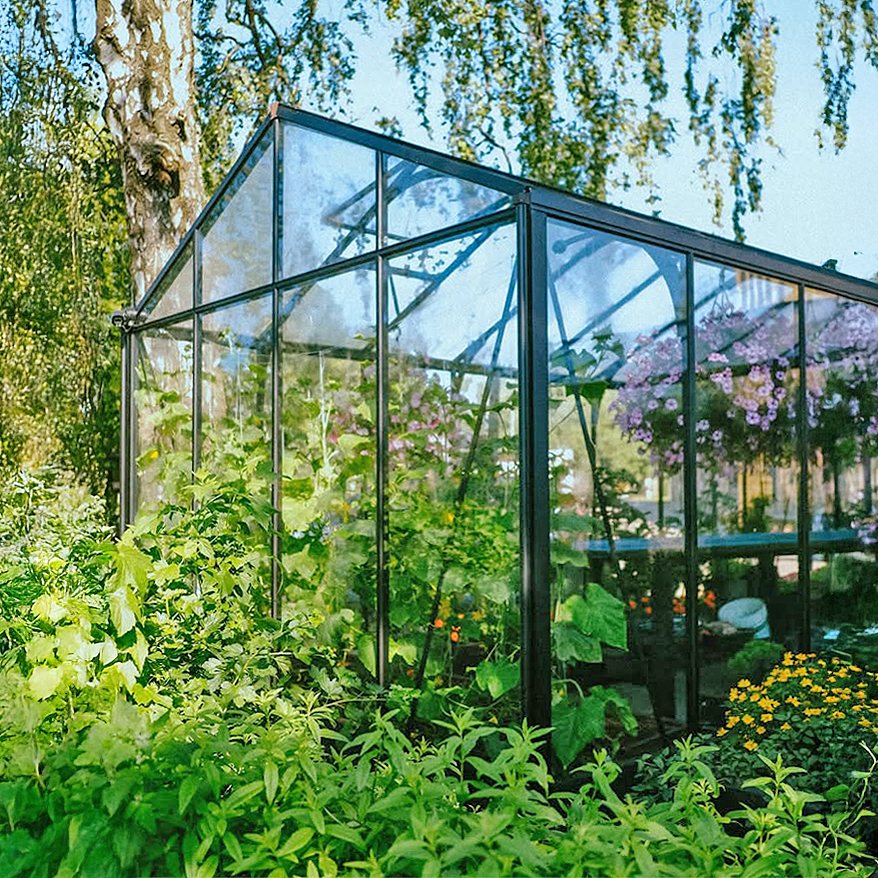
A greenhouse permanently sits between a managed interior and changing weather outside. Wind pressure and suction, snow, driving rain, frost, summer heat and sharp temperature changes can occur in sequence or together. It is therefore not enough to consider only the frame and glazing. Site, design, foundation, anchoring, installation and everyday use must form one suitable system.
This guide supports technical preparation and later use. It does not replace the model-specific installation instructions, a structural assessment or a planning review. Where requirements depend on the site, Planning Authority classification, local conditions or the particular product, check the applicable requirements.
What “designed for outdoor conditions” really means
A greenhouse developed for outdoor use is intended to face changing environmental conditions over time. That does not mean it can withstand every conceivable weather event regardless of site, foundation and operation. A structure performs only within the conditions specified for its model and when assembled correctly.
Weather readiness includes several connected tasks:
- Load transfer: Wind and any snow loads must pass from roof and walls through the frame, fixings and base into the ground.
- Shape stability: Profiles, panes or sheets and connectors must be fitted and secured completely as instructed.
- Water management: Rain and meltwater need clear discharge routes, without pooling at the base or on neighbouring surfaces.
- Movement allowance: Aluminium, glass, polycarbonate and seals react differently to temperature changes.
- Operational checks: Doors, windows and automatic openers must be used and checked for the weather conditions.
The care of an aluminium greenhouse is therefore not merely cosmetic. Cleaning and inspections help drainage, ventilation and connection points remain functional.
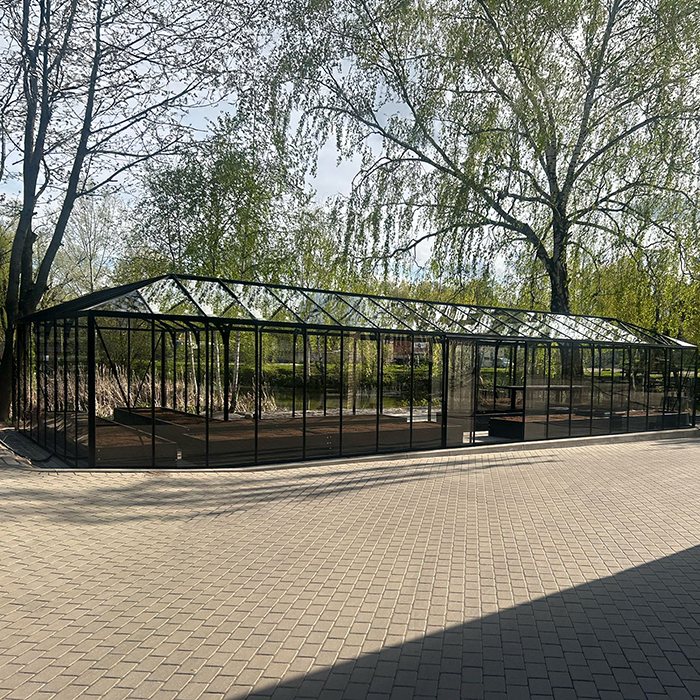
Assess the site before choosing a model
Assess the site before fixing the size, roof shape or equipment. Photograph the proposed location from several directions and observe it during rain and on a windy day where possible. Note slopes, shade, trees, buildings, walls, access routes and existing services.
Wind exposure
Coastal plots, exposed ridges, open land, broad streets and gaps between buildings may experience stronger or more turbulent airflow than sheltered gardens. Apparent wind protection can also cause problems: walls, hedges and building corners can create eddies and locally increased suction.
Check the direction from which strong winds most often arrive and whether doors or roof vents would face it directly. An open door becomes a large exposed surface. At the same time, do not choose a site so cramped that assembly, pane replacement, cleaning or snow removal becomes impossible.
Rainwater and occasional snow movement
Consider more than precipitation falling directly on the greenhouse. If snow occurs, it may slide from higher roofs or drift between buildings. Rainwater may run towards the foundation from slopes, terraces and neighbouring areas. Avoid these added loads when selecting the position.
The ground should lead water away from the structure. Roof outlets need a suitable discharge point that does not undermine the foundation or paths. Where the ground freezes, meltwater can also collect in places that seem harmless in milder weather.
Access and seasonal use
A greenhouse used throughout the year needs safe access in every season. Allow space for door movement, transport routes, cleaning and maintenance. Electrical or water installations must be planned and completed in line with applicable local requirements.
Also consider how the greenhouse will be used. A propagation house has different requirements from a larger orangery or sitting area. The orangery and greenhouse guide and the overview of greenhouses and conservatories offer ideas for different concepts.
Choose the model and configuration
Start with the real site conditions, not only the available floor area. Compare roof form, door position, ventilation options, glazing type, access and the intended foundation solution. Product information always applies to the specific version; values or characteristics must not be transferred from one model to another.
With polycarbonate, construction, light transmission and thermal properties differ from glass. The article Polycarbonate for greenhouses explains the key differences. For design and form, greenhouse reviews and project experiences can provide orientation without replacing a site-specific assessment.
Compare fully defined configurations only. Extra windows, doors, shelves or technical fittings change use, airflow and sometimes the assembly sequence. Accessories must be expressly suitable for the model and installed as instructed.
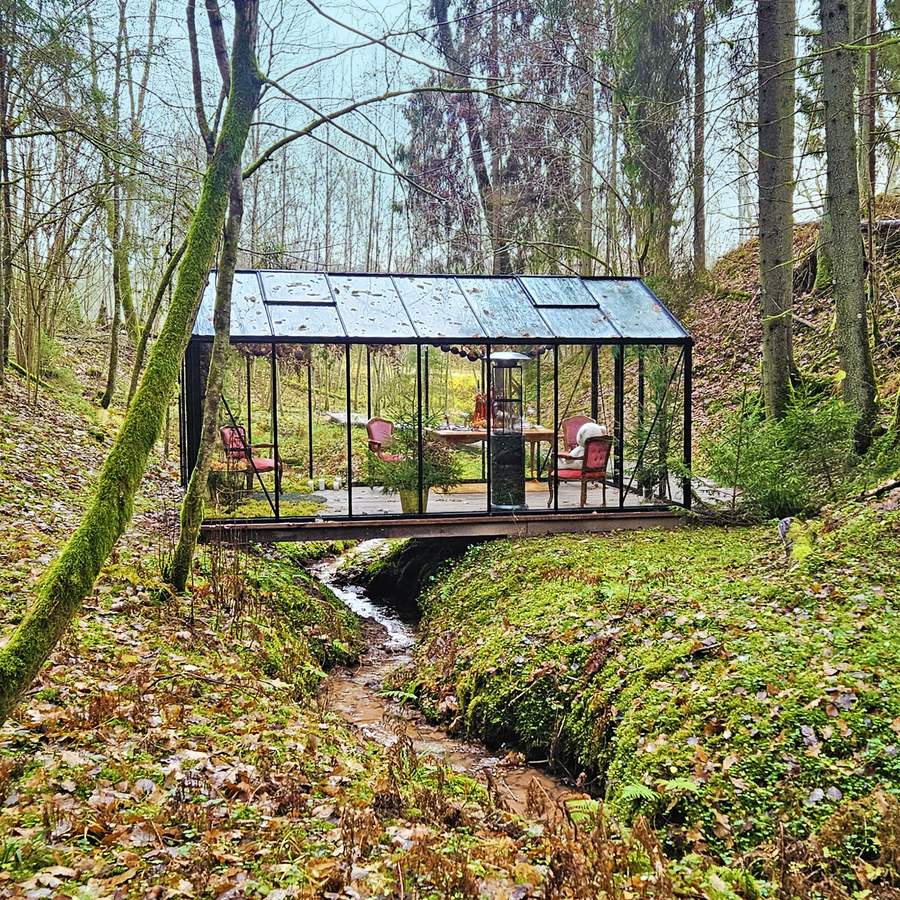
The foundation is part of weather preparation
The frame can transfer forces reliably only when its base is level, load-bearing, dimensionally accurate and permanently stable. A sloping or settling foundation can strain profiles, prevent doors closing properly, create uneven glazing support and lead to leaking connection areas.
The right foundation depends on the model, soil, frost conditions and local requirements. An existing terrace is not automatically suitable. Paving may look level but can settle with an inadequate sub-base or fail to allow the intended anchoring. Check model-specific information and have uncertain ground assessed professionally.
Foundation planning checklist
- Set external dimensions and reference points from current documentation.
- Check squareness across both diagonals.
- Check surrounding height, level and fall.
- Consider ground bearing capacity and frost behaviour.
- Coordinate anchoring points before concreting or drilling.
- Lead rainwater and meltwater away from the base.
- Locate and protect underground services.
- Keep sufficient working space around every side.
- Recheck dimensions and surface before assembly starts.
The same physical principles apply to other outdoor structures. The pergola foundation guide shows why ground, drainage and fixings must always be planned together.
Receive and store components before assembly
Check the delivery promptly against the accompanying documents. Record packaging condition and visible discrepancies before distributing parts or disposing of packaging. Find process information under Purchasing and delivery.
Store profiles, panes, sheets and small parts dry, securely and according to the instructions. Long components need even support. Glazing must not topple or be damaged by point loads. Secure light packaging and sheets against wind. Do not leave components on wet ground or in standing water for extended periods.
Sort fixings only by their position or part identification. Similar-looking screws can have different functions. Mixing them prematurely increases the risk of incorrect allocation.
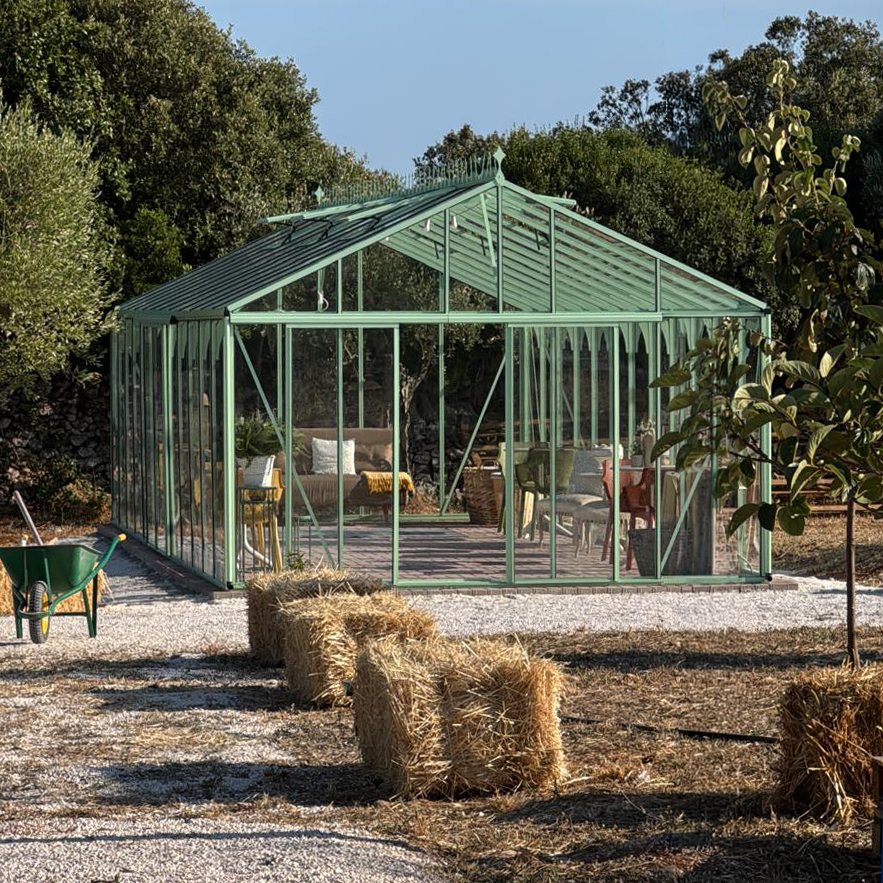
Assembly quality and the Anna-Koku-Skola sequence
The documented Anna-Koku-Skola installation should be understood as one connected assembly sequence: from preparing the ground through orderly erection of the frame sections to glazing and final inspection. What matters is not a single image or isolated task, but the controlled order.
Begin only in suitable weather. Strong wind makes aligning large frames difficult and handling panes or sheets hazardous. Before each stage, check that the preceding assembly is square, plumb and fixed according to the instructions. Small deviations at the base can become obvious at roof level.
Practical assembly checks
- Match documents: Ensure the instructions and parts list match the delivered version.
- Pre-sort parts: Group profiles and fittings by construction stage without removing labels.
- Measure the base: Check sides, diagonals, level and anchoring before erecting the frame.
- Align the frame provisionally: Tighten connections only as far as the instructions specify initially.
- Check roof geometry: Ridge, eaves and rafters must not be forced into position.
- Fit glazing systematically: Keep bearing surfaces clean and use every specified retainer.
- Test opening elements: Doors and windows must work without rubbing, binding or excessive play.
- Complete final checks: Carry out all specified finishing work only after checking overall geometry.
Do not drill additional holes, shorten profiles or replace fixings unless expressly approved. Such changes can affect load paths, corrosion behaviour or glazing support. If uncertain, contact Bloomcabin before making a change.
Manage wind in everyday use
Many wind-related failures begin not with the closed frame but with an open door, unsecured window or loose object. Check catches regularly and keep the area around the greenhouse clear of garden furniture, tools, branches and lightweight plant containers.
Before strong winds
- Close and lock doors and manually operated windows fully.
- Check automatic openers against their instructions and prepare them where necessary.
- Secure or remove loose items inside and outside.
- Do not ignore damaged panes, sheet retainers or seals until after the storm.
- Keep gutters and outlets clear if heavy rain is expected.
- Do not attempt outdoor repairs during a storm.
A partly open door is not controlled pressure relief. It can catch wind and transfer additional forces to the frame and glazing.
Snow, ice and frost
Snow load is not determined only by visible depth. Wet snow is much heavier than loose powder; drifting and sliding snow can create uneven loads. If snow occurs, always follow the specifications for the particular model and the actual site conditions.
Monitor the roof during prolonged periods of snow and act before critical or uneven accumulations form. Remove snow only with a safe, material-friendly method. Never climb onto the roof, strike panes or sheets with hard tools, or force frozen surfaces free.
Ice can block doors, windows and outlets. Never force opening elements. Where water repeatedly thaws and refreezes, inspect connections and drainage routes after the cold spell. Further transferable advice appears in Pergolas in winter: snow, ice and wind.
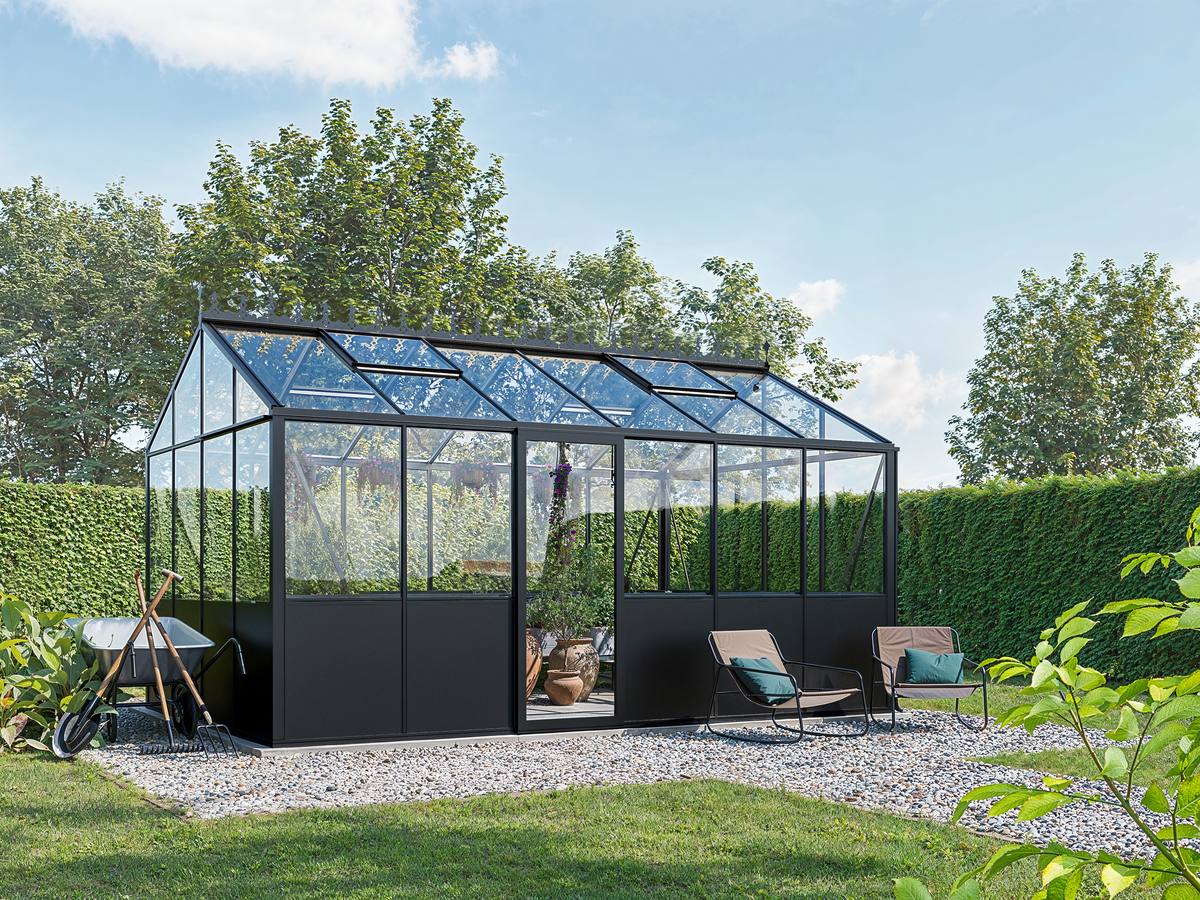
Rain, drainage and condensation
A greenhouse is not a climatically sealed space. Rainwater must drain in an orderly way outside, while plants, damp soil and temperature differences create condensation inside. Drops on the inner surface are therefore not automatically evidence of a leak.
Clean leaves, moss and soil from gutters, outlets and connection areas. Water standing at the base is more likely to indicate a ground or drainage problem than a glazing fault. After driving rain, check whether water from adjacent roofs or paved areas is being directed towards the greenhouse.
Condensation can be reduced through balanced ventilation, adequate air movement and controlled watering. Detailed guidance is available in Temperature and humidity in the greenhouse.
Heat, ventilation and seasonal temperature changes
Solar radiation can heat the interior rapidly, even on mild days. Roof vents, doors and suitable shading where needed must therefore be treated as an operating system. A position that works in summer may be unsuitable when wind rises.
Automatic window openers simplify temperature management but do not replace checks. Inspect their function, setting and free movement according to the relevant documentation. Plants must not obstruct window leaves or mechanisms.
In winter, sunshine does not automatically provide lasting frost-free conditions. Temperatures can fall quickly after sunset. Anyone growing lettuce in a greenhouse must consider plant needs, ventilation and local cold spots together. Active heating requires separate professional planning.
Regular inspection and maintenance plan
| When | Checks | Action |
|---|---|---|
| Monthly during the season of use | Doors, windows, catches, visible connection points | Clean, test operation and address visible looseness as instructed |
| Before forecast severe weather | Openings, loose objects, outlets, damaged glazing | Close, secure, clear and investigate damage in good time |
| After storms or heavy rain | Frame geometry, pane retainers, seals, foundation surroundings | Document changes and stop use where safety is in doubt |
| Before winter | Gutters, roof surfaces, door function, anchoring, nearby branches | Clean and remedy visible defects before frost and snow |
| After a cold spell | Settlement, standing water, ice effects, moving parts | Inspect the ground and components again |
Use only suitable products and methods for cleaning and care. Aggressive chemicals, abrasives or hard tools can damage surfaces, seals or glazing. A simple maintenance record with dates and photographs makes gradual changes easier to identify.
Purchase planning and documentation
Keep the quotation, order confirmation, parts list, assembly instructions, foundation documents and installation photographs together. Record accessories and later changes. Find ordering information under How to order; the applicable manufacturer guarantee terms appear under Guarantee.
Before purchasing, also check whether the site requires planning permission, a notification, boundary review or consent. In Malta, ask a perit to assess the Planning Authority classification, footprint, height, enclosure, land designation and existing permit conditions. The article Planning permission for a greenhouse or pergola in Malta offers initial guidance but does not replace advice from the competent authority.
For delivery to Malta, check the applicable ordering and delivery terms separately. Bloomcabin delivers to Malta and its islands; free delivery applies to most products, so check the terms for the specific product. More subjects are collected in delivery information for greenhouses and in the useful information section.
Frequently asked questions
Can a greenhouse remain outside all year?
Yes, where the particular model is intended for permanent outdoor installation and its site, foundation, assembly and use meet the associated requirements. Year-round installation does not mean maintenance-free operation. Checks are needed before and after exceptional weather events.
Does an aluminium frame eliminate rust and maintenance issues completely?
Aluminium resists corrosion, but cleaning and inspection remain necessary. Fixings, contact areas, coatings, seals, gutters and moving parts can become dirty, damaged or altered. Avoid unsuitable cleaners and unauthorised combinations of materials.
Can I install a greenhouse on an existing terrace?
Only where construction, bearing capacity, level, drainage and anchoring options suit the intended structure. A level surface alone is not enough. Unknown sub-bases or floating-laid slabs should be professionally assessed first.
Should roof vents remain open in strong wind?
Generally, close and secure doors and windows properly before strong winds. Open elements increase the exposed area and can create internal pressure. Always follow the instructions for the particular model and opening mechanism used.
Must every snowfall be removed immediately and completely?
Not every thin layer of snow automatically requires action. Model requirements, snow type, drifting, snow sliding from other roofs and the actual load distribution are decisive. Monitor developments and avoid heavy or one-sided accumulations.
Does a greenhouse stay warm in winter?
An unheated greenhouse retains solar warmth by day but can cool substantially at night. Glazing and design influence the pattern but do not guarantee frost-free temperatures. A required minimum temperature needs a coordinated heating, ventilation and safety plan.
Does condensation prove that the greenhouse leaks?
No. Condensation forms when humid internal air meets colder surfaces. Repeated water at the same outer connection point, especially during rain, should still be investigated. Internal humidity, watering, ventilation and possible water ingress need separate assessment.
Can a lean-to greenhouse be attached to any wall?
No. Wall construction, bearing capacity, level, waterproofing, roof overhangs, drainage and existing services must be suitable. External insulation systems and façade cladding also require appropriate connection solutions. Seek professional assessment when in doubt.
May I replace fittings or drill additional holes?
Only where the documentation provides for it or approval has been expressly given. Additional holes and different fixings can weaken profiles, alter water routes or create unsuitable material contact. An apparent assembly shortcut can cause later problems.
What should I do after a severe storm?
Approach only when the surrounding area is safe. Inspect and photograph glazing, opening elements, frame, connections, anchoring and the foundation surroundings. Secure the area if components are broken or displaced, and do not resume normal use until the issue is resolved.
What is the most important preparation step?
Careful site and foundation planning. It determines how wind, water and loads affect the structure and whether the frame can be assembled accurately. An unsuitable base cannot be compensated for by tightening screws more firmly.
The same planning principles apply to other outdoor installations, even where their construction and use differ. If coordinating several garden buildings, also consult the pergola size guide, the comparison of wall-mounted or freestanding pergolas and the guide to bioclimatic or classic pergolas . For a separately planned wellness area, consider the Elma S outdoor sauna and the HC150 thermowood barrel sauna . Check foundations, distances, connections and planning questions separately for every structure.
