



SUPPORT
Check your delivery and report transport damage correctly
A systematic goods-in check helps identify visible damage, concealed transport damage, missing packages and incorrect deliveries early. This guide explains inspection, photo documentation, reporting and safe temporary storage.

Why checking delivery matters
Greenhouses, pergolas and outdoor saunas consist of many component types: long aluminium profiles, glazing or roof elements, timber parts, fittings, fixings and sometimes pre-assembled sections. They may arrive on one or several pallets and in separate cartons. A compact-looking consignment can therefore contain numerous components needed for assembly.
A structured inspection at handover creates a clear baseline. It records how many packages arrived, the condition of the packaging and whether there are signs of mechanical impact. Precise documentation then makes it easier to determine whether only the packaging was affected or a component needs replacement or technical assessment.
Checking goods on arrival is not a full assembly inspection. Many parts can only be identified after the packaging is opened and compared with the packing list and instructions. Even so, the time while the driver is present is especially important: visible damage, a shifted load or a discrepancy in the package count can be recorded immediately.
You can find information on the usual process under Buying and delivery. Delivery procedures can differ by destination; see our information on buying a greenhouse with delivery to Malta.

Preparing for delivery
Choose a suitable receiving and storage area
Before the delivery date, plan where the vehicle can stop and where the consignment can be unloaded. Access, gate width, ground conditions, slopes, parked vehicles, branches and other obstacles all affect the process. The intended area must safely support the delivered load. If you are unsure about access or unloading, clarify this in advance using the contact details provided for your order.
The inspection area should be level, load-bearing, well lit and large enough. Long profiles must not project uncontrolled or bend over point supports. Glass, panels and pre-assembled elements need protection against tipping. Do not store packages in traffic routes, on wet ground or where water runs off from roofs.
Clear the area beforehand and have a mobile phone or camera, writing materials, work gloves and, if necessary, a torch ready. A second person should be present for heavy or bulky deliveries. Do not try to lift awkward components on your own. Include the size of the receiving area in project planning, for example with the pergola size guide.
Keep relevant documents ready
Save or print the order confirmation, delivery-note information and any package details. Note the order number, recipient name and delivery address. Anyone accepting delivery for you needs brief instructions: count packages, check their condition, record deviations clearly and take photographs.
The person receiving the delivery should not sign simply because the driver is waiting. A neutral note such as “packaging damaged” is less useful than a specific description, for example “upper right corner of long carton crushed; strapping broken”. The page How to order explains how an order is generally arranged. Further planning and use topics are available under Useful information.
Delivery check: the essential sequence
- Safety first: Before unloading, observe whether the load is visibly tilted, unstable or damaged. Keep clear if components could shift.
- Photograph the overall condition: Take photos of the consignment from several directions while still on the vehicle where possible, or immediately after setting it down.
- Count packages: Compare the pallets and cartons actually handed over with the available delivery information. Count not only pallets, but also loose or separately secured packages.
- Check external packaging: Inspect corners, edges, undersides, protective film, carton faces, strapping and fixings.
- Locate irregularities: Pay particular attention to areas with dents, tears, holes, moisture, abrasion or movement.
- Record deviations: Have visible damage or missing packages recorded specifically on the available delivery documents or in the carrier’s recording system.
- Keep evidence: Photograph the note or retain a copy. Do not sign a description that conflicts with the visible condition.
- Unpack carefully after handover: Open suspicious areas carefully without unnecessarily changing the packaging, labels or damaged components.
- Compare contents: Identify components using the packing list and assembly documents. Report damage, shortages or incorrect parts without unnecessary delay through Contact or the channel specified for your order.
A systematic process is particularly useful when many similar-looking profiles are present. The number of visible cartons does not show how many individual items should be inside. Open and inspect each package in turn, and retain all markings.
What to check while the driver is present
| Check point | Possible issue | Useful documentation |
|---|---|---|
| Load position | Pallet tilted, packages shifted or insufficiently supported | Overview photo before further movement |
| Carton and film | Tear, hole, severe crushing, abrasion mark or open seam | Overall view and close-up |
| Strapping | Broken, loose, cut into or obviously replaced | Photograph strap, closure and affected edge |
| Moisture | Soaked carton, water marks or condensation beneath film | Compare dry and wet areas |
| Rigid components | Deformed profile ends, cracked panels or damaged frames | Photograph damage without loading the component |
| Package count | Fewer or more units than announced | Capture the entire delivery and every label |
An intact top surface is not enough. Fork tines, edge contact or point loading can damage undersides. Never go beneath a raised or unstable load, however. An inspection must never create a safety risk.
Accept or refuse a damaged delivery?
Damaged packaging does not automatically mean the entire delivery is unusable. Conversely, an almost intact outer cover does not guarantee faultless contents. The decision should reflect the type and extent of visible damage, load stability and the receiving instructions applying to the particular order.
For limited external damage, accepting the delivery with precise documentation can be sensible if it can be unloaded and stored safely. Record not only a general reservation, but also the location and type of irregularity. A blanket note replaces neither photographs nor a prompt report.
If the load is clearly unstable, essential assemblies are severely damaged or unloading would be unsafe, do not attempt improvised transfer or securing work. Photograph the situation from a safe distance and contact Bloomcabin. Decide whether full or partial refusal is appropriate from the specific delivery documents and in consultation with the responsible contact. The right response depends on the circumstances.
Taking useful damage photographs
Good photographs do not need to be artistic. They need to identify the consignment, show the location of the damage and make its extent understandable. Photograph in even light and check that each image is sharp.
- Overall image: the complete pallet or package with its surroundings.
- Location image: the damaged area together with a recognisable corner, edge or package marking.
- Close-up: show a tear, dent, break, scratch or deformation in detail.
- Label: photograph the shipping or package label clearly without unnecessarily sharing personal data publicly.
- Opened packaging: show the affected component’s position in the carton before removing it.
- Component marking: capture any item number or marking together with the damage.
For deformation, a straight unloaded comparison object or measuring scale can help. Do not place anything against it that could further bend the component or scratch a sensitive surface. Do not alter original images with filters or markings. Additional copies with arrows can help explain the issue, but keep the unaltered files.
Visible damage, concealed damage, shortages and incorrect deliveries
Visible transport damage
Visible transport damage can be seen before or during acceptance. Examples include torn cartons, crushed ends, broken panels, bent frames or loose components. Photograph and record the issue before unpacking, and have it entered on the delivery documents. Then open the packaging carefully so the relationship between the external impact and any internal damage remains clear.
Concealed transport damage
Concealed damage becomes visible only after opening. It may include a bent profile inside a carton, damaged coating, a cracked element or a distorted connector. Pause unpacking briefly at the affected point, photograph the original position and retain the protective material and carton. Report the finding promptly in accordance with your order documents.
With greenhouse panels, careful identification is especially important because protective films and packaging marks should not be mistaken for material damage. Learn more about the material in our article on polycarbonate for greenhouses. You can also find general planning examples in greenhouses and conservatories.
Missing packages or parts
Distinguish between a missing package and a missing individual part. If an announced pallet or separate carton is absent, record this at handover. If a screw, fitting or profile is missing from a package that arrived, the discrepancy can usually only be identified when comparing the contents with the packing list and instructions.
Open all related cartons methodically. Small fittings may be in cavities, accessory cartons or attached to larger components. Record the item number, description and expected quantity rather than reporting only “parts missing”. Consulting the assembly documents early avoids confusion between mirrored, optional and later-stage components.
Incorrectly delivered parts
An incorrect part may look similar at first. Compare its marking, drilling pattern, connection shape, material, colour and allocation in the instructions. Do not alter or install it. Photograph it beside its label and state both the expected and received item positions.
This applies equally to structures such as a bioclimatic or classic pergola, a wall-mounted or freestanding pergola and more complex sauna kits.
Complete report of transport damage
Include these details in your report
- order number, recipient name and delivery address,
- delivery date and, where relevant, time of discovery,
- actual number of pallets and packages received,
- a precise description of external packaging condition,
- affected component or item numbers, where identifiable,
- description of the type, location and extent of each issue,
- whether the damage was visible at handover or only during unpacking,
- photos of the complete delivery, packaging, labels and individual parts,
- a copy or photo of any delivery notes,
- whether the component has been stored unchanged.
Group several issues in an orderly way, for example by package and item number. Avoid separate, unconnected messages where one combined report is possible. This makes technical assessment easier. Matters separate from delivery documentation, such as guarantees should not be mixed with the transport report itself.

Do not install or repair questionable components
Straightening a bent profile, touching up a coating or trial-fitting a cracked panel can alter the original damage. Without technical inspection, it is also not possible to tell reliably whether connection geometry, dimensional accuracy or load-bearing performance is affected. Do not drill, saw, glue, sand or heat a reported component before receiving a response.
Normal later care, as described under caring for an aluminium greenhouse is not the same as repairing transport damage. Do not test electrical or heated outdoor-sauna components if housings, cables or connections appear abnormal. Any fixed electrical installation should be assessed by a REWS-authorised professional whose authorisation covers the work.
Protect the rest of the delivery
One damaged item is no reason to leave remaining components unprotected. Separate checked and unchecked packages spatially or with easily removable markings. Store profiles horizontally with adequate support unless the assembly documents state otherwise. Sensitive panels and frames must remain stable and protected from impact, wind, moisture and site traffic.
Keep original packaging until the matter is resolved. Remove wet outer packaging only where necessary to prevent consequential damage; document its condition first. Then provide dry, suitable covering without tightly trapping moisture. Do not discard labels, carton sections or padding while they may be needed for identification or assessment.
Planning notes for different outdoor structures
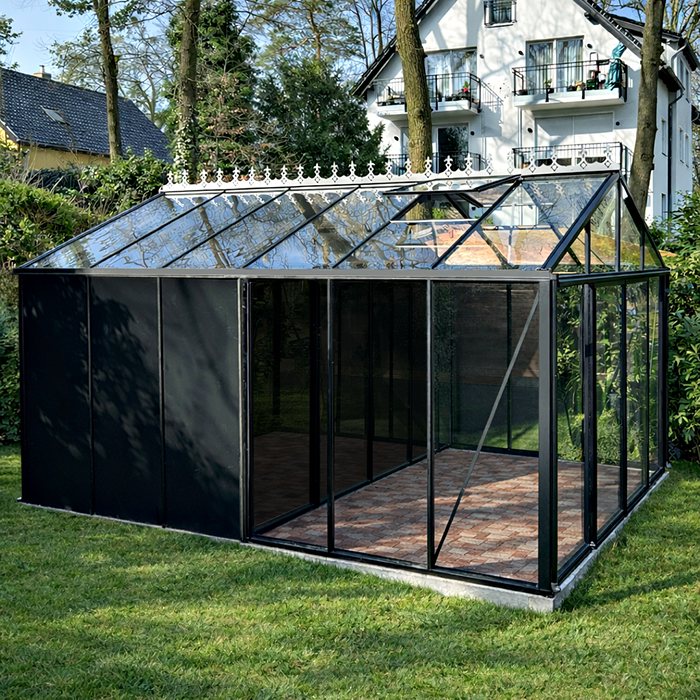
Greenhouses: Long profiles and transparent elements need a clean, level storage surface. Historical or decorative concepts, such as those shown in our article on Victorian greenhouses can contain many visually similar frame parts. Keep markings until every component is clearly identified. A planned orangery also needs enough organised storage space.
Pergolas: Posts, beams and roof components can be long and heavy. The storage area must not block prepared foundation points. Our pergola foundation guide supports site planning. Whether a particular roof solution suits your project is a separate question; see Is a bioclimatic pergola worthwhile?.
Outdoor saunas: Larger timber and frame elements must be stored dry, stable and protected from dirt. For models such as the Elma S outdoor sauna, the Elma L or the HC150 barrel sauna the receiving area should be fixed before unloading. Find further models and information in the sauna section.
Whatever the product type, check which local rules apply to the project. In Malta, ask a perit to confirm its Planning Authority classification by checking the footprint, height, enclosure, land designation and existing permit conditions. See our guide to planning permission for greenhouses and pergolas in Malta . Requirements depend on the actual site and proposed works.
Quick goods-in checklist
- Access, unloading space and safe storage area prepared?
- Order number, delivery details and camera ready?
- Load checked for instability before unloading?
- All pallets, cartons and loose packages counted?
- Packaging, including edges and underside, inspected?
- Overall, detailed and label photographs taken?
- Deviations recorded specifically on delivery documents?
- Suspicious packages opened carefully and parts identified?
- Damaged components stored unchanged?
- Complete report sent without unnecessary delay?
Frequently asked questions
Does damaged packaging always mean the product is damaged?
No. Packaging is intended to absorb external impact and may be damaged while the contents remain intact. Nevertheless, document and carefully open the affected area. Only inspection of the associated component allows a reliable assessment.
What should I do if the driver has left and I discover concealed damage?
Pause unpacking at that point. Photograph the component, its position in the package, inner packaging, outer carton and label. Keep every material and report the finding promptly with the order and item numbers. No note at handover does not prevent technical documentation of concealed damage.
Should I discard packaging after checking the parts?
Not while damage, a shortage or an incorrect delivery remains unresolved. Cartons, protective materials and labels can show where a part was placed and which package it belonged to. Intact packaging also helps protect items during temporary storage.
Can I straighten or repair a bent component myself?
Not before technical clarification. Straightening can alter the geometry further and make the original condition harder to assess. Send photographs and identification details first. Do not carry out your own mechanical or thermal treatment.
What if the package count is correct but a part is missing?
Check the packing list and assembly instructions completely. Look in accessory cartons, cavities and around larger components without damaging anything. Then report the exact item number and expected quantity. A statement such as “a fixing part is missing” is usually insufficient without clear identification.
Is a transport-damage report the same as a guarantee claim or return?
No. A transport-damage report records condition and completeness in connection with delivery. Guarantee or return matters may have different requirements and procedures. First describe factually when and how the irregularity was discovered.
How many photographs should I send?
Send as many as needed to show identity, position and extent clearly, but avoid series of almost identical images. For one issue, the key views are usually an overall image, location image, close-up, label and packaging position. With several parts, each item should be separately recognisable.
Can assembly continue with undamaged components?
Only if it is clear that this will not hinder assessment or later installation of the reported part. For load-bearing, connected or essential components, wait for a response. Do not choose a construction sequence that hides damaged parts or creates unnecessary dismantling.
What should I do if the delivered load appears unsafe?
Keep away, move people out of the danger area and do not step beneath or between unstable packages. Do not attempt to secure shifted heavy components by hand. Document the situation from a safe position and agree the next steps with the driver and responsible contact.
What is the most important action on delivery?
Check and document the external condition and package count before handover is completed. Specific notes and clear photographs are far more useful than a later recollection. Then unpack in a controlled way, identify each part clearly and send a complete report promptly.
Find further technical and gardening content in the Bloomcabin Blog, for example about greenhouse temperature and humidity. These usage topics become relevant only after delivery, foundations and assembly have been completed correctly.
