



SUPPORT
Receiving Checklist: Inspect, Photograph and Report Freight Damage
A methodical receiving check helps you spot visible damage, concealed transport damage, missing packages and incorrect items early. This guide covers inspection, photographs, reporting and safe temporary storage.

Why an arrival check matters
Greenhouses, pergolas and outdoor saunas contain many kinds of components: long aluminium profiles, glazing or roof sections, timber pieces, hardware, fasteners and sometimes pre-assembled assemblies. They may arrive on one or several pallets, as well as in separate cartons. Even a compact-looking shipment can therefore contain many parts needed at different stages of assembly.
A careful handover inspection creates a clear starting record. It confirms how many packages arrived, the condition of the wrapping and whether there are obvious signs of impact. Detailed notes make it easier to tell the difference between cosmetic packaging damage and a component that needs replacement or technical assessment.
Receiving a shipment is not the same as completing an assembly inspection. Many individual parts can only be identified once the packaging is opened and checked against the packing list and instructions. However, the time while the driver is present is especially valuable for recording visible damage, shifted freight or an unexpected package count.
For an overview of the usual process, see Ordering and delivery. Procedures can differ by destination and order. For guidance relevant to Canadian shipments, see greenhouse purchasing and delivery in Canada.

Prepare before the delivery arrives
Choose a suitable receiving and storage area
Before the delivery date, decide where the vehicle can stop and where the shipment can be unloaded. Access width, gates, ground conditions, slopes, parked vehicles, branches and other obstacles can all affect the process. The chosen area must safely support the delivered load. If you are unsure about access or unloading, check the contact details provided for your order in advance.
Use a level, load-bearing, well-lit inspection area with enough room to work safely. Long profiles should not project unsupported or bend over narrow supports. Protect glass, panels and pre-assembled elements from tipping. Keep packages out of traffic routes, off wet ground and away from roof runoff.
Clear the area beforehand and have a phone or camera, writing materials, work gloves and, if useful, a flashlight ready. Arrange for a second person when a delivery is heavy or awkward. Do not try to lift unwieldy components alone. Include the size of the receiving area in your project planning, for example with the pergola size guide.
Keep key documents ready
Save or print your order confirmation, delivery information and any package details. Note the order number, recipient name and delivery address. Anyone receiving the shipment on your behalf should have simple instructions: count packages, check their condition, note specific discrepancies and take photographs.
The receiver should not simply sign because the driver is waiting. A general note such as “packaging damaged” is less useful than a precise description, for example “upper right corner of long carton crushed; strapping broken.” The general order process is explained in How to order. More planning and ownership resources are available in Useful information.
Delivery inspection: a practical sequence
- Safety first: Before unloading, look from a safe distance for a visibly leaning, unstable or damaged load. Keep clear if any item could shift.
- Photograph the overall condition: Take pictures of the shipment from several angles while it is still on the vehicle, if safe, or immediately after it is set down.
- Count the packages: Compare the pallets and cartons handed over with the delivery details available to you. Count loose or separately secured packages as well as pallets.
- Check the outer packaging: Inspect corners, edges, undersides, protective films, carton surfaces, straps and fastenings.
- Locate irregularities: Pay particular attention to compression marks, tears, holes, moisture, abrasion and signs of movement.
- Record discrepancies: Ask for visible damage or missing packages to be described specifically on the available delivery paperwork or in the carrier’s recording system.
- Keep the evidence: Photograph the notation or retain a copy. Do not sign a description that conflicts with the condition you can see.
- Unpack carefully after handover: Open questionable areas cautiously, without unnecessarily changing the packaging, labels or damaged parts.
- Match the contents: Identify components using the packing list and assembly documentation. Report damage, shortages or incorrect parts without unnecessary delay through Contact or the channel specified for your order.
A structured approach is particularly helpful when many profiles look alike. The number of visible cartons does not reveal how many individual items should be inside. Check one package at a time and leave identification markings in place.
What to check while the driver is present
| Check point | Possible concern | Useful record |
|---|---|---|
| Load position | Pallet leaning, packages shifted or insufficiently supported | Wide photograph before anything is moved |
| Carton and film | Tear, hole, severe crushing, abrasion or open seam | Overall image and close-up |
| Strapping | Broken, loose, nicked or apparently replaced | Photograph the strap, closure and affected edge |
| Moisture | Soaked carton, water marks or condensation beneath film | Compare dry and wet areas |
| Rigid components | Distorted profile ends, cracked panels or damaged frames | Photograph the damage without putting stress on the component |
| Package count | Fewer or more units than expected | Capture the full shipment and every label |
An undamaged top surface is not enough. Forklift contact, edge strikes and concentrated loads can affect the underside. Never go beneath a raised or unstable load: inspection must not create a safety risk.
Accept or refuse a damaged shipment?
Damaged packaging does not automatically make the whole shipment unusable. Equally, an almost intact outer layer does not guarantee fault-free contents. Base your decision on the type and extent of visible damage, the stability of the load and the receiving guidance for the specific order.
For limited exterior damage, accepting the shipment with precise documentation can be sensible if it can be unloaded and stored safely. Record the location and type of concern, not just a general reservation. A broad note is no substitute for photographs and a prompt report.
If the load is clearly unstable, major assemblies are badly damaged or unloading presents a risk, do not attempt your own transfer or securing work. Photograph the situation from a safe position and contact Bloomcabin. Whether full or partial refusal is appropriate should be decided against the delivery documents and in discussion with the relevant contact. No single response suits every damage case.
Taking useful damage photographs
Your photographs do not need to be artistic. They need to identify the shipment, show where the damage is and make its extent understandable. Use even lighting and check that each image is in focus.
- Overall view: the complete pallet or package with its surroundings.
- Location view: the damaged area with a recognizable corner, edge or package marking.
- Close-up: a clear detailed image of the tear, dent, break, scratch or distortion.
- Label: photograph the shipping or package label clearly without unnecessarily sharing personal information publicly.
- Opened package: show the affected component’s position inside the carton before removing it.
- Component identification: photograph any item number or marking alongside the damage.
For distortion, a straight, unloaded comparison object or scale can help. Do not position anything in a way that further bends the part or scratches a sensitive surface. Keep original images free of filters or markings. Copies with arrows can help explain the issue, but retain the unedited files.
Visible damage, concealed damage, shortages and incorrect deliveries
Visible transport damage
Visible transport damage can be seen before or during acceptance. Examples include torn cartons, crushed ends, broken panels, bent frames or loose components. Document the issue before unpacking and have it noted on the delivery records. Then open the packaging carefully so the relationship between the exterior impact and any damage inside remains clear.
Concealed transport damage
Concealed damage only becomes apparent after opening. It may include a bent profile inside a carton, damaged coating, a cracked element or a distorted connector. Pause unpacking at the affected point, photograph the original position and keep the protective material and carton. Report the finding promptly in line with your order documentation.
Careful identification is especially important for greenhouse panels, because protective films and packaging marks should not be mistaken for material damage. Learn more about the material in the article on polycarbonate for greenhouses. You can also find general planning examples in greenhouses and conservatories.
Missing packages or parts
Distinguish between a missing package and a missing individual component. A promised pallet or separate carton that is absent should be recorded at handover. A missing screw, fitting or profile inside an existing package will usually only emerge when you compare the contents with the packing list and instructions.
Open all related cartons methodically. Small fittings may be in cavities, accessory cartons or attached to larger components. Record the item number, description and expected quantity instead of reporting only “parts missing.” Reviewing the assembly documents early helps avoid confusion between mirrored, optional and later-stage components.
Incorrectly delivered parts
An incorrect part may look similar at first glance. Compare its marking, hole pattern, connection shape, material, colour and placement in the instructions. Do not alter or install it. Photograph it beside the label and state both the expected and received item positions.
This applies equally to structures such as a bioclimatic or standard pergola, a wall-mounted or freestanding pergola and more complex sauna kits.
Submitting a complete transport damage report
Include these details in your report
- Order number, recipient name and delivery address,
- delivery date and, where relevant, the time the issue was identified,
- the actual number of pallets and packages received,
- a precise description of the outer packaging condition,
- affected component or item numbers, where identifiable,
- the type, location and extent of each area of damage,
- whether the issue was visible at handover or discovered during unpacking,
- photos of the complete delivery, packaging, labels and individual parts,
- a copy or photograph of any delivery notation,
- whether the component has remained in its received condition.
Organize several damage items, for example by package and item number. Avoid separate, disconnected messages when one combined report is possible. This makes technical assessment easier. Separate topics such as warranty should be handled separately from the transport-damage record.

Do not install or repair questionable components
Straightening a bent profile, touching up a coating or test-fitting a cracked panel can change the original damage. Without technical assessment, it is not possible to know whether connection geometry, dimensional accuracy or load behaviour has been affected. Do not drill, saw, glue, sand or heat a disputed part before receiving a response.
Routine later care, as described in maintaining an aluminium greenhouse , is not a repair method for transport damage. Do not test-connect electrical or heated outdoor-sauna components if the housing, cables or connections appear damaged. A qualified local professional should assess applicable technical and electrical requirements.
Protect the rest of the shipment
One damaged item is not a reason to leave the remaining components unprotected. Separate checked and unchecked packages by location or with removable markings. Store profiles horizontally with adequate support unless the assembly documents state otherwise. Keep sensitive panels and frames stable and protect them from impact, wind, moisture and site traffic.
Retain the original packaging until the matter is resolved. Remove wet outer wrapping only when necessary to prevent further damage, and document its condition first. Then use dry, suitable cover without sealing moisture inside. Do not discard labels, carton sections or padding while they may still be needed for identification or assessment.
Planning notes for different outdoor structures
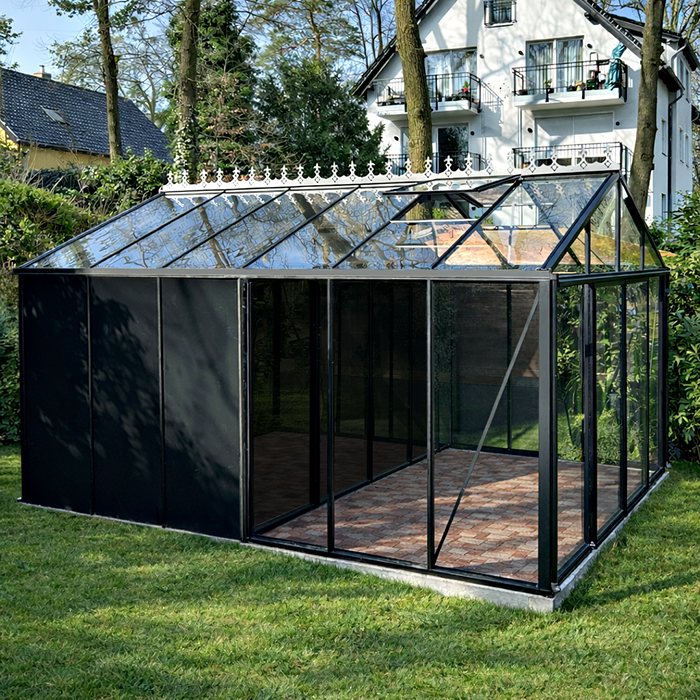
Greenhouses: Long profiles and transparent components need a clean, level resting surface. Decorative or historic-inspired designs, such as those in our guide to Victorian greenhouses , can contain many visually similar frame parts. Keep markings until each part is identified. Plan sufficient organized storage space for a future orangery as well.
Pergolas: Posts, beams and roof components may be long and heavy. The storage area should not obstruct prepared foundation points. Our pergola foundation guide can help with site planning. Whether a particular roof solution is suitable is a separate project question; see Is a bioclimatic pergola worthwhile?.
Outdoor saunas: Large timber and frame components need dry, stable, clean storage. For models such as the Elma S outdoor sauna, the Elma L or the HC150 barrel sauna , establish the receiving area before unloading. Find further models and information in Saunas.
Whatever the product type, check whether local requirements apply to your planned construction project. Start with our article on whether a greenhouse or pergola needs a building permit . In Canada, the National Model Codes do not create one nationwide approval rule. The province or territory’s adopted code and municipal zoning or permit process may apply, so confirm the requirements for the property with the municipality and the relevant provincial or territorial authority.
Quick receiving checklist
- Access, unloading point and secure storage space prepared?
- Order number, delivery details and camera ready?
- Load checked for instability before unloading?
- All pallets, cartons and loose packages counted?
- Packaging, including edges and undersides, inspected?
- Overview images, detail images and labels photographed?
- Discrepancies noted specifically on the delivery records?
- Questionable packages opened carefully and parts identified?
- Damaged components stored unchanged?
- A complete report sent without unnecessary delay?
Frequently asked questions
Does damaged packaging always mean the product is damaged?
No. Packaging is designed to absorb external handling and may be damaged while the contents remain intact. The affected area should still be documented and opened carefully. Only inspection of the related component can provide a reliable assessment.
What should I do if the driver has left and I discover concealed damage?
Pause unpacking at that point. Photograph the component, its position in the package, the internal packaging, outer carton and label. Retain all materials and report the finding promptly with the order and item numbers. The absence of a handover note does not prevent you from documenting concealed damage for technical review.
Should I dispose of the packaging after checking the parts?
Not while damage, a shortage or an incorrect delivery remains unresolved. Cartons, protective materials and labels can show where a part was placed and which package it belongs to. Undamaged packaging also helps with protected temporary storage.
Can I straighten or repair a bent component myself?
Not before technical clarification. Straightening can further alter the geometry and make the original condition more difficult to assess. Send photographs and identification details first. Do not carry out your own mechanical or heat treatment.
What if the package count is correct but a part is missing?
Check the packing list and assembly instructions in full. Look in accessory cartons, cavities and around larger components without damaging anything. Then report the exact item number and expected quantity. A statement such as “a fastening part is missing” is generally not enough without clear identification.
Is a transport damage report the same as a warranty claim or return?
No. A transport damage report records condition and completeness in connection with delivery. Warranty or return matters can have different conditions and processes. First describe factually when and how the discrepancy was found.
How many photos should I send?
Send enough to show the item’s identity, location and extent of damage clearly, without a series of almost identical images. For one damage item, the most useful views are usually an overall image, location image, close-up, label and packaging position. Make every affected item identifiable separately.
Can assembly continue with undamaged components?
Only if it is clear that doing so will not hinder assessment or later fitting of the disputed part. Wait for a response when the item is structural, adjoining or installation-critical. Do not choose an assembly sequence that conceals damaged parts or creates unnecessary disassembly.
What should I do if the delivered load seems unsafe?
Keep back, move people out of the danger area and do not step under or between unstable packages. Do not try to secure shifted heavy components by hand. Record the situation from a safe place and agree on next steps with the driver and the appropriate contact.
What is the most important action at delivery?
Check and record the external condition and package count before handover is complete. Specific notes and clear photographs are far more useful than a later recollection. Then proceed with careful unpacking, clear part identification and a complete, prompt report.
Find further technical and gardening content in the Bloomcabin Blog, including guidance on greenhouse temperature and humidity. Those ownership topics become relevant once delivery, foundations and assembly have been completed properly.
