



PROCESS
How to Plan Production and Delivery Times
From placing an order to completing installation, a project moves through several connected stages. This guide explains production and delivery timing, common influences on the schedule, and how to prepare the site, delivery and assembly.
See the whole order timeline
For a greenhouse, pergola or outdoor sauna, the project timeline is more than manufacturing alone. Product selection and technical clarification, order confirmation, production, transport, unloading, site preparation and installation are separate activities. A delay at any point can move the intended completion period.
A stated production period should not automatically be read as an arrival date or installation appointment. It normally describes just one stage of the project. The information confirmed for your own order always takes precedence. Find general purchasing and shipping guidance under Purchasing & Delivery. If you are still choosing a product, see How to Order.
Plan around a sequence of confirmed configuration, production, transport, receipt and installation—not one number.
The five key stages of a Bloomcabin project
- Selection and technical planning: The product type, specification, accessories, delivery address and site-specific requirements are established.
- Order review and confirmation: Bloomcabin reviews the submitted details. Any unanswered questions need to be settled before the confirmed order can move to the next stage.
- Production and dispatch preparation: The confirmed configuration is manufactured, gathered into the order, inspected and readied for shipment.
- Transport and delivery: The consignment leaves the dispatch location and travels to the agreed address. Transit time and delivery arrangements are separate from production.
- Installation and commissioning: Installation can begin after the goods have been checked and the prepared site is ready. Further work, such as electrical connections, needs separate coordination.
More general planning resources are collected in Useful Information .
What is production time?
Production time is the period in which a confirmed order is scheduled for manufacturing and dispatch preparation. It does not necessarily begin with first contact, creating a shopping cart or making a non-binding enquiry. Payment alone does not automatically mean that every technical and commercial requirement has been met.
The relevant starting point is shown by the order confirmation and its stated processing status. Where information is missing or a configuration choice remains open, production planning may not yet be final. A production indication is also not a promise that the product will be installed and ready to use within that same period.
What can affect the production schedule?
Product family and configuration
A greenhouse, louvred pergola and sauna have different components, manufacturing processes and packaging methods. Variants within the same product family can also be scheduled differently. Material, colour, glazing, roof design, doors, accessories and other confirmed options affect how an order is prepared.
For this reason, do not compare timing for different models without checking the details. For greenhouses, intended use and glazing selection can matter; learn more in Polycarbonate, panel thickness and insulation. For pergolas, settle the construction type and size first. Helpful guides include bioclimatic or classic pergolas, wall-mounted or freestanding pergolas and the pergola size guide.
Complete order information
A correct delivery address, reachable contacts and a clearly confirmed specification reduce avoidable queries. Check names, telephone number, access conditions and configuration before confirmation. Resolve conflicting information immediately. For assistance, visit Contact .
Changes after confirmation
A later change may require fresh checks, different components or revised production planning. Whether it remains possible depends on the processing stage and should not be assumed. Request changes in writing and wait for confirmation before changing foundations, connections or installation arrangements.
Production capacity and season
Demand for garden structures varies through the year. Seasonal order peaks can affect available manufacturing and transport capacity. If you have a preferred period of use, plan early, but do not use past timing as a prediction for your current order.
Exceptional disruption
Unexpected disruption to material supply, transport, weather or infrastructure can affect schedules. These events cannot be eliminated entirely. Build a sensible buffer between expected delivery, installation and a planned date of use.
Production time and delivery time are different
| Period | What it includes | What it does not automatically include |
|---|---|---|
| Production time | Manufacturing planning, processing, preparation, checking and dispatch readiness | Transport, unloading and installation |
| Delivery time | Transport after dispatch readiness and the coordinated delivery | Site work and product installation |
| Installation period | Assembly at the prepared site | Later foundation corrections or work by other trades |
An expected dispatch date is not a guaranteed delivery day. Receipt can be planned more precisely only once the shipment is ready for transport and delivery has been arranged. Information about planning greenhouse deliveries in Canada also illustrates why destination, address and transport route need to be considered separately from production.
How product choice shapes planning
Make the fundamental product choices before ordering where possible. For a pergola, first establish whether it will be attached to the building or freestanding. External dimensions, orientation, foundation concept and any technical connections follow. The pergola foundation guide supports this early planning. The article on bioclimatic pergolas and roof solutions provides further context.
For a sauna, decide early on the location, access, foundation, ventilation and the execution of required connections. Product pages such as the Elma S outdoor sauna, the Elma L outdoor sauna or the HC150 thermowood barrel sauna offer model-specific orientation. The full range appears under Saunas .
For a greenhouse, intended use influences site and interior planning. An orangery, propagation house and intensively used vegetable greenhouse call for different approaches. Explore Victorian greenhouses and the orangery greenhouse guide. For an overview of styles, see Greenhouses and Conservatories.
Work backwards from your preferred completion period
Canadian growing and construction windows vary considerably by region. If you want the project ready for a growing season or family occasion, start with the period when you hope to use it and work backwards, allowing for more than production and transport.
- Set a preferred completion window rather than one immovable date.
- Allow for installation, checking and any finishing work.
- Reserve time for unloading, checking the consignment and secure interim storage.
- Place transport and production ahead of these steps in line with current order information.
- Also allow time for selection, permit review, site planning and foundation work.
- Add a buffer for weather, questions and the availability of external contractors.
Whether a permit, notification or approval is needed depends on the province or territory, municipality, site and type of structure. The article building permits for greenhouses or pergolas Use it as a starting point, then ask the municipal permit office which zoning and permit rules apply and which provincial or territorial code has been adopted locally. Canada’s national model codes do not form one rule that automatically applies everywhere. Confirm setbacks, height, lot coverage, drainage and services, and have the site’s snow, wind and foundation conditions assessed for the chosen structure.
Preparing the site during production
Production can be a useful period for preparatory work. Do not begin final construction, however, until confirmed product documents and relevant dimensions are available. Measurements taken from sketches, photographs or similar models are not a reliable basis.
- Check the site: Consider property boundaries, setbacks, services, drainage, slope, sunlight and access.
- Confirm local requirements: Independently check permits, approvals and other applicable requirements.
- Plan the foundation: Set the construction, levelness and connection details to suit the confirmed product.
- Secure access: Check the transport route, gate widths, turns, overhangs, ground bearing capacity and unloading area.
- Coordinate contractors: Keep installation, groundworks and required technical connections clearly separated.
- Prepare storage space: If assembly will not happen immediately, provide a dry, level and protected area.
For a greenhouse, internal paths, beds and irrigation can be planned in parallel. If you intend to grow lettuce, the greenhouse lettuce-growing guide offers planning advice. Read about temperature and ventilation in greenhouse temperature and humidity .
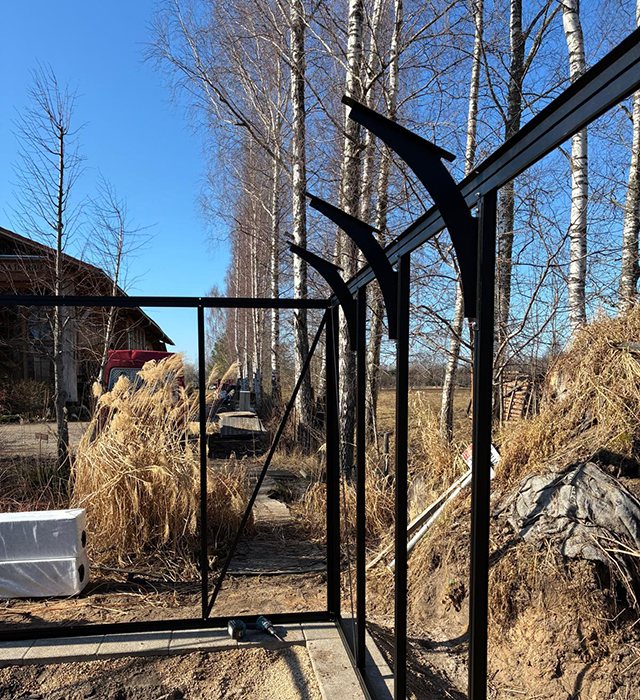
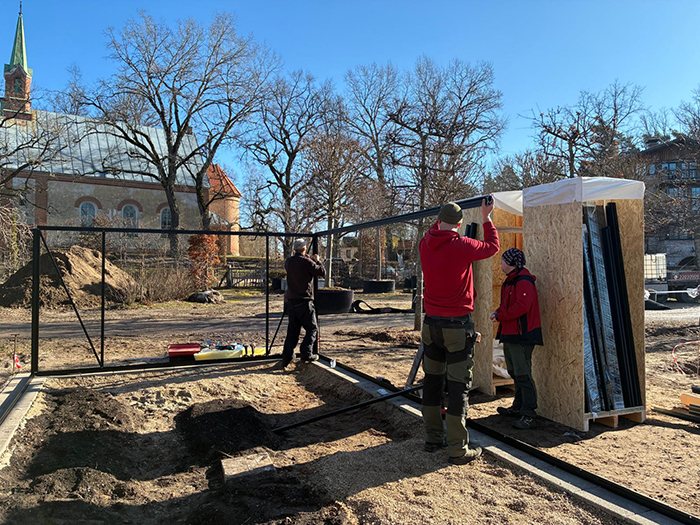
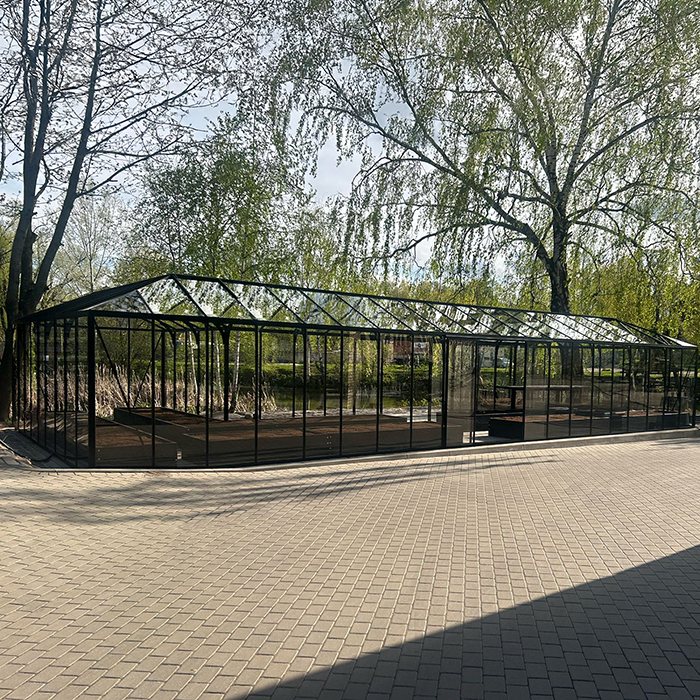
Anna Koku Skola: one continuous installation sequence
The Anna Koku Skola image series records one project through successive stages. It is not a collection of different installations. Such a sequence shows that delivery, sorting, frame assembly, fitting further components and finishing work need to follow a coordinated order.
The practical lesson is straightforward: inspect and arrange components before use, keep the assembly area clear, and ensure everyone involved can access the correct documents. Do not skip checks simply to meet an earlier hoped-for completion day.
Delivery-readiness checklist
- The delivery address and contact details are current and complete.
- A reachable person has been nominated for delivery coordination.
- Vehicle access and the unloading area have been checked for obstructions.
- Parked vehicles, branches, low cables or narrow gates will not obstruct delivery.
- Responsibility for unloading and onward movement on the property is clear.
- A suitable, protected place is available for individual packages.
- Helpers or equipment are arranged only in accordance with the delivery requirements confirmed for the order.
- The order and expected package information are ready for checking.
- The installation site has not been confused with the unloading area; they may be in different places.
What to do when the shipment arrives
At handover, check the shipment as far as possible for package count and externally visible damage. Compare it with the available delivery documents. Record concerns directly on the handover paperwork and document them with clear photographs. Photograph the overall view as well as the packaging, label and affected area.
Do not rush to open, move or install components that are visibly damaged. Keep packaging and labels, and report the matter immediately through the stated contact channels. A recorded concern does not automatically mean that all contents are damaged, but it allows an orderly review.
Even where there is no visible transport damage, check components against the documents before the installer arrives. Information about product-specific claims is available under Warranty.
Coordinating installers and other trades
An estimated dispatch date is not enough for a fixed installation appointment. Agree flexible time windows where possible and keep the installer informed about the order status. The final date should account for whether all goods have arrived, been checked and can be accessed safely.
Define responsibilities clearly: who prepares the foundation, carries out assembly, completes required connections, and checks drainage or work on the building? For outdoor circuits, pergola motors and sauna heaters, ask a qualified local electrical contractor which product approvals and installation steps apply at the destination. Keep that enquiry separate from structural permit discussions.
How to reduce avoidable delays
- Compare the product and options carefully before ordering.
- Double-check all contact details and the delivery address.
- Answer questions promptly and completely.
- Communicate requested changes as early as possible.
- Build foundations only from confirmed information.
- Do not leave local permits and site questions until delivery is due.
- Do not make fixed bookings with external trades solely from a non-binding estimate.
- Prepare the delivery route and storage area before dispatch.
- Carry out a structured goods check immediately after arrival.
Customer reports can help you assess design, use and service. The greenhouse reviews provide useful perspectives. Other customers’ experiences cannot replace a current schedule for your own order.
After installation: allow time for setup and care
Completing assembly does not necessarily mean that the project is fully set up. Allow time for checks, cleaning, interior fitting and, where necessary, work by other trades. A greenhouse may still need paths, staging, irrigation or beds. A pergola may need additional site-specific finishing work, and a sauna should not be used until all required work has been completed and checked correctly.
For the long-term condition of a greenhouse, follow the guidance on caring for an aluminium greenhouse. Discuss product care when the assembled structure is handed over, rather than waiting for visible dirt or operating issues.
Frequently asked questions
Does production time include delivery?
No, not automatically. Production and transport are separate stages. Check which period is named in your order information and whether a dispatch or delivery status has already been provided.
When does production begin?
Production scheduling follows the confirmed processing status of the order. Unresolved configuration questions, missing details or other outstanding requirements can prevent the order from being scheduled.
Can Bloomcabin guarantee installation by my preferred date?
A preferred period can be considered during planning, but a production estimate alone does not guarantee it. Transport, site readiness, weather, goods checking and installer availability are further steps in the sequence.
Should I build the foundation before ordering?
Site assessment can begin early. The final foundation should, however, be based on the confirmed specification and correct documentation. Building too early can result in unsuitable dimensions or connection locations.
Can I change the configuration after ordering?
That depends on the processing stage. Changes may be unavailable or affect timing and cost. Submit the request immediately and do not carry out follow-on work until the change is confirmed in writing.
Can I book an installer using the estimated dispatch date?
Only with sufficient flexibility. Dispatch is not the same as delivery and checked completeness. Otherwise, a fixed installer may arrive before the materials are available or the site can be used.
What happens if the site is not ready when the goods arrive?
Suitable, secure interim storage will be needed and installation may have to be postponed. This can create additional organizational work. Establish early what conditions apply for storage and later movement to the installation site.
What should I do if I see delivery damage?
Record the concern at handover, photograph the shipment, packaging, marking and affected area, and report it immediately. Keep packaging until the matter is resolved.
Are all greenhouse models produced on the same timetable?
Do not assume so. Model, material, configuration and current production planning can vary. Use the information supplied for the specific order.
Does seasonal demand affect when I should order?
Yes. Seasonal activity can influence manufacturing, transport and installation capacity. Planning early gives you more flexibility, but does not replace current confirmation.
Can customer reviews tell me how long my delivery will take?
No. Reviews describe other orders at another time, often with a different configuration or delivery region. They are useful for qualitative impressions, not as a delivery forecast.
Who is responsible for local requirements at the site?
The purchaser or property representative should verify the permits, setbacks, foundation, access and other requirements that apply to the site. Consult the appropriate authorities and qualified local professionals before ordering where needed.
Final planning advice
The most dependable process comes from clear decisions, complete information and realistic buffers. Settle on the product, assess the site, keep production distinct from delivery and do not commit follow-on trades too early. Always use the current information for your own order. This keeps dependencies visible and helps ensure that your greenhouse, pergola or sauna can be delivered and installed professionally without avoidable deadline pressure.
