



MATERIALS
Powder-Coated Aluminium: RAL Finishes, Corrosion and Service Life
Available in numerous RAL shades, powder-finished aluminium combines durability with corrosion resistance. Product selection, careful assembly, suitable fasteners and material-appropriate care remain essential to its performance.

Aluminium garden frames can combine low weight, dimensional stability, resistance to corrosion and lasting powder-applied colour. That combination suits greenhouses, pergolas and related outdoor builds. It does not make the finish indestructible: exposure, substrate preparation, assembly, fixings, cleaning and mechanical loading all influence its ageing.
This guide covers the technical principles alongside checks at ordering, receipt, installation and during use. Always give the specific product instructions priority. For related subjects, explore Useful Information.
How does powder-coated aluminium work?
The process begins with prepared aluminium parts receiving a dry coating powder. Controlled curing bonds that powder into a continuous, firmly attached layer. Before curing, it contains no liquid carrier, which distinguishes its application from conventional liquid paint.
Finish quality depends on more than the visible powder. Alloy selection, substrate cleaning and pre-treatment, coating conditions and component construction all matter. Most are hard to assess after installation. Verify the specified colour and finish against your product paperwork and confirmed order instead of inferring technical properties from photographs.
The finish supplies the visible appearance, eases regular washing and provides a further barrier against damp and contamination. Sound structural design, correct drainage and proper assembly remain necessary.
Performance in ordinary outdoor conditions
A garden frame encounters rain, UV, temperature shifts, pollen, bird mess, sap and occasional knocks. Powder-finished aluminium can handle these everyday conditions well when the coating and components are treated as intended.
Changes in appearance with age do not necessarily indicate structural damage. Exposure and service duration can gradually reduce sheen and colour intensity. Pale dust, lime marks and pollen show readily on dark surfaces; dark deposits stand out against light colours. Neither observation alone establishes how well the frame functions.
Contact damage can be more significant than routine weather exposure. Tools resting against the frame, moving branches, outdoor furniture, metal ladders or trapped grit may score the surface. Decorations must also be secured so they cannot chafe against profiles in windy weather. For ongoing maintenance, consult Caring for Your Aluminium Greenhouse.
Aluminium’s response to corrosion
Oxygen creates a very thin natural oxide film on aluminium. This slows attack on the underlying material, unlike the behaviour of unprotected steel. The reddish-brown corrosion familiar on iron does not form in the same way. A powder finish adds another separating barrier over that natural protection.
Corrosion resistance has limits. Salt, persistent damp, unsuitable cleaners or incompatible metals can encourage local attack, particularly in narrow dirt-filled, wet crevices. Leave drain outlets and water routes unobstructed by soil, leaves, sealant or assembly materials.
Galvanic corrosion is another possibility when unlike metals form an electrically conductive connection while moisture acts as an electrolyte. Avoid substituting hardware: use the specified screws, washers and connectors, or replacements expressly approved for the structure.
Exposure that calls for closer attention
- Coastal sites and salty air: Rinse accumulated salt away with fresh water and clean more frequently.
- Traffic splash and de-icing salt: Remove contaminated water thrown up from nearby roads or paths rather than leaving it on the frame.
- Urban or industrial deposits: Wash them off before they can hold moisture against the finish.
- Pools, spas and wellness settings: Never presume that vapour, splashes or treatment chemicals are compatible; confirm suitability for the particular setting.
- New render, concrete and mortar: Shield adjacent components during building work and remove alkaline residue before it dries.
- Plants trained along the frame: Position wires, supports and fasteners so neither vegetation nor hardware blocks drainage or rubs through the coating.
Interpreting RAL colour references
Use a RAL reference to communicate a hue precisely. Loose descriptions such as anthracite, dark green and black-grey are less specific. Nevertheless, the standard colour number leaves some visible characteristics of the finished coating undefined.
Texture and sheen alter the result alongside hue. Smooth gloss reflects its surroundings differently from a matt or finely structured finish. When confirming an order, check both the RAL reference and the exact surface treatment assigned to that product.
Use screen images and printed illustrations only as guides. Brightness, display colour, browser settings, surrounding illumination and editing all affect perception. For sensitive designs, a physical swatch of the proposed finish is more useful. Before ordering, confirm whether one is available and whether it defines the agreed result.
How lighting and surroundings change appearance
Morning light may make a frame seem cooler and deeper in colour, while direct afternoon sun can give it a lighter, warmer character. Nearby glass, polycarbonate, timber cladding, paving and foliage alter the contrast as well. For more on traditional designs, visit Victorian Greenhouses and the Orangery Greenhouse Guide.
Geometry, viewpoint, manufacturing batch and texture may produce modest visual variation. Light reflects differently from a thin profile and a broad sheet. Arrange colour coordination before ordering if an exact visual match with existing doors, windows or other components is required.
Resolve the product first, then its finish
Choose colour after settling the form, dimensions, location and intended use. On a pergola, the wall junction, roof arrangement and route for rainwater have greater planning consequences than colour. Compare the guidance in Bioclimatic or Classic Pergola, Wall-Mounted or Freestanding Pergola and the Pergola Size Guide.
Greenhouse decisions should likewise consider glazing, airflow, internal growing conditions and purpose as a single system. The Greenhouses and Conservatories page gives a starting point, while Greenhouse Polycarbonate and Temperature and Humidity cover other important selection questions.
Where an outdoor product combines several materials, rely on its own specification. For an Elma S Outdoor Sauna or HC150 Barrel Sauna , do not carry details about timber, frames, hardware or surface treatments across from another model. Use the broader Sauna section to compare construction formats.
Finish checks to complete before purchase
- Write down the precise product, chosen variant and required dimensions.
- Verify the offered RAL reference and the stated surface treatment.
- Avoid deciding from a mobile phone or computer image alone.
- Account for interfaces with walls, foundations, gutters and neighbouring components.
- Disclose coastal exposure, traffic salts, heavy pollution or other demanding conditions.
- Decide whether exposed hardware and accessories must produce a matching visual effect.
- Before authorising the order, confirm its colour, quantity and complete specification.
- Use Contact to resolve outstanding questions, then retain the answers in writing.
Practical ordering information is also available in How to Order and Purchasing and Delivery .
Checking coated components on arrival
Whenever practical, inspect the consignment before assembly starts. Look for dampness, punctures and impact marks on the packaging, then compare the packages and identifiable components with the delivery paperwork. Use opening tools carefully so a blade cannot run into an aluminium profile.
Check whether a mark comes from loose packaging residue, dirt or actual damage. For dirt, try a gentle water wash with a soft cloth; hard rubbing is no way to test a mark. Before assembly, photograph scratches, dents, chipped coating and missing components from different viewpoints. Follow the reporting procedure. Claim requirements are explained in Warranty.
Store components stably in a dry place, protected from worksite traffic until assembly. Unless the product instructions differ, remove protective film without prolonged exposure to sun and moisture on the coated part.
Prevent damage while assembling the structure
Unpacking and assembly cause many preventable coating marks. Keep profiles off paving, gravel and concrete, placing them on clean, soft supports so trapped sand cannot abrade them. Store tools and screws in containers, away from coated surfaces.
Set out, align and anchor the structure on the intended base; forcing parts together may distort profiles or harm their joints. During design, consult the Pergola Foundation Guide . Include site approval checks during planning. Depending on the property and proposed dimensions, consult the council and relevant state or territory authority about planning permission, building certification, notification and other consents. Our guide to Approvals for Greenhouses or Pergolas provides introductory information, but the requirements applying to the actual address and design must be checked.
- Install only the nominated holes, fasteners, seals and fittings.
- Clear away every metal shaving immediately after drilling or adjustment.
- Protect profiles from bare clamps and direct contact with metal tools.
- Remove protective wrapping films following the installation instructions.
- Leave every drain channel and outlet unobstructed.
- Make no unapproved cut or additional hole in a component.
Routine washing and surface care
Wash gently and regularly instead of resorting to occasional harsh scrubbing. Rinse loose dirt away first. Apply a mild cleaner approved for the coating with a soft cloth or sponge; finish by rinsing all cleaned surfaces thoroughly in fresh water.
Keep abrasive powders, wire wool, rigid brushes, blades and harsh solvents away from the finish. Strong acids, alkalis and unidentified construction cleaners require confirmed material compatibility before use. Work on a cool surface so cleaner cannot bake dry, trial unfamiliar products in a hidden spot, and observe the product’s care directions.
Let exposure determine cleaning frequency. Open, clean countryside may demand less attention than overhanging trees, heavy road traffic or salty air. Rather than follow a fixed calendar, prevent corrosive deposits and moisture-retaining dirt from remaining on the finish.
A practical inspection schedule
| Situation | Inspection or response |
|---|---|
| Assembly completed | Clear adhesive, swarf, packaging and worksite debris, then verify drainage. |
| Dirt becomes visible | Wash gently with water and soft materials; promptly lift off sap and bird droppings. |
| After winter or the main local pollen season | Examine and clean profiles, joints, gutters and all water outlets. |
| Following a storm or nearby construction | Look for abrasion, loose objects, mortar contamination and impact damage. |
| A minor defect appears | Record it in photographs, stop its cause and seek the correct repair procedure. |
Dealing with scratches, chips and touch-ups
Begin by identifying what a scratch has reached: removable contamination, the coating itself or the shape of the profile. Dents, distortion and damage around a joint are not merely cosmetic. Where the significance is uncertain, avoid loading, modifying or continuing work on that part until suitable advice is obtained.
An appropriate touch-up material may improve the look of a small coating defect and reduce its direct environmental exposure. Nevertheless, work done on site will not reproduce the original factory powder-coating process. Colour, texture and sheen may remain noticeably different, so do not select generic automotive or hardware paint merely because its name sounds similar.
Prepare any repair area so it is dry, clean and without loose fragments. Compare both the proposed method and material with the relevant product and care literature. Broad sanding can destroy sound layers surrounding a small blemish.
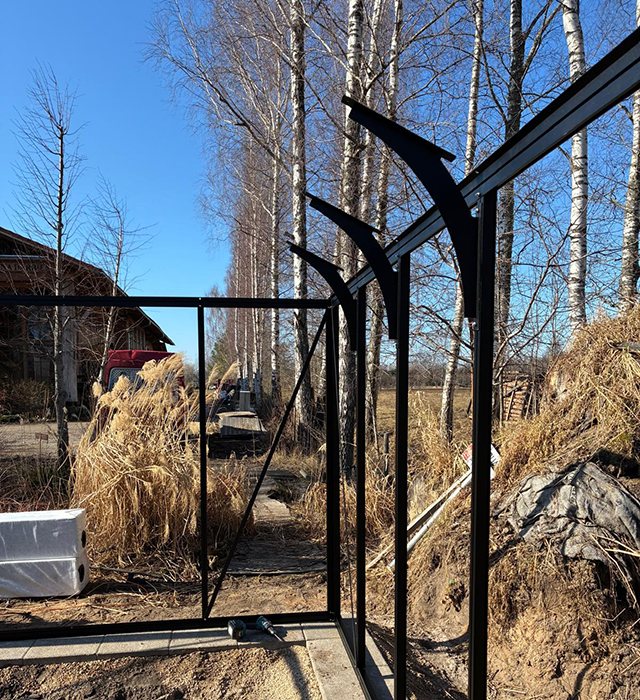
Points specific to greenhouses and pergolas
Greenhouse profiles encounter condensation, humid air, fertilisers, crop treatments, cleaners and organic residues in a confined space. Remove splashes promptly rather than leave deposits behind. Prevent soil and plant debris from blocking gutters or drainage channels. For intensive cultivation, further practical advice covers Growing Lettuce in a Greenhouse, although cultivation advice is not a substitute for the frame’s maintenance instructions.
For a pergola, prioritise foundations, the building connection and effective water management. Powder coating cannot compensate for a poorly designed drainage system. Keep moving louvres and mechanisms free of added paint, obstructions and unsuitable lubricants. The following comparison may help: Is a Bioclimatic Pergola Worth It? .
Light and dark coatings may reach different temperatures in sunshine, but that does not identify one universally superior colour. For greenhouse plants, glazing, ventilation, shade, moisture control and the site generally have a more direct effect than narrow frame colour. Pergola comfort also depends strongly on roof form, orientation and airflow.
Questions people often ask
Can powder-coated aluminium develop rust?
It will not form the red-brown iron oxide associated with steel. Aluminium may still suffer corrosion where salt, retained water, incompatible chemicals or unsuitable metal contact create adverse conditions. Powder coating supplies extra separation, but sound detailing, drainage and maintenance remain necessary.
Does the finish need repainting after a set period?
Repainting should follow condition, exposure and mechanical wear rather than a universal schedule. Clean an intact finish instead of painting over it pre-emptively. Where wear is widespread or many areas are damaged, first establish whether professional refurbishment makes technical sense.
Does a RAL reference equal a precise screen colour?
No. RAL identifies a standard hue, not a single screen value. Display calibration, brightness, photography and ambient lighting affect the image. The code also does not specify the finished coating’s sheen or texture.
Why might matching RAL references appear slightly different?
Yes. How a colour looks depends on the part’s shape, lighting, surface texture and sheen, underlying material and manufacturing batch. Small apparent differences need not mean a colour-code error. When visual coordination is especially important, agree suitable physical samples together.
Is pressure washing appropriate for the frame?
The safer default is fresh water with a soft sponge and compatible mild detergent. High-pressure spray may strain joints and seals, aggravate damaged areas or drive contamination into narrow gaps. Use that equipment only where the instructions for the particular product expressly permit it.
How should a scratched part be handled at delivery?
Do not rush to fit the affected component or touch up its coating without agreement. Take clear photos covering the packaging, item, damaged spot and identification. Reconcile delivery against the paperwork, then report by the designated procedure. Retain packaging until clarification.
Does powder coating eliminate all maintenance?
No. Although care demands are low, salt, dirt, leaves and harmful residues still need removing. Check drainage routes, connections and areas under mechanical stress regularly. Decide upkeep effort and intervals according to site exposure and how the structure is used.
Will any stainless screw or retail fixing be suitable?
Only after compatibility has been established. The construction dictates the required dimensions, strength, head profile, seal, surface treatment and metal pairing. A premium reputation does not make a fastener correct for every joint; select the supplied item or one that has received explicit approval.
Does every scratch signal failure of the frame?
No. Superficial scratching generally affects a small area of finish. Deep notches, deformation, cracked joints or damage at structural connections instead require technical assessment. Where a defect lies and how deep it goes matter more than its visibility.
Is one frame colour better for warmth or crops?
Frame colours cannot be ranked universally. Dark finishes tend to absorb more solar energy, yet a greenhouse’s interior climate depends much more on its size, position, glazing, shading and ventilation. Select colour as part of functional climate planning, without expecting it to replace that work.
Which documents confirm the colour and care instructions?
Check the supplied care documents, assembly instructions, order confirmation, quotation and product description together. Generic photos or specifications for a similar model cannot substitute for them. Obtain written clarification of discrepancies before ordering or treating the surface.
Purchase and ownership: final checks
- Confirm the product, option, RAL reference and finish in writing.
- Judge colour under representative lighting and regard screens as indicative only.
- Resolve the site, base, drainage and local approval questions before purchase.
- Examine the consignment before assembly and record anything unusual.
- Assemble profiles on soft, clean supports; remove metal chips immediately.
- Fit only the designated seals, accessories and fasteners.
- Choose gentle cleaning products and avoid abrasion or aggressive chemistry.
- Promptly remove salts, sap, bird droppings and construction contamination.
- Consider a scratch’s location and depth before applying any coating.
- Let the specific product literature override general recommendations.
Treating design, colour and care as connected decisions preserves the desired appearance and helps prevent avoidable harm during transport, assembly and service. Further perspectives are available through Greenhouse Reviews and the main Bloomcabin Australia page.
