



SYSTEM
Sauna Heater and Electrical Requirements Explained
A practical guide to planning an electric sauna heater in the UK, covering room information, electrical data, dedicated circuits, service capacity, controls, sensors, cable routes, clearances and commissioning.
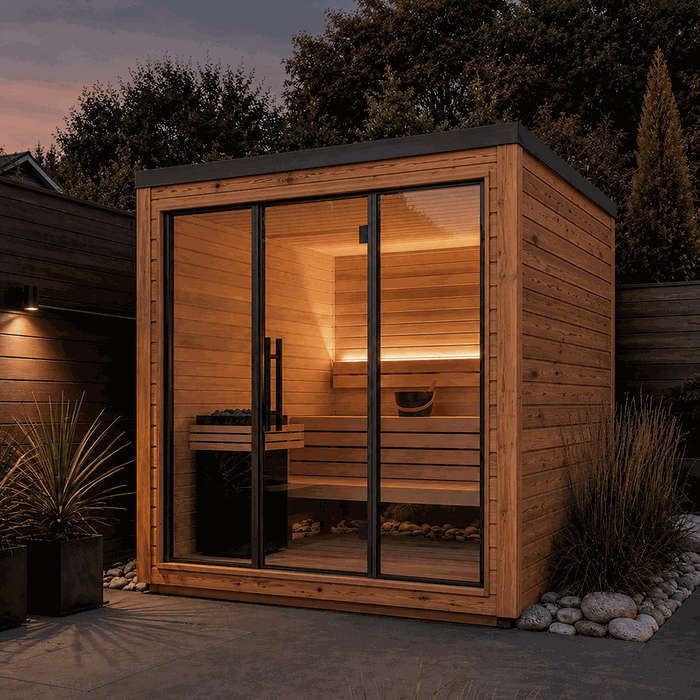
An electric sauna heater must be selected as part of a complete system: the sauna room, heater, controls, sensors, electrical supply and installation conditions all affect one another. Choosing a heater from its advertised output alone can lead to poor performance, unnecessary electrical alterations or an installation that does not follow the manufacturer’s instructions.
This guide explains the information that a sauna supplier and electrician will normally need. It does not replace the heater’s installation manual or project-specific electrical design. Electrical work must comply with the applicable requirements in the part of the United Kingdom where the sauna is installed, as well as the manufacturer’s instructions. Final decisions should be made by a suitably qualified electrician familiar with sauna equipment and outdoor installations.
What an electric sauna heating system includes
The visible heater is only one part of the installation. Depending on the model, a complete electric heating system may include:
- the heater body and heating elements;
- the correct quantity and type of sauna stones;
- an integral or separate control unit;
- one or more temperature or safety sensors;
- a contactor or power unit supplied or specified by the manufacturer;
- heater guards and required clear spaces;
- fixed wiring, protective devices and a means of isolation;
- lighting, ventilation or other separately controlled electrical equipment.
Not every heater contains its controls. Some have knobs on the casing, while others depend on an external control panel, sensor and power module. Components that look compatible are not necessarily approved to operate together. Treat the manufacturer’s specified heater, controller, sensor and power components as a matched system.
Sauna stones are also functional components rather than decoration. Their type, size, arrangement and loading method affect airflow around the elements. Follow the heater instructions rather than packing the stone compartment as tightly as possible.

Start with the sauna room, not the electrical panel
The appropriate heater is determined first by the completed heated room. Internal volume is important, but it is not the only consideration. Glazed doors, windows, uninsulated surfaces, masonry and unusual ceiling forms can increase heat loss. An outdoor sauna may also experience lower ambient temperatures than an internal room.
Do not assume that two cabins with similar external dimensions need the same heater. Wall construction, insulation, internal height, glazing and ventilation can differ. Ask the sauna supplier or heater manufacturer to recommend equipment from the actual room specification.
Information to collect before requesting a heater recommendation
- Internal length, width and finished ceiling height.
- Wall and ceiling construction, including insulation and internal lining.
- Dimensions and materials of doors, windows and other glazed areas.
- Any exposed brick, stone, tile or other high-mass surface.
- Proposed heater location and available safety clearances.
- Ventilation inlet and outlet positions.
- Whether the sauna is indoors, attached to a building or freestanding outdoors.
- Expected ambient conditions and intended frequency of use.
- The property’s supply type and information from the existing consumer unit, obtained by an electrician.
Provide drawings where possible. A supplier cannot give a dependable recommendation if key surfaces or room dimensions are missing. If the cabin design changes, confirm the heater selection again before ordering.
How to read the heater’s electrical information
The product label and installation manual may state rated output, voltage, supply arrangement, current, conductor requirements, control equipment and protective-device information. Read these together. A headline kilowatt figure is not a complete electrical design.
| Information | Why it matters |
|---|---|
| Rated output | Helps establish room suitability and expected electrical demand. |
| Rated voltage and phases | Must match the available supply and permitted wiring configuration. |
| Rated current | Used by the electrician when designing conductors and protection. |
| Connection diagram | Shows permitted terminals, links, controls and supply arrangements. |
| Control-system details | Identifies whether additional sensors, contactors or power units are required. |
| Maximum protective-device rating | Must be considered alongside cable capacity and local installation requirements. |
Many UK homes have a nominal single-phase supply, but that does not mean every heater can be connected to every property. Some heaters permit more than one configuration; others do not. Never alter links or terminals by analogy with a different model.
Dedicated circuits, breakers and disconnecting means
An electric sauna heater is generally a substantial fixed load. The circuit should be designed for the specific appliance and installation rather than connected casually to a nearby socket or shared garden circuit. The electrician must assess design current, cable route, installation method, ambient temperature, grouping, voltage drop, fault protection and the heater manufacturer’s requirements.
The protective device is selected to protect the circuit while allowing the heater to operate correctly. It must not simply be increased because a smaller breaker trips. A suitable means of isolation or disconnection may also be required, but its type and position depend on the equipment instructions and applicable UK rules. Controls intended for routine operation are not automatically a substitute for safe electrical isolation.
Questions for the electrician
- Can the existing supply and consumer unit accommodate the calculated demand?
- Will the heater have a dedicated final circuit?
- What cable type and route are appropriate indoors, underground and inside the sauna?
- Which protective devices are required for this equipment and location?
- Where should isolation equipment be positioned?
- Does the installation involve work that must be notified or certified locally?
- Are earthing and bonding arrangements satisfactory?
- Will the controller, sensor and lighting require separate cables or circuits?
- What inspection, testing and certification will be provided?

Service capacity and panel planning
A spare way in the consumer unit does not prove that sufficient capacity is available. The electrician should consider the main supply, service equipment, existing loads and likely simultaneous demand. Electric vehicle charging, electric showers, heat pumps, cooking appliances, hot tubs and workshop machinery can be relevant.
If capacity appears limited, do not order a different breaker or assume that users will remember not to operate appliances together. Possible solutions must be assessed professionally and may include load management, alterations to distribution equipment or discussion with the electricity network operator. The correct approach depends on the property and heater.
Allow physical room for all required equipment. A separate sauna controller or contactor enclosure may need an accessible, dry and suitably ventilated position outside the hot room. Confirm locations before walls, landscaping or paving make cable access difficult.
Wiring routes and heat exposure
Sauna wiring passes through very different environments. An outdoor route may face moisture, sunlight, accidental damage or burial, while wiring near the heater faces elevated temperatures. One cable type is not automatically suitable for the entire route.
The electrician and cabin installer should agree the route before assembly. Record where ducts enter the base or walls, where cables transition to heat-resistant wiring, and how penetrations will be sealed without trapping moisture. Keep hidden wiring clear of future screw positions for benches, cladding and heater guards.
Do not run ordinary flex close to the heater merely because it reaches the terminals. Use only wiring methods permitted by the heater manual and selected for the actual temperature and installation conditions. Sensor cable routes can also be restricted: separation from power wiring may be necessary to avoid interference or unreliable readings.
Controls, sensors and remote operation
A temperature sensor is a safety and control component. Its prescribed position reflects the airflow and temperature pattern around a particular heater. Moving it to a cooler location to obtain a hotter sauna can defeat the control strategy and create unsafe temperatures.
Follow the exact distances and orientation in the current manual. Ventilation openings, doors and nearby surfaces can influence readings, so coordinate sensor placement with the room layout. Do not conceal a sensor behind trim or place it where towels can cover it.
Remote starting requires particular care. A connected controller, app or timer must be explicitly approved for the heater and installed with every required safeguard. A generic smart relay is not an acceptable substitute for a manufacturer-approved controller. Before any unattended or remote start, the system must prevent operation when combustible objects have been left on or near the heater, using whatever arrangements the manufacturer requires.

Grounding, bonding and shock protection
A sauna combines heat, perspiration and, in many installations, an outdoor cable route. Protective measures therefore require careful design. The electrician must verify the property’s earthing arrangement, protective conductor continuity, automatic disconnection and any residual-current protection required by the equipment instructions and current rules.
Metal parts must not be connected together indiscriminately. Some exposed conductive parts require protective earthing, while other metalwork may not require additional bonding. Unnecessary or incorrectly connected bonding can introduce risks. Let the electrician identify which parts are electrical equipment, which are structural and what protection is appropriate.
Water must never be directed at control panels, connection boxes or electrical accessories unless the equipment is specifically designed for that exposure. The familiar practice of applying small amounts of water to suitable sauna stones does not make the rest of the installation waterproof.
Clearances and heater guarding
The heater manual defines minimum distances from walls, benches, ceilings, floors, guards and combustible materials. These distances are model-specific. A guard must prevent accidental contact without restricting the airflow required to cool the heater and circulate warm air.
Measure clearances from finished surfaces, not structural framing that will later receive cladding. Check the heater’s stone basket, connection area and service access as well as its outer casing. A visually attractive installation is not acceptable if a bench, backrest or guard sits inside a prohibited area.
Never reduce a clearance because another heater looks similar or because a heat shield has been added. A shield changes the arrangement only where the manufacturer expressly permits it and explains how it must be constructed.

A practical pre-purchase sequence
- Define the room. Finalise internal dimensions, construction, glazing, ventilation, benches and heater position.
- Request a heater recommendation. Give the supplier complete room information and ask for the matching controls and sensors.
- Obtain the current manual. Check supply requirements, clearances, cable entries and component locations.
- Arrange an electrical survey. Ask an electrician to assess the supply, consumer unit, cable route and local compliance requirements.
- Coordinate groundwork. Plan ducts and penetrations with the base, drainage and landscaping.
- Confirm the complete order. Include required controls, sensors, power units, stones and approved accessories.
- Keep written records. Retain the recommended configuration and the exact manuals for the supplied model.
Before purchasing, review Bloomcabin’s how to order, terms of purchase and delivery and warranty information. For project-specific questions, use the contact page.
Receiving and checking heater components
Inspect the delivered items before installation. Match model and rating information against the order, then check that the controller, sensors and power components correspond to the heater documentation. Do not assume that a box with similar branding is the correct version.
- Record model and serial information.
- Check packaging and components for transit damage.
- Locate all manuals, wiring diagrams and supplied fixings.
- Confirm the specified stones and accessories are present.
- Do not energise damaged or incomplete equipment.
- Keep components dry and protected until installation.
If anything is missing or damaged, stop and clarify it before the electrician makes permanent connections. The applicable return and cancellation policy should be read before modifying or installing components.

Installation and commissioning checklist
- Sauna construction, ventilation and internal finishes match the agreed design.
- Heater and guard clearances have been measured from finished surfaces.
- All heater stones have been installed according to the instructions.
- Controller, power unit and sensors are the approved matching components.
- Sensor position and cable routing match the current manual.
- Electrical connections have been completed and tested by a suitably qualified person.
- Protective devices and isolation arrangements are identified.
- Air inlets and outlets are unobstructed.
- No packaging, tools, timber offcuts or protective film remain near the heater.
- The first heating cycle is supervised and unusual smells, noise or control behaviour are investigated.
- The user has been shown normal operation, shutdown and safe isolation.
- Manuals, test results, certificates and purchase records are retained.
New heaters and timber can produce an initial odour during early heating. Ventilate as instructed, but do not dismiss persistent smoke, scorching, electrical smells or repeated tripping as normal commissioning behaviour.
Maintenance and troubleshooting
Inspect the heater, stones, guard and surrounding timber regularly. Stones can settle or deteriorate with use, affecting airflow. Replace and rearrange them only as directed by the heater manufacturer. Keep ventilation openings clear and do not dry towels or clothing on the heater or guard.
If the heater does not warm correctly, first use the documented controls and check for displayed fault information. Confirm that a timer or delayed-start function has not been misunderstood. Do not remove electrical covers or repeatedly reset a protective device.
A tripping breaker or residual-current device indicates a fault or an unsuitable installation condition that needs investigation. Possible causes are varied and cannot be diagnosed from wattage alone. Isolate the equipment safely and contact the installer. Similarly, unexplained overheating, discoloured timber, damaged sensor cables or erratic control readings require prompt attention.
Coordinating a sauna with the wider garden plan
An outdoor sauna should be planned alongside access, drainage, privacy, lighting and other garden structures. Cable trenches and service routes are easier to coordinate before paving and planting. Check whether local planning or building controls apply; requirements vary by location and project. Bloomcabin’s guide to planning permission for garden structures provides broader questions to consider, but the relevant authority must confirm the position for a sauna.
If the garden will also contain a Bloomcabin pergola or a bioclimatic aluminium pergola, decide whether lighting and power are independent from the sauna circuit. The comparisons of wall-mounted and freestanding pergolas and whether louvred pergolas are worthwhile can assist with layout choices.
For a mixed wellness and growing garden, compare circulation around an aluminium classic greenhouse, Premium Classic Plus glass greenhouse, limited-edition aluminium greenhouse or Prestige greenhouse with metallic base. Larger plans may include a Bloomcabin orangery; the orangery and greenhouse guide explains the design distinctions.
Useful background is available in the Useful Information library, the main greenhouses and conservatories section and the summer houses section. For planting zones, see guidance on greenhouse temperature and humidity, polycarbonate panels and insulation and British garden planning trends. Keeping sauna power routes separate from irrigation, greenhouse paths and future foundations reduces avoidable rework.
Frequently asked questions
Can I use an existing household outlet for an electric sauna heater?
Do not assume so. Most fixed electric sauna heaters represent a significant load and commonly need a purpose-designed circuit. The heater manual and an electrician’s assessment determine the correct arrangement. A plug fitting physically into a socket would not prove that the circuit is suitable.
How do I know what size heater I need?
Use the completed room’s internal volume and construction details. Glazing, masonry, insulation, ceiling height, outdoor exposure and ventilation can affect selection. Ask the sauna or heater supplier to recommend a model from full room information rather than choosing by floor area alone.
Should I buy the heater before calling an electrician?
Ideally, identify the proposed heater and obtain its manual first, but arrange the electrical survey before committing to purchase. The electrician needs model-specific data, while you need confirmation that the property can support the installation.
Can the electrician choose the breaker from the heater’s advertised wattage?
No. Wattage is only one input. Supply arrangement, rated current, cable capacity, installation method, temperature, grouping, fault protection, manufacturer limits and applicable wiring requirements must all be considered.
Does every heater have controls built in?
No. Controls may be integral, externally mounted or divided between a user panel and separate power unit. Sensors and contactors may also be required. Order only the combination approved for the exact heater.
Can I put the temperature sensor wherever it gives the reading I prefer?
No. The specified position is part of the heater’s control and over-temperature protection. Moving it to manipulate the reading may cause excessive room or surface temperatures and invalidate the intended safety arrangement.
Can a smart-home relay control the heater?
Only where the heater manufacturer explicitly approves the complete method. Generic relays can bypass safety logic or be unsuitable for the load. Remote starting may require additional safeguards and must follow the manufacturer’s instructions.
What if the breaker trips during heating?
Switch the sauna off and arrange investigation. Do not repeatedly reset the device or replace it with a higher-rated one. The cause could involve the heater, wiring, protective device, moisture or circuit design and requires proper testing.
Does a wood-fired sauna need electrical planning?
It may. Lighting, controls, ventilation, sockets or other accessories can still need power, particularly in an outdoor building. Combustion appliances also have separate ventilation, flue, clearance and fire-safety considerations that are outside this electrical guide.
Can electrical work be finished before the sauna is assembled?
Some infrastructure can be prepared, but final heater connections and sensor positions depend on finished construction. Coordinate ducts and supply routes early, leave suitable allowance, and verify all dimensions before concealed work is closed.
What documents should I retain?
Keep the order confirmation, product labels, heater and controller manuals, wiring diagrams, commissioning records, electrical test results, certificates, warranty documents and photographs of concealed cable routes. These help with maintenance, fault-finding and future alterations.
Who should make the final electrical decisions?
A suitably qualified electrician should design, install, inspect and test the electrical work using the exact equipment documentation and applicable UK requirements. The sauna supplier should confirm room and heater compatibility; neither role should be replaced by assumptions from generic online advice.
